Wednesday, August 28, 2013

Joani Presents

Joani Presents
Joani Presents

Location: 6413 Lankershim Boulevard, North Hollywood, California, USA

Opened: 1961

Closed: 1973

From Remembering LA's Earliest Lesbian Bars:

Joani Presents – Located in North Hollywood at 6413 Lankershim Boulevard, this bar was owned by Joan Hannan, who was most famous for playing the drummer in the all-girl band in the 1959 Marilyn Monroe film “Some Like it Hot.” Attracting many classes of women, the bar was popular throughout the 1960s and 1970s, only closing when Hannan and her partner moved to Humboldt County.

You can find out more about Georgia (Joan) Hannan here. Seems that back in 1958, Joan was playing with a band in Palm Springs. It was probably an "all-girl band" as Joan formed many of these over the years. Somebody in Hollywood must have seen her perform, as she was soon contacted about playing a drummer in a movie. And the rest is history.  

In a 2011 interview, Joan described some of her experiences on the set:

“Monroe was standing beside her drum set as a scene was set up, Hannan said, and remarked in her famously breathy voice: ‘I just love the drums. I wish you’d teach me to play.’

Hannan was speechless. In that moment, she was as starstruck as Monroe seemed nervous.

Joan Hannan
‘She was a sweet, sweet person,’ Hannan said about the star. ‘She was not dumb at all. Always late? Yes.’

Hannan counts the film among her career highlights. But it was not without challenges.

Getting the part required acting in a way that made her uncomfortable. She knew from prior experience performing with bands on USO tours that an “extremely feminine” drummer was wanted.

‘I was forced to be a heterosexual woman,’ said Hannan, who is a lesbian. ‘I had to constantly flirt.’

You can see a little bit of Joan in this clip, though she's mostly in the back and in shadow. 
Joan Hannan in her
later years

Joan died last year at the age of 83. According to her obituary, she "passed away peacefully at home on April 13, 2012 in the arms of her partner. "

Jeanne Cordova has this memory of Joani Presents:

On the outskirts of feminism in ’72, I stopped at a traffic signal next to a dyke bar in North Hollywood. The car in back of me repeatedly bumped my fender. Furious, I jumped out of my car, marched back, and leaned my flattop into the driver’s window demanding, “You blind, drunk, or just stupid, Mister? How about staying off my fender?”
His beer-glazed eyes registered me. “Fuck you, bull dyke!” He jabbed a fist in my face.
“Don’t you just wish…” I laughed.
Just then the light turned green and I rushed back to my car. Sweeping around the corner and into the parking lot of Joanie Presents, I parked. As I walked toward the bar, I gulped. Archie Bunker had followed me. He was coming at me with a crowbar.
The goddess was with me that night. The man thundered past me and smashed his crowbar into my car’s rear window.
 
The Boy Mechanic captured this photo of the former Joani Presents.


The former Joani Presents
The Boy Mechanic is an excellent documentary source on lesbian bars over the years. If you've never checked out the project, please do. 

Sunday, August 25, 2013

Michigan Female College

Michigan Female College 
Michigan Female College

Location: Lansing, Michigan 

Opened:1855

Closed: By 1880 at latest, when the property was turned into Michigan School for the Blind. Probably shortly after founder Abigail Roger's death in 1869.

Michigan Female College was founded by Abigail Rogers (1818-1860), a first-wave feminist. Unfortunatly, the College did not survive much beond the founder's lifetime--apparently because the school had no vision for sustaining itself beyond the time when women were finally admitted into the state universities. As Frank M. Turner states: "Her great work, the work on which she spent her whole life was the admission of women in to the University of Michigan and the Michigan Agricultural College on an equal basis with men." It appears, then, that the Michigan Female College was not much more than a means to that end. 

From the Michigan Women's Historical Center and Hall of Fame: 

Abigail Rogers was one of Michigan’s most distinguished and admired women of the 19th century. Her great work to which she dedicated her whole life was the admission of women into the state’s universities.

Educated and experienced in the administration of college-level education, Abigail and her sister Delia Rogers determined to open a school of the highest grade for young women in Lansing, “to keep before the public mind as constantly as they could, the duty of the State to provide for the education of its daughters as it had already provided for the education of its sons.”

Abigail Rogers
The Michigan Female College was founded in 1855, holding daily sessions in the capitol for two years until a permanent building could be obtained. By 1867, Abigail Rogers had helped to educate more than a thousand women from Michigan and nine other states, in both classical and scientific matters.

Thorough attention was given to instruction in all areas including mathematics, philosophy, and political economy, and the inability to pay was never an impediment. According to historian Eliza Smith, “No young woman anxious for improvement, but lacking means to meet the expense of tuition, ever stated her case in vain to [Rogers,] this true earnest friend of all who wished to help themselves.”

Upon her death in 1869, the Lansing Republican newspaper called Rogers “the acknowledged and leading champion of the higher education of women in Michigan.” Later that year, Michigan Agricultural College (now Michigan State University) admitted its first female student. The University of Michigan followed suit in 1870. 

Here's a description of the college course from 1858. Abigail and her sister obviously believed in academic rigor: 

Young Ladies applying for admission to the Classical Course, will be required to pass an examination in the following preparatory studies: Arithmetic (Stoddard's); Algebra, (through the sixth chapter of Davies' Bourdon); English Grammar, (Welch's Analysis); Geography; Physiology; History of the United States; Andrews & Stoddard's Latin Grammar; Arnold's First Latin Book, (Harkness edition); Arnold's Latin Prose Composition, (through forty exercises); Cornelius Nepos or Q. Curtius; Caesar, and Cicero's Select Orations; Kuhner's Elementary Greek Grammar; Xenophon's Anabasis, (Boise edition) to the Fourth Book; and Arnold's Greek Prose Composition.

In the Scientific Course, candidates for admission will be examined in all the studies preparatory to the Classical Department, except the Latin and Greek. Fifty Exercises in Fasquelle's French Method, the regular Verbs; and fifty Exercises in Woodbury's German Method will also be required.

The study of the Holy Scriptures will form a regular part of the whole Course, both Preparatory and Collegiate. The Text-Books named, are those which are used in the Institution, but an equivalent amount of knowledge is all that will be required of candidates for admission.

The entire expense of Board, including Fuel, Lights, &c., for the College year of forty weeks is.....$130.00

Tuition in the Preparatory Department, for English Branches, per term.....$10.00
Tuition in the Preparatory Department, for each of the Languages, per term.....$4.00
Tuition in the College Department, per term.....$18.00
"     "     Drawing, per term.....$4.00
"     "     Painting in Oil Colors, per term.....$16.00
"     on Piano or Guitar, per term.....$20.00
Use of Instrument, per term.....$5.00

The only extra charge will be twenty cents per dozen for washing.

Young Ladies are expected to furnish their own towels, table-napkins, napkin-rings and forks, and will be required to provide themselves with umbrellas and overshoes.

Wednesday, August 7, 2013

Slack's Restaurant and Bar

Slacks interior
Slack's Restaurant & Bar

Location: 562 Church Street, Toronto, Ontario, Canada

Opened: 2005

Closed: June 2013

Yet another victim in the great Lesbian Bar Die-off. From the Daily Xtra, June 27 2013: 
Slack's closes just before Toronto Pride
'Only true women's bar' on Church Street first opened as Slack Alice in 1997

It’s a sad month for Toronto lesbians. After eight years of operating as the “only true women’s bar” on the Church Street strip, Slack’s Restaurant and Bar has closed its doors.

Co-owner Karen Halliday confirmed the closure on her Facebook page earlier in June, while friends of the owners and regular performers at Slack’s verified the news this week.
Slacks exterior

The venue first opened in 1997 under the name Slack Alice. Operated by Heather Mackenzie (who now runs The Flying Beaver Pubaret on Parliament Street) and a male friend, Stephen Brailsford, the bar was never intended to be a lesbian hangout. But as more women flocked to the space, Slack Alice was quickly coined a “women’s place” for female Village-goers, many of whom recall dancing atop the bar during wild nights early on in Slack Alice’s inception.
In 2005, the venue was rebranded as Slack’s by Halliday and partner Michele Hammerton, and it became the Village’s trademark lesbian bar.
From 2006 review of Slack's
Many remember Slack’s for its cozy, laid-back atmosphere, free comedy shows and dirty bingo nights. It was also home to some of the Village’s best lesbian music nights, with female DJs spinning almost every weekend.
Mackenzie says news of the closure is “saddening,” but she thinks that times are changing and the need for an exclusive women’s bar is slowly declining. “It seems the trend now is that there are more parties all over the city rather than one set bar,” she says. “Different parties tend to cater to all different types of women.”
It’s an especially great loss during Pride season, says Pride Toronto executive director Kevin Beaulieu. “We benefit from a strong local community of queer businesses, and certainly, we hope that we can maintain that [despite Slack’s closure],” he says.
Halliday has not responded to Xtra’s requests for comment.

Tuesday, July 9, 2013

T's Bar and Restaurant

T's Bar and Restaurant interior
T's Bar and Grill 

Location: 5025 North Clark Street, Chicago, Illinois, USA

Opened: 2001

Closed: March 2013

Here's an undated review of T's from Chicago Reader:

T's is a little of everything: a casual neighborhood bar, a sports bar (if there's a game on), and the closest thing Chicago's got to a lesbian bar. It's not exactly a beer bar, especially given the recent explosion of places with extensive tap lists, but they do specialize in double pints and variations on the Black & Tan like the Black & Blue (Blue Moon and Guinness) and the Black Magic (Magic Hat and Guinness). The food's better than average for a watering hole, with plenty of vegetarian and healthy options—balanced by stuff like garlic mayo fries and mozzarella sticks for those whose arteries need a little clogging.

"The closest thing Chicago's got to a lesbian bar"? But not not a real bonafide lesbian bar? 

More research was obviously necessary. 

It seems that T's conformed to a very old pattern commonly seen in women's spaces and lesbian spaces in particular: the "front" was dominated by the straights/gay males, while the "backroom" was conceded to the lesbians. 
T's Bar and Restaurant

Yelp has a variety of customer reviews which confirm this spatial arrangement to one degree or another.

From R.J. W., May 2007:

The perfect neighborhood bar in a great eclectic neighborhood.  From biker chicks to folks with kids, this is the perfect melting pot....

They have a girl's bar in back.  But I always felt welcomed. No attitude is the perfect description of T's.


From Erika G., June 2008:

Great place, great energy.The back bar was girls, girls, girls, but the other areas were mixed with all sorts of people. I got sort of a "beach bar" vibe from the back part, not sure why - but I really liked it, and will be back. The drinks were well poured, and the nibbles of food I snuck from two of the people in our party - well, I want to come back for more of that!!

From Yvonne B., February 2012: 

T's definitely holds it's own as a restaurant and bar. In fact, the surprisingly good food lands T's in the top 10% of it's class. Solid. What sets it apart (at least in my mind), is that it's my favorite lezzie hang-out.

Complete with good eats, yummy drinks, and a pool table, what more could a girl ask for? Oh yeah - that's right. Women! It's just a relaxed place to go and it seems as if everyone loves it. Although I haven't necessarily seen kiddos at T's, I've definitely seen all other types....

The front portion of T's has an expansive bar, but it definitely feels more like a restaurant with the good lighting from the large windows. The back portion is a spacious den: another bar, dim lighting, pool table, and a juke box to play some Melissa Etheridge as many times as you can afford.


From Iliana C., October 2008:

Great lesbian bar!  Walking by it we thought it was just a restaurant but then you get to the back and see the lovely sea of lesbians and alcohol.  I was told this was the place to be on Saturdays.  I wish they had a place like this in California.

Of course, there were always the complainers: 

From Kellie K., July 2009:

T's is just that.  It's a place that I often forget about.  Not because it's forgettable, however it's not really memorable either.  I will say that it's significant to have a decent place in the neighborhood for the girl-girl crowd to congregate.  With that said, T's is also friendly and welcoming for everyone.  The typical crowd at T's tends to be clique-ish, but I don't fault the place for that at all.

From Shannon K., October 2012: 

It's a lesbian bar, which as a lesbian I adore, but what I didn't adore was the bitchy ass lesbians who didn't want to share the pool table. I was informed the table was theirs for their night. Um ok. Who said so? Am I missing an unwritten (or written) rule that says first lesbians to claim the table own said table for the remainder of the night? Please advise.

From Nhung T., September 2011:

I have no idea why some Chicagons recommended this bar. Literally on a Sunday night it was full of Lesbians and it was dead. I have nothing against them because I have a few gay/lesbians friends, but I wanted to mingle. Get to know the crowd and have some fun. It was so low keyed, literally we took one shot, stayed for a little bit and just left.

But there were also loyal fans: 

From Stephanie H., August 2009:

T's is a friendly, laid back neighborhood, predominantly lesbian bar/restaurant. There's a pool table, a large outdoor seating area, a great jukebox, excellent food (turkey burgers!), and cuties running amok. What more could you want?

Chicago Bar Project also gave T's a great review: 

There aren't enough good things that I can say about T's Bar & Restaurant. I'm usually not a huge fan of gay bars and come from a city unlike Chicago where they're all pretty much the same and geared towards gay men. Instead, T's is all about the ladies! Whether you're there to play or just observe, you will not be disappointed with the selection.

Located at the southeast corner of Clark Street and Winnemac Avenue in Andersonville, T's is a lesbian's dream when it comes to eye candy—I swear that all of the city's attractive lesbians can be found at T's on any night of the week. T's front room is used as the restaurant area and also has a full-size bar. The back room sports a jukebox, pool table, smaller bar, and some tables but is mostly an open space meant for the crowds that pack the place on weekends. In summer months T's offers a huge outdoor patio that is often packed full, leaving the inside of T's almost empty. On any given night, and especially weekends, T's is typically 90% women with 10% being the gay men who love them. However, the quality of food attracts straight couples during the quieter weekday nights when T's mostly acts as a restaurant.

Unfortunately, T's ran into problems paying the rent, and they were evicted by their landlord earlier this year. See here and here. 

Saturday, July 6, 2013

Provincetown Landing

Bleecker and Thompson Streets today
Provincetown Landing

Location: Corner of Bleecker Street at Thompson Street, New York, New York, USA

Opened/Closed: 1940s/1950s

According to Lisa E. Davis,

Provincetown Landing was a popular lesbian bar and hangout that lasted at least into the 1950s. On the corner of Bleecker at Thompson St., it was only three blocks away from the Provincetown Playhouse on MacDougal, which originally linked Provincetown, MA, and the Village as twin bastions of liberality and creativity.

It certainly served as a magnet for lesbian writers.

According to Joan Schenkar, Patricia Highsmith was "something of a fixture" at Provincetown Landing back in the 50s. 

Sandra Scoppettone also visited Provincetown Landing  in 1955. These recollections are from a 2005 interview.

I was working for the now defunct National Airlines as a phone reservation clerk. There was this one guy, Bob, who was a very obvious gay man and we began to talk.  Nobody was intending to make a career of this job so he asked me what I wanted to do with my life.  I told him I wanted to be a writer.  He told me he had a very good friend who was a writer.  I asked who and he told me she wrote under the name of Vin Packer.  I almost fainted.  I had read her first novel Spring Fire and two others that were crime oriented.  I thought Packer was very good and I desperately wanted to meet her. He said he'd see what he could do.  It seems to me there was some negotiating on his part with Packer, who he told me was really Marijane Meaker.

I worked the 2-11pm shift so going directly home was out of the question. Eventually the night was set.  I was very nervous about this meeting.  She was an idol to me.  There was a bar in the Village called The Provincetown Landing.  We went there.  I believe Packer/Meaker was late so Bob and I got a table and I had two fast drinks while we waited a short time until she arrived.

She was so funny and smart.  I think we immediately started a sparring type conversation, but it was in fun.  I kept up with her and we both liked that.  She was the first published writer I'd ever met. I don't really remember, but I'm sure I asked questions about writing and her books, because that would be like me.  On the other hand, it would be like her to deflect them.

Friday, July 5, 2013

Portofino

Undated postcard for Portofino
Portofino

Location: 206 Thompson Street, New York, New York, USA

Opened: 1959

Closed: 1975

David W. Dunlap had a charming piece in the New York Times a few months ago. It was on Portofino, a little Italian restaurant in Greenwich Village. It was not extraordinarily famous in its day. Relative to other New York restaurants of the time (the early 1960s), it was pretty affordable and informal. But the food was tasty (the boneless chicken Portofino and the scaloppine with butter and lemon were raved about by food critic Craig Claiborne). And on a good night, you might even spot a celebrity at the next table, somebody like Bobby Short or Lorraine Hansberry (the African-American lesbian writer). 

More than that, it had a reputation for being friendly to lesbian diners:

But Portofino offered something else — on Friday nights in particular. It offered a place where women who wanted to rendezvous with other women could do so discreetly, with little fear of exposure or entrapment.

In fact, this is where Edith S. Windsor (who brought about the end of DOMA in the recent Supreme Court decision) met her future wife in 1963.

At the time, Edie was divorced and 34 years of age. As Dunlap explains, 


She knew what she wanted but had no clue how to get it without risking her career at I.B.M. “I suddenly couldn’t take it any more,” she said in the documentary “Edie and Thea: A Very Long Engagement” (2010), “and I called an old friend of mine — a very good friend — and I said, ‘If you know where the lesbians go, please take me.’ O.K. So she took me to the Portofino for dinner.”

“The lesbians used to go there on Friday night,” she said, “and somebody brought Thea [Spyer] over and introduced her. And we ended up dancing.”
With more research, a picture of Portofino takes shape. 

“It was not one of the bars the ladies frequented regularly,” said the writer Marijane Meaker (pseudonymously M. E. Kerr), who is now finishing a memoir, “Remind Me.”

“You would be in error to write that Thea and Edie going to the Portofino was what began the landmark case coming up tomorrow,” she said in an e-mail. “It had begun years before, in many bars, mostly in Greenwich Village.” Some of the better-known among them were the Bagatelle, the Laurels, Provincetown Landing, the Sea Colony, Page Three, Seven Steps Down and Lonnie’s Hideaway.
“Most of these little joints were owned and run by organized crime in cahoots with the cops,” the novelist Ann Bannon said. “It was scary to be there if they hadn’t been raided by the police in a while. It meant the restaurant might be overdue for a raid, and you could end up in a paddy wagon on your way to the police station.
The dining room of the Malt House.David W. Dunlap/The New York TimesThe dining room of the Malt House, formerly Portofino
“Those were the days when they printed your name in the paper the next day,” Ms. Bannon continued. “And if, as a result, you were outed as L.G.B.T., your life was really turned upside down. It was not uncommon for people to lose their jobs, their friendships, even their family ties, so great was the opprobrium attached to that contaminated identity.”
If someone spotted you leaving Portofino, on the other hand, no suspicions were likely to be attached. The owner was Alfredo Viazzi, a restaurateur who became better known later for Trattoria da Alfredo, at Eighth Avenue and West 12th Street.
“It was a nice mix of people,” Mr. Guaitolini said. “A couple of the waiters were gay, but it was not a big issue. In that environment, it was taken for granted.”
The space is now occupied by the Malt House gastro pub. 

Tuesday, June 18, 2013

Women's Restaurants

This is a fantastic post on women's restaurants that I found at Restaurant-ing Through History, one of my favorite blogs. Reproduced with the author's permission.

Women's Restaurants

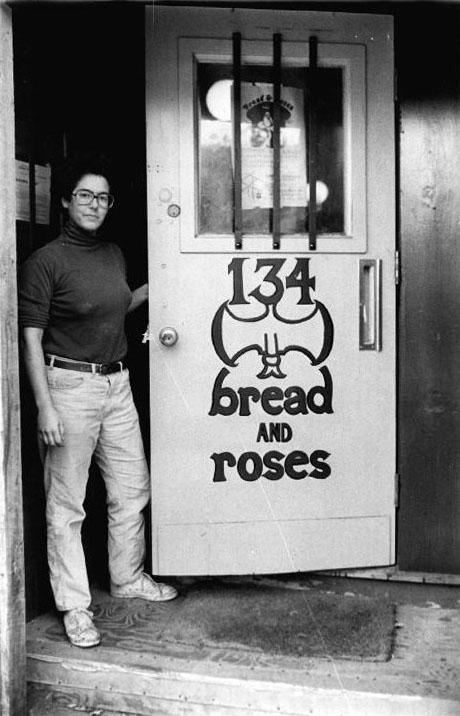
feministBreadandRosesBarbaraFried1976

Not all restaurants have been purely, or even mainly, commercial ventures. This was particularly true of women’s suffrage eating places and those of the 1970s feminist movement.

Although the women’s restaurants of these two periods were quite different in some ways, they shared a dedication to furthering women’s causes and giving women spaces of their own in which to eat meals, hold meetings, and in the 1970s, to enjoy music and poetry by women.

SuffrageLunchBoston1918

In the 1910s most major U.S. cities had at least one suffrage restaurant, tea room, or lunch room sponsored by an organization such as the National American Woman Suffrage Association (NAWSA).

As was true of later feminist restaurants, those of the suffrage era tended to be small and undercapitalized. An exception was the suffrage restaurant financed by the wealthy socialite Alva Belmont in NYC. In terms of patronage, it was almost certainly the most successful women’s restaurant of either era. It reportedly served 900 meals per day from a low-priced menu on which most items were 5 or 10 cents and consisted of soup, fish cakes, baked beans, and home-made pie.

Suffrage restaurants admitted men and welcomed the opportunity to ply them with leaflets and home-made soups, salads, and fritters that would incline them to support the cause. An aged Philadelphia activist recalled in 1988, “I worked at a suffrage tea room. We lured men in, for a good, cheap business lunch. Then you could hand them literature and talk.” In the NYC restaurant operated by NAWSA in 1911, it was impossible to ignore the suffrage issue since every dish, glass, and napkin bore script saying Votes for Women.

suffrageRestaurant1912

Though dedicated to women’s causes, women’s restaurants were not free of conflict. Many suffragists objected to how Alva Belmont ruled with an iron fist, brusquely ordering servers around until they walked out on strike, followed by the dishwashers. Belmont was ridiculed when she brought in her butler and footman to fill the gap. Her footman quit too. Some feminist restaurants experienced discord over cooperative management and, especially, whether or not to serve men.

The first feminist restaurant, NYC’s Mother Courage, was founded in April of 1972. (Its co-founder Dolores Alexander discussed it in 2004-2005 interviews.) Others established in the 1970s included Susan B. Restaurant, Chicago; Bread & Roses, Cambridge MA; The Brick Hut, Berkeley CA; Los Angeles Women’s Saloon and Parlor, Hollywood CA; and Bloodroot, Bridgeport CT). Undoubtedly there were more, especially in college towns. In the 1980s a number of women’s coffeehouses appeared, but they were performance spaces more than eating places.

FeministBloodroot1981

As part of the counterculture, 1970s feminist restaurants typically aimed at a broad set of goals. Women’s equal position in society was paramount but it was embedded in a project of establishing a more peaceful and egalitarian world. Feminist restaurants rotated jobs and paid everyone the same wages. They raised capital by small donations from friends. Staffs were entirely female and women also did most of the renovating. Their decor was spare, with exposed brick walls, mismatched furniture, and chalkboard menus. They served simple peasant-style food, usually prepared from scratch. Some served wine and beer. More often than not menus were vegetarian, or at least beef-less. The L. A. Women’s Saloon and Parlor supported farm workers and would not serve grapes or lettuce. The Brick Hut boycotted Florida orange juice during the anti-gay campaign of spokesperson Anita Bryant. The Women’s Saloon avoided diet plates and sodas, deeming them insulting to large-sized women.

Many proponents of feminist restaurants felt that women were often treated poorly in restaurants, many of which regarded men as their prime customers. Feminist restaurants made a point of presenting women dining with men with the check and wine to sample. But for many women patrons, perhaps especially lesbians, the enjoyment of a non-hostile space was more significant.

At some point each feminist restaurant confronted the touchy question of whether they would serve men. Considerable acrimony erupted around this question at the Susan B. Restaurant in Chicago and Bread & Roses in Cambridge, resulting in the former restaurant’s closure after only a few months. At Bread & Roses a co-founder exercised non-consensus managerial power and fired a server who made men and some heterosexual women feel unwelcome, setting off rounds of group meetings. The restaurant, opened in 1974, was put up for sale and in 1978 became the short-lived “women only” Amaranth restaurant and performance space.

Today Bloodroot may be the sole survivor of the feminist restaurant era.

© Jan Whitaker, 2013