Stouffer's Ladies Restaurant
Location: 4 North Court Street, Harrisburg, Pennsylvania, USA
Opened/Closed: c. 1916
Here's an ad for a ladies restaurant that appeared in the Harrisburg Daily Independent, June 16, 1916:
Stouffer's at least appeared to have a strict code about admitting men, even relative to other local restaurants: "It is the only one of its kind in the city where a Gentleman must be accompanied by a Lady to be admitted. It is, therefore, practically a private Ladies' Restaurant...."
Wonder what was on the menu?
And, most importantly, do you take reservations???
This purpose of this project is to commemorate and honor lost womyn's space--both ancient and modern. This can mean anything from lost women's colleges and schools, to lesbian bars and clubs. And everything sacred and profane in between.
Showing posts with label ladies restaurant. Show all posts
Monday, October 15, 2018
Stouffer's Ladies Restaurant
Labels:
Harrisburg,
ladies cafe,
ladies restaurant,
Pennsylvania
Saturday, September 29, 2018
Mr. M. M'Ginley's Ladies Restaurant
Mr. M. M'Ginley's Ladies' Restaurant
Location: Fifth Street, Pittsburgh, Pennsylvania, USA
Opened/Closed: c. 1858
I wasn't even trying to do research on ladies restaurants when I happened to stumble across this little item. It's from the Pittsburgh Daily Post, Oct. 29, 1858:
Ladies Restaurant.--Mr. M. M'Ginley's Ladies' Restaurant, on Fifth Street, opposite the Exchange Bank, is a great public convenience. He has fitted up his rooms in elegant style, and the ladies can enjoy a dish of "stewed, fried or roasted" in the most complete privacy. When at a distance from their residences at meal time, the ladies will find this establishment fully prepared to furnish them with good things.
Labels:
ladies cafe,
ladies restaurant,
Pennsylvania,
Pittsburgh
Monday, January 30, 2017
National Dairy Kitchen Ladies Restaurant
Location: Charlotte, North Carolina, USA
Opened/Closed: c. 1900
![]() |
| Charlotte [NC] News, Jan. 3, 1900 |
Location: Charlotte, North Carolina, USA
Opened/Closed: c. 1900
The political news is so depressing these days that I'm digging into history as a kind of reprieve.
This 1900 article on the opening of a ladies restaurant is a good illustration of the basic observations we've made about the history of women's spaces.
1) Because men tend to have the monopoly on societal resources (money, authority, expertise, etc.), it is not uncommon for men to open/own/control women's spaces. Notice that two men (Messrs. Rutledge & LeGallais) opened this restaurant.
2) When men open women's spaces, they often do as an after thought, as a way to make money off of women after the market for men is saturated. This is the case here. By there own admission, there were "several well kept restaurants in the city for men" which did not admit women. So these guys saw an untapped market for women diners who want an "a-la-carte lunch." (And yes, I fully recognize that they did not mean all women, just wealthy white women of leisure.)
3) When men open women's spaces, they do not really limit them to women--even though the men's spaces rigorously excluded women. Notice that this "ladies restaurant is for "ladies or ladies with escorts." By escorts, they mean men. But as we know from other ladies restaurants we have examined, the "escort" rule was often broken, meaning it was not uncommon for more men than women to show up in a "ladies restaurant."
This is a persistent historical problem around women's spaces, and one that even feminists (especially of the "liberal" variety) are often unaware of (or consciously ignore). In efforts to be all "inclusive," women will make all kinds of amends to include males, while they somehow miss (or don't care) that men are not doing the same. Notice the debate around bathrooms these days--it's all about women's bathrooms becoming "inclusive" to "all genders." Meanwhile, men's bathrooms carry on just as they always have.
Does that mean that I think ladies restaurants were somehow "bad" then? Nope. Even with all their limitations of social/economic class and race, even though it was men dictating the terms, it still opened up a space for women to dine together and talk. And that's the start of all kinds of good things.
Monday, January 23, 2017
Bresnahan's Ladies Cafe
![]() |
| Evening Star, September 19, 1900 |
Location: 426 Ninth Street, Washington, DC, USA
Opened/Closed: c. 1900
Especially after the Women's March on Washington, the pressure on women to be "inclusive" (include males) is big again--as if women had a long history of excluding males.
What a big joke.
In reality, that has rarely happened. Women have had the authority to exclude male from various gatherings for only very short periods of time in history and under very limited circumstances--all while men were quite comfortable making the dominant cultural institutions all male, or at minimum, with tiny, hard fought for token female representation, for centuries.
Sometimes, we get the cognitive dissonance thing--which is very popular today. We call an event or space something "for women, "but then let the men run amuck anyway.
While it's very popular today, it's not unique to today, as the ad for the Bresnahan's Ladies Café shows. Even while the power in Washington government was 100% controlled by men in 1900, men could still barge in and take over this little "high-class" ladies café.
So why bother with the name? Because it was a crumb, and you have to start somewhere. Even as women were barred from going into many Washington restaurants, cafe's, and bars, especially with no male escort, they could still go to Bresnahan's. Without a male escort. But they still had to put up with loud men taking up seats and tables anyway. (And yes, we're talking exclusively about wealthy white women who even had this limited "privilege.")
Sound like any "women's" places you know of? That is how persistent and consistent the patriarchal domination of space has been over history.
Monday, April 25, 2016
Macy's Ladies Restaurant
Location: New York City, New York, USA
Opened/Closed: c. 1880
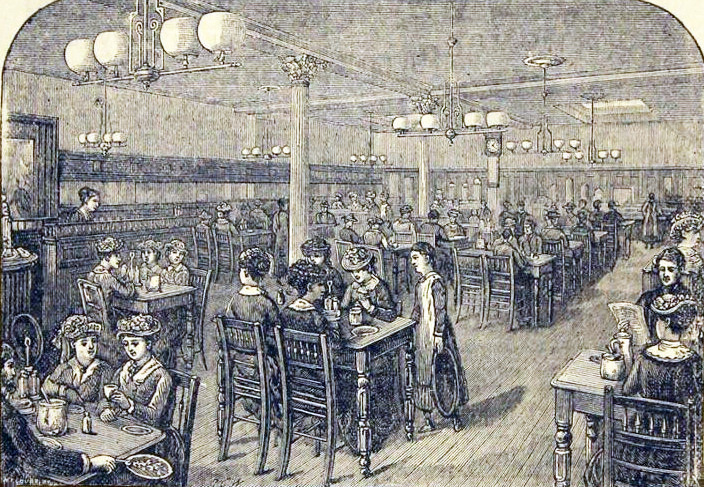
One of my very favorite blogs is Restaurant-ing through History. In a post on 1880s restaurants, the following is mentioned for 1880:
On the second floor of its newly expanded NYC department store, Macy’s restaurant for shoppers seats 200.
I'm not sure where this would have been in NYC, since the Herald Square location (still there today) didn't open till 1902.
But this was clearly a ladies restaurant. Check out the illustration below!
Though it was very common for men to crash "other" ladies restaurants of that era, perhaps one located in a department store failed to attract much interest. However, notice that it was not male-free. If you look carefully, you can still pick out a few fellows who just couldn't help themselves from barging in, though the New York of that era had tons of restaurants that were strictly male-only.
![]() |
| Macy's Restaurant (c. 1880) |
Sunday, January 4, 2015
Monroe Restaurant Ladies Cafe
Monroe Restaurant Ladies Café
Location: 118 and 120 Monroe Street, Chicago, Illinois, USA
Opened/Closed: 1895
This ad appears in the Chicago Eagle for November 9, 1895. In many ways this is a typical ladies café, in that the ladies café is located on the second floor--generally considered inferior square footage from a commercial point of view. If this is a typical ladies café (which I suspect it was), male escorts were more than welcome in the ladies café--and may in fact have represented a majority of the patrons. However, rest assured that the Gentlemen's Café did not admit ladies, escorted or not.
The place existed less than three years after this ad appeared, as it burned to the ground in March 1898.
![]() |
| From the Chicago Eagle, November 8, 1895 |
Location: 118 and 120 Monroe Street, Chicago, Illinois, USA
Opened/Closed: 1895
This ad appears in the Chicago Eagle for November 9, 1895. In many ways this is a typical ladies café, in that the ladies café is located on the second floor--generally considered inferior square footage from a commercial point of view. If this is a typical ladies café (which I suspect it was), male escorts were more than welcome in the ladies café--and may in fact have represented a majority of the patrons. However, rest assured that the Gentlemen's Café did not admit ladies, escorted or not.
The place existed less than three years after this ad appeared, as it burned to the ground in March 1898.
Wednesday, December 31, 2014
Ladies Cafe - East 119th Street and Lexington Avenue
Ladies Café
Location: East 119th Street and Lexington Avenue (East Harlem), New York, New York, USA
Opened/Closed: Photo taken in 1913
Happened to find this photo at Harlem World Magazine. The Ladies Café is to the right. I have briefly looked around, but can't find out what the name of this place might have been much less any advertisements for the place. Still, photos of ladies restaurants and cafes are comparatively rare, so this is a nice find. This is what was said about the photo:
The image was taken looking north on Lexington Avenue, the corner of 119th Street with construction underway to the left on top of that the photographers head and camera are in the right hand corner. Above that is the Ladies Cafe in the right side of the image. As we move to the middle of the photograph two gentlemen stand and talk as other Harlemites walk up Lexington Avenue towards 125th Street.
Sunday, December 21, 2014
The Planter's House Ladies Restaurant
![]() |
| The Planter's House (1841-1887) |
Location: Fourth and Pine, St. Louis, Missouri, USA
Opened: Hotel opened in March 1841
Closed: Hotel severely damaged by fire in 1887 and closed. Demolished in 1891 and rebuilt on the same site.
In an 1885 publication including St. Louis business cards, we find the following advertisement:
THE FINEST RESTAURANT IN THE WEST.
Is undoubtedly the Planters' House Ladies Restaurant. The MESSRS. GERARDI, Proprietors of the Planters' House, have taken special pride in furnishing it. It is exclusively for ladies, or ladies and their escorts. Ladies when alone feel entirely "at home" here, as they, perhaps, do not at any other restaurant in the city, and when on shopping tours from the suburbs find this a most desirable place. Try our strawberry shortcake and other delicacies.
Here we see a lot of common themes with women's spaces that bear mentioning.
First, is that the space is under the proprietorship (control) of men, not women. Women's spaces that are under the ownership, control, and/or management of women are a comparative historical rarity.
Second, this is not "exclusively" a women's space but is basically "coed"--this despite the name and the (deliberately) confusing use of the word "exclusively." How often do we see similar gas lighting and obfuscation around so-called women's spaces to this day?
This is in contrast to the hotel bar and other dining areas which were most likely reserved exclusively for men.
As we see again and again, the "ladies restaurant" is not just for ladies. It is (presumably) for ladies and their escorts, though we have also seen many examples where men who were not in the company of ladies tried to crash the place (see this example from Boston). Or men who seemed to somehow manage to dominate the "ladies café" anyway despite the so-called restrictions (see this complaint from a New York City lady and this analysis of a Chicago hotel ladies café.) Again, we see echoes of this in customer reviews for "lesbian bars" where reviewers note more men than women present.
And third, notice the subtle acknowledgement of how women, especially women alone, are threatened by men in public spaces including eating and drinking establishments. Though the emphasis is shifted away from women's realistic perception of danger to one of psychology (i.e. of "feeling" comfortable or "at home" here--as if this were a familiar women's domestic space, and not the men's public realm.)Still, I'd love to sample the strawberry shortcake....Just for fun, here is one of the first recorded recipes for what we would call strawberry shortcake today. It was published by "Miss Leslie" in 1847--one of history's many forgotten women cooks.
In this history of the Planter's House (or Planter's Hotel), we're told that the hotel built after the 1887 fire also included a ladies dining room:
The main restaurant was considered the most elegant room in the city. It had many Doric columns and was decorated in tones of Empire green and silver. The hotel offered other elegant public rooms — the ladies' dining room, a sumptuous Moorish room, and various meeting and banquet rooms were much admired.
This last hotel closed in 1922.
Labels:
ladies café,
ladies restaurant,
Missouri,
St. Louis,
women's restaurant
Tuesday, November 25, 2014
Shakespearean Inn Ladies Cafe
Shakespearean Inn Ladies Café
Location: Beach Street, Boston, Massachusetts,USA
Opened/Closed: Early 1900s
Men showing disrespect for women's spaces is nothing new. Their urge to crash any space set aside for (or forcibly claimed by) women is seen in all times and all places.
Realize that the ladies cafes of the 19th century/early 20th century were largely in the former (i.e. set aside) category, as many eating and drinking establishments of the time were male-only either by law or by custom. In most cases, ladies cafes were an afterthought, a sop if you will. And in fact, ladies cafes did not typically exclude men per se (even though the men's ones excluded women), but they usually "preferred" that gentlemen be accompanied by ladies (sounds like the unofficial policy of a lot of lesbian bars, another example of a fragile and increasingly endangered women's space. And a policy that men complain about endlessly, despite the plethora of spaces catering to gay and straight males).
And yet even though there were (and are) male only/and or male-dominated establishments in abundance, they gentlemen couldn't help themselves from intruding on Shakespearean Inn Ladies Café. At least in this case, they got push-back from the management. From the Boston Post, March 19, 1901:
Landlord William Hennessy of the Shakespearean Inn in denying admission to teh [sic] Rev. Herbert S. Johnson and his party to the ladies' café because they were not accompanied by ladies followed a rule that has been in vogue at his hotel ever since he opened. It is known to the frequenters of the Inn that no hotel in the city is conducted more carefully, and that, too, in a neighborhood where every effort is made to break down rules of propriety and decorum. Mr. Hennessy has established the reputation of meeting all difficulties and conforming to the laws and police regulations as well, if not better, than any other hotel proprietor in the city.
Unfortunately, it appears that Mr. Hennessy's reputation for a well-run house ran into a bit of trouble less than a year later. A man shot another man through the head (killing him instantly), just outside the Shakespearean Inn. It seems it all started as a brawl while the two men were in "the barroom at the Shakespearean Inn." According to this article, the killer was "driven to desperation" by the victim's "insulting language"-- though the insult seems pretty mild by modern standards. We're informed that a "dozen men were standing about the bar" when the "trouble began," so this obviously took place in the men's bar. The killer later committed suicide.
So I can kind of see how the ladies preferred to do their imbibing without a lot of menfolk about.
The former Shakespearean Inn is now part of Boston's Chinatown, specifically within the tiny (six building) Beach-Knapp Historical district. I'm unable to identify the specific building.
![]() |
| Beach Street today |
Location: Beach Street, Boston, Massachusetts,USA
Opened/Closed: Early 1900s
Men showing disrespect for women's spaces is nothing new. Their urge to crash any space set aside for (or forcibly claimed by) women is seen in all times and all places.
Realize that the ladies cafes of the 19th century/early 20th century were largely in the former (i.e. set aside) category, as many eating and drinking establishments of the time were male-only either by law or by custom. In most cases, ladies cafes were an afterthought, a sop if you will. And in fact, ladies cafes did not typically exclude men per se (even though the men's ones excluded women), but they usually "preferred" that gentlemen be accompanied by ladies (sounds like the unofficial policy of a lot of lesbian bars, another example of a fragile and increasingly endangered women's space. And a policy that men complain about endlessly, despite the plethora of spaces catering to gay and straight males).
And yet even though there were (and are) male only/and or male-dominated establishments in abundance, they gentlemen couldn't help themselves from intruding on Shakespearean Inn Ladies Café. At least in this case, they got push-back from the management. From the Boston Post, March 19, 1901:
Landlord William Hennessy of the Shakespearean Inn in denying admission to teh [sic] Rev. Herbert S. Johnson and his party to the ladies' café because they were not accompanied by ladies followed a rule that has been in vogue at his hotel ever since he opened. It is known to the frequenters of the Inn that no hotel in the city is conducted more carefully, and that, too, in a neighborhood where every effort is made to break down rules of propriety and decorum. Mr. Hennessy has established the reputation of meeting all difficulties and conforming to the laws and police regulations as well, if not better, than any other hotel proprietor in the city.
Unfortunately, it appears that Mr. Hennessy's reputation for a well-run house ran into a bit of trouble less than a year later. A man shot another man through the head (killing him instantly), just outside the Shakespearean Inn. It seems it all started as a brawl while the two men were in "the barroom at the Shakespearean Inn." According to this article, the killer was "driven to desperation" by the victim's "insulting language"-- though the insult seems pretty mild by modern standards. We're informed that a "dozen men were standing about the bar" when the "trouble began," so this obviously took place in the men's bar. The killer later committed suicide.
So I can kind of see how the ladies preferred to do their imbibing without a lot of menfolk about.
The former Shakespearean Inn is now part of Boston's Chinatown, specifically within the tiny (six building) Beach-Knapp Historical district. I'm unable to identify the specific building.
Monday, November 10, 2014
Navarre Hotel Ladies Restaurant
![]() |
| Ad from the Bath [Maine] Independent, March 5, 1910 |
Location: 7th Avenue at 38th Street, New York, New York, USA
Opened: Hotel opened in 1900, ladies restaurant probably didn't open till after 1907
Closed: Hotel demolished in 1930
The 1910 ad for the Navarre Hotel (to the right) appeared in Maine, but I imagine something similar appeared in newspapers all over the east coast.
Notice that a "Ladies Restaurant" is listed under the "Dutch Grill Rooms."
As we have pointed out in previous ladies restaurant posts, restaurants specifically designated for ladies were not unusual in turn-of-the century hotels. Chances are the "Dutch Grill Rooms" were designated as male-only, as cooking meat over an open flame is generally associated with men, masculinity, and men's space, and still is to some extent. That is not to say that the "Ladies Restaurant" was female-only. Typically male escorts were not only allowed, they could even outnumber the ladies on occasion based on our analysis of other ladies restaurants from the period.
In many cases, the ladies restaurant was an after thought by the management. That also appears to be the case here. In this newspaper ad from 1907, there is mention of the "New Dutch Grill Rooms Largest in City," but no mention of a ladies restaurant.
As for the rest of the hotel...at Beyond the Guided Age, we're told that the building was designed by Barney & Chapman around 1900 and demolished in 1930.
We get a little more background from this contemporary description:
On the corner of Seventh Ave., at 38th St., is the NAVARRE HOTEL, most conveniently located. 300 ft. from Broadway. Constructed in the French Renaissance style of architecture, it is one of the handsomest structures of its kind, not only in this country. but in the world. It is built and maintained strictly fire-proof throughout, with its ten stately stories of steel construction, stone and brick walls, red-tiled roof and marble mosaic and terrazzo floors. Among many hostelries of a great city, the Navarre stands unique in this respect. It truly offers the maximum of comfort and luxury at minimum cost. Its richness and high-class appointments, while affording all that is attainable as to the substantial and elegant in hotel service, are to be enjoyed at rates reasonable beyond ordinary expectations.![]() |
| Navarre Hotel Main Lobby |
Judging by the few images we have of the interior, this hotel was as beautiful on the inside as it was on the outside. Unfortunately, we have no images of the ladies restaurant. And I don't find any images from the time of the (men's) grill room either. However, you can see an artist's rendition of what the Navarre Hotel "Gentleman's Café and Bar" looked like here.
Labels:
hotel,
ladies café,
ladies restaurant,
New York,
women's restaurant
Monday, August 4, 2014
Wild Sisters Coffee House
![]() |
| Wild Sisters Coffee House |
Location: 2700 Jane Street, Pittsburgh, Pennsylvania, USA
Opened: 1982
Closed: 1985
Wow! Not often that you open your local paper and find an article about a former womyn's space.
From the Pittsburgh Post-Gazette, July 31, 2014:
1982: Pittsburgh’s first feminist bar, bistro and cabaret
Pittsburgh residents have always had a thirst for ale, good coffee and strong spirits.
James O’Hara, one of the city’s early settlers, was a successful businessman and real estate investor who, by 1803, was operating the Point Brewery on land now occupied by Point State Park.
In 1969, gay men and lesbians rioted outside the Stonewall inn in New York’s Greenwich Village. The women’s rights movement was in full flower and by the spring of 1975, local feminists wanted a place where women’s art could be seen and their voices heard.
So, they organized the Wild Sisters Coffeehouse to provide a performance venue that would showcase women artists, poets and musicians. Among the 15 founders were Dana Ventriglia, a trained carpenter, local lawyer Ann Begler and Felice Newman, then a University of Pittsburgh student and published poet. The coffeehouses were staged in various locations, including the Chatham College Chapel.
By July of 1982, the dedicated, determined women had raised nearly $55,000, enough to buy a liquor license and a South Side building located at 2700 Jane Street. The women invested lots of sweat equity by painting, sanding and plastering their new property. Interior designer Janice Lott did the floor plan for the new establishment. Wild Sisters, the first feminist bar, cabaret and restaurant in Pittsburgh, opened in 1982 .
Mary Pat Donegan, a psychotherapist, was president.
"When we first started, we put one ad in the newspapers — ‘Women Artists Wanted’ — and since that time we’ve been flooded by requests," Ms. Donegan told the Pittsburgh Post-Gazette in a 1982 interview.
Wild Sisters welcomed women and men. Patrons could get a drink, a bowl of soup, a piece of quiche or a sandwich and listen to music. The venue opened long before the letters LGBT entered the daily vernacular of American language.
John G. Craig Jr., the late editor of the Pittsburgh Post-Gazette, mentioned Wild Sisters in a column he wrote on July 27, 1985.
He called it “a South Side bistro with a sympathy for a liberated clientele.”
Wild Sisters closed in 1985 and became Bloomer’s, a bar, music venue and space for women’s art. Next, the building hosted two Italian restaurants and a Mexican taqueria. Today, it is home to the Hot Metal Bridge Faith Community.
— Marylynne Pitz
Wednesday, July 30, 2014
Red Dora's Bearded Lady
![]() |
| Bearded Lady owners Lori Hartman, Harry Dodge, and Silas Howard |
Location: 485 14th Street, San Francisco, California, USA
Opened: Early 1990s?
Closed: Early 2000s?
This description of Red Dora's Bearded Lady is from a much longer piece by Rachel Swan at SF Weekly on the disappearance of urban lesbian space in San Francisco. Escalating rents are forcing lesbians into cheaper suburban areas, a trend which is seen in many cities. So much for the "gayborhood"--which was traditionally male-dominated, and has only become increasingly so.
When Harry Dodge moved to San Francisco in 1985, he was what you might call a typical Midwestern transplant: Nineteen years old, footloose, gay, and ready for a change — a biological woman who would eventually take testosterone, grow a goatee, and characterize himself with "he" pronouns. He was, at that time, prone to fantasies about opening "an anarchist performance space with wrestling mats."
"There was something in me that always identified with San Francisco," Dodge says, decades later. "It had this sheen of being a gay mecca. That was sublimated for me, at that point, but clearly the things were intertwined."
Dodge found a one-bedroom apartment at 21st and Valencia streets for $275 a month, a deal forged with a wizened landlord who hadn't fixed anything in a long time. He began consorting with the bike messenger and punk crowds, dabbling in classes at San Francisco State University (where tuition was $286.50 a semester) and City College (where tuition was considerably lower, he says), and flitting through the city's seven or eight lesbian bars, which all seemed to have female names with a possessive apostrophe ("Amelia's," "Clementina's").
He also entertained ideas of opening his own venue, which at that time didn't seem like a pipe dream. The Mission harbored a fervent lesbian bohemia (including many women who, like Dodge, would later describe themselves as "gender-queer" or "gender-fluid"), and several of Dodge's friends had already launched their own bootstrap enterprises. Rents were cheap, and empty storefronts were there for the taking.
One such building, a rundown, turquoise-and-black tiled shell at 14th and Guerrero, caught Dodge's eye. He'd already teamed up with Silas Howard, bass player for the lesbian punk band Tribe 8, to launch a roving open mic called the Whiptail Lizard Lounge; once they set eyes on the 14th Street storefront, the two scrounged up $1500 for the security deposit, and hoped for the best. "We were rigid with panic, signing the lease," Dodge recalls. "We were already out of money."
Friends came in to paint the walls and scrape debris off the floor. A plumber acquaintance smoothed dirt all over the drains to make them look old, so that a health inspector would grandfather the place without imposing new regulations. An electrician friend rigged the wiring so that it bypassed the PG&E meter — allowing Dodge and Howard to pirate their electricity for the next seven years. They scrounged up enough money for a toaster oven and began serving beans and rice and black coffee. They hosted puppet shows, spoken-word nights, piano performances by the drag cabaret duo Kiki and Herb (who now tour Broadway, but were then a Mission District fixture). They christened the place Red Dora's Bearded Lady.
"I went there every single day," spoken word poet and author Michelle Tea remembers. "Everyone was always on the back patio smoking pot and drinking coffee. ... At night they'd change the lighting and people would sit on the counter and do performance."
Twenty years later, the Bearded Lady is long gone, as is the Mission District lesbian neighborhood that helped birth it. Dodge and Howard moved to New York and Los Angeles, respectively, to pursue artistic careers; their friends dispersed throughout the country. The storefront at 485 14th St. is still gay-owned, and still has turquoise tile on its facade — but it now houses an architecture firm.
Though still not sure when it closed, Red Dora's was still open when it is mentioned in another SF Weekly article from 2001 which states that the original owners had sold Red Dora's. Notice that by now, Red Dora's is increasingly identified as a "queer space" and not as a "lesbian space":
![]() |
| Michelle Tea |
[Michelle] Tea, co-founder of the legendary all-girl, all-queer spoken word group Sister Spit, said that "Wicked Awesome" includes a different range of performers than her earlier group, which was formed in reaction to the very straight, very male slam scene of the early '90s. "With these shows ["Wicked Awesome"] I bring in anybody whose writing I like -- straight boys, gay boys, straight girls, queer girls, tranny girls," Tea said. "It's all mixed up."
![]() |
| SF Weekly cover (July 2008) |
Then there is this recollection from Michelle Rosenbaum:
Red Dora's Bearded Lady [was] a closet-sized cafe and performance space near the notoriously sketchy Valencia Gardens housing projects. Red Dora's was where Michelle Tea and Sini Anderson started Sister Spit, with their weekly writers squeezed up against the muffin counter reading to sweaty overflow crowds. It would get so hot in there that I remember asking the crowd one night if they'd mind if I stripped off my shirt and read just wearing a bra.
And finally, here is a touching review/epitaph from Yelp.
I used to work here.
If I ever had 10 million dollars, I open this place back up.
But with less bugs living in the TV.
RIP Bearded
Friday, June 27, 2014
The Ladies Restaurant and Ice Cream Saloon
![]() |
| Three shilling token for the Ladies Restaurant and Ice Cream Saloon |
Location: 8th Avenue, New York, New York, USA
Opened/Closed: Nineteenth Century
As we have discussed here before, many nineteenth-century eating and drinking establishments barred women, especially women who were not escorted by men. These policies persisted in some cases clear up until the 1970s.
As a result, some enterprising businessmen established dining rooms, cafe's, and restaurants where ladies who were not in the company of men could enjoy a noonday meal, a spot of tea, or something sweet. (Note, however, that men were NOT barred from such places, and even had a tendency to take them over. See this complaint from a woman in the New York Times in 1885.)
The Ladies Restaurant and Ice Cream Saloon was one of the places where ladies could go and partake of some light refreshments. The only reason we know of this place is that they once issued "tokens" to promote their business and solicit customers, and that some of those tokens have survived. The particular token illustrated above was for 3 shillings.
According to the American Numismatic Society, "Tokens and notes for restaurants, bars and hotels were common in the 19th century. The bars were meeting places that often offered musical and theatrical entertainment. The prices for lunches vary between 1 and 5 shillings."
Monday, February 17, 2014
Dingo's
![]() |
| Dingo's |
Location: 4612 SE Hawthorne Boulevard, Portland, Oregon, USA
Opened: 2000
Closed: July 2013
Here is how Kathy Beige described Dingo's at About.com. The review is undated, but as the piece also mentions the Egyptian Room, a Portland lesbian bar that closed in October 2010, it must predate that time.
Dingo’s, a lesbian-owned restaurant and bar is THE place to be on Thursday nights. The margaritas and lime chicken enchiladas are not to be missed.
Then there is this review from Barfly, which is decisively less enthusiastic:
Not hard to imagine a Dingo's outside every twenty-second century left-coast megamall brightly-lit, colorfully-decorated, family-friendly franchises serving up a vaguely-Mexican-themed cuisine and vaguely-dyke-themed nightlife.
It's possible, of course, for the average clientele, enjoying a microbrew on the benches dotting Hawthorne's still singular enterprise, to remain blissfully unaware of either, of course (presuming it's not Thursday's Lesbian Speed Dating night), until your kid inquires about the 'Priscilla Queen Of The ’Ritas!' cocktail.
Long enough established to be a Hawthorne fixture, but service and food have run decidely downhill in the last couple of years.
The consensus at Yelp (and a few other sites) was that the Mexican food at Dingo's was pretty awful. While there are some 99 reviews in total, there are comparatively few references to this also being a lesbian place. So it definitely appears most folks remained "blissfully unaware" of the dykes hanging about.
The first reference is in the very first posted Yelp review of Dingo's from Chrissy S. in October 2007:
![]() |
| A March 2013 event at Dingo's |
I may be a southern belle, but I am still super left in terms of thinking. My friend Laura (not a Yelper) is gay and she was suuuuper excited to go to Dingo's which is supposedly a lesbian run taco bar, for Gay Margarita Night. I was totally down with this plan, (even though if there were a Ryan Gosling Look-a-Like Margartia Night, I probably would've high-tailed it thata way instead!)
Nevertheless, while Chrissy enjoyed the drinks, she hated the food and overall service.
In summation, if you are looking for a gay friendly hangout and you don't want to eat anything but chips and guac, come here. Down some yummy Margaritas in as many flavors as you can stand. But expect to invest in the property...'cause you ain't goin' nowhere, baby.
Sorry, Dingo's. You suck!
Then there's Chris S. in July 2008, who played the role of condescending @$$hole dude most admirably:
a bar/restaurant with lots of lesbians called a Taco Bar makes me giggle.
Here's Katie P. in November 2008, who is just judgmental. If you're all bent by the sight of women kissing, then why are you here?
![]() |
| Dingo patrons hamming it up |
I seriously can't remember the last time I had food that bad.
If you want to watch girls play tonsil hockey, however, this would be the place to go. The lesbian scene here is impressive but depresses me, c'mmon ladies, isn't there a place you can hang out at that has good food and descent service? Don't you think you're worth it? I didn't have a drink there but apparently that's where it's at. They should close down the food, just do chips and that crap salsa and make it a larger bar.
The ever condescending Chris L. returned for encore performance in January 2009, and regurgitated his earlier comments. Boy, is this guy clever or what? And folks can't figure out why a lot of lesbians don't like dudes hanging around their scarce space.
The Leggy One mentioned off hand that Dingo's was a lesbian taco bar; this in of itself really has no bearing on the review...but those familiar with my debaucherous mind can imagine the images this phrase conjured in my immature brain. Plus, I just like saying "lesbian taco bar". It kind of rolls off the tongue and it makes me giggle. The same giggle when I think of the Pink Taco in Vegas.
Robin K. in April 2009 said similar things:
we came here for "Girl's night out". What we saw, was not even close. We were expecting a happening cantina type feel. Semi-loud music, margarita's flowing, big bar, talkative atmosphere, etc. What we got instead was a taco bar with a lesbian staff.
A lesbian taco bar? you'd think that was start to a bad joke. A nun, priest, and rabbi walk into a lesbian taco bar......
Then there were the oh-so-liberal dudes like Darrell L. This is from March 2010:
I'm not uncomfortable with Lesbians. But this place kind of had the vibe that the people who worked there, and the patrons didn't want you there. So they can have their wish. We will never go back. Burp. That hamburger is coming up now, gotta run.
Then there is Wayne C. in August 2010:
Food yucky, service questionable. I loved the company. Por que no! across the street, I was jealous of those people, even the lesbians.
The last Yelp review is dated December 2013. However, the Facebook page reports that the last day was July 31, 2013. Here's the farewell notice:
After 13 unforgettable years,(well...maybe we forgot a little) it is with many mixed emotions we announce Dingos will be closing its doors on July 31st.
Being a part of this community has been a great gift to all of us. We need to thank our daughter Saci, for running Dingos better than we ever could. Our bad ass staff, past and present...you all have made our world a better place. We will never forget our amazing and loyal customers who have supported us for so long. So...you have until the 31st to get your Dingos on!!!!
Big loves..Tiff and Diane
According to this article, Fado Portuguese Kitchen & Bar now occupies the site.
Saturday, January 11, 2014
Eden
![]() |
| Eden |
Location: 3090 Downing Street, Denver, Colorado, USA
Opened: August 2011
Closed: 2013
Like any new establishment, Eden opened with great hopes. Here's the August 2011 birth announcement from Denver Westword:
Eden is the latest revamp of the capacious space at 3090 Downing Street that previously held Swallows, Blackberries Bar and Tosh's Hacienda, among others. Opened by the folks behind Tracks, who now own the building, Eden is designed as a lesbian bar.
"We appreciate the spectrum, of course," says general manager Brittany Joseph. "We're a women's bar, but we are a garden and celebrate all flowers that are blooming."
After telling us all about the great vegetarian food, we're provided with the following description of the premises:
The club, which is housed in what was once a church, covers three floors and has two patios, both sporting lime green walls painted with leaf-like designs -- the garden of Eden. The large foyer is covered with artwork you can purchase by local artists. The main room has a coin-operated pool table and flatscreen televisions playing such music videos as Madonna's "Material Girl" and Abba's "Dancing Queen." Beyond the music videos, entertainment includes DJs and burlesque shows, depending on the night.
But uh oh. We already see signs of trouble in paradise. Note this observation:
This address has had a rough run; here's hoping Eden keeps blooming.
In February 2012, Kathleen St. John at the Denver Post gave Eden a good review. Here is a portion:
Eden calls itself a "bar and cuisine lounge," but that's really just the front room.
The multilevel, multipurpose building offers a lot more than meets the eye. From performance space to party rooms, Eden aims to please.
An open iron gate in Eden's leaf-green, Southwestern-style facade welcomes visitors into a spacious entryway/art gallery. A trail of flickering electronic candles guides the way upstairs to the main bar and lounge.
The bar feels like someone's living room, cozy and carpeted, with Asian décor details. Four-top tables, covered in real tableclothes, take up most of the space, though the drinking clientele hovers around the bar. Eden cultivates a following in Denver's lesbian community but takes care to remain inclusive. The staff does a good job of it, too — the vibe is relaxed and welcoming.
After praise for the vegetarian/vegan/gluten-free menu ("pho rolls" and quinoa sliders) and drink specials, the description of Eden continues thus:
The bar extends into a dimmer, more intimate anteroom to the rentable party space next door. The party room is actually in the building attached behind Eden, the Exdo Annex. Dotted with couches and outfitted with its own bar, the lofted room overlooks Eden's dance floor.
Up another flight of stairs (Eden's a bit of a labyrinth) is a room with a small stage in the corner, plus another bar, plenty of tables and seating. On a recent visit, the Lady D Industries burlesque troupe was setting up for a Wild West extravaganza.
Despite the lack of focus and clear-cut definition, Eden doesn't feel scattershot. Its greatest strength is its versatility. Want to see a show? Have dinner? Drink and dance? All of the above? You're in the right place.
Denver Westword gave Eden the Best Lesbian Bar Award in 2013--a category for which, admittedly, there is little competition:
Eden is a garden of lesbian delights. Thanks to a diverse menu of vegetarian- and vegan-friendly options, Eden is as green-friendly on the inside as the grass-colored building is on the outside. But it's the after-dinner fare that makes Eden a standout on the nightlife scene: In addition to regularly supporting the women of Denver with events dedicated to roller derby, women in slam poetry, female fundraisers, International Women's Day and the like, the restaurant also offers fun, one-night-only events that cater to the double-X-chromosomed. Did you miss the Lady Gaga tour documentary on HBO? Eden's got a bad romance with the singer. You might also encounter diva-centric dance jams, sapphic sirens burlesque, yoga over brunch, or your favorite lesbian reality star.
Here are the comments from a site called WeGoOut:
eden has become a favorite neighborhood hangout and won the Best Lesbian Bar in Denver from OutFront Colorado. The leafy green building is hard to miss, just 1 block at the north end of the Light Rail D line. However, the paint isn’t the only thing that’s different here. eden is a cozy retreat for people from all walks of life as well as the creative and health conscious members of the neighborhood. Step up to our bar and you will discover that this is more than just a place to get a beer.
There are 49 customer reviews at Yelp, nearly all of which were quite positive about the menu. There is almost no mention of this being a lesbian place however. To be exact, there was one mention from Shanna K. in May 2013:
Designed as a lesbian bar, successful as a restaurant, events center, community meeting space and neighborhood watering hole, Eden does it all for everyone. Did I mention the free wifi and epic patio area? Or the weekend dance parties? Plus, an off street lot. It just doesn't get any better!
At Foursquare, there are 15 customer reviews, most of which are good as well. Here's one from May 2012:
A woman’s bar for everyone, with great drink specials, outdoor patio and fantastic vegetarian food. Located 1 block from the Downing St. lightrail.
So what happened? It's not real clear, but both yelp and Denver Westword report that Eden is now closed.
So I presume that Eden blooms no more...
Wednesday, November 20, 2013
Ladies Restaurant at Sage's
| Terre Haute, Indiana --Wabash Avenue looking west |
Location: 425 Main Street, Terre Haute, Indiana, USA
Opened: November 1889
Closed: ???
We haven't posted on an old-fashioned ladies restaurant in a while, and I miss 'em. So climb into your time machine, ladies, as we're taking our luncheon at Sage's today. Don't forget your hat and gloves!
From the Brazil [Indiana] Register, November 28, 1889:
A Beautiful Dining Hall.
The new ladies' restaurant at Sage's was opened to the public Saturday, as the Gazette of Friday said it would be. The room was greatly admired and was visited by a large number [illegible word] the evening. The stairway is very handsomely carpeted and there is an air of elegance about the whole establishment. The menu and the table and waiting service are all excellent. This restaurant is not designed for men; in fact, no men unaccompanied by ladies will be admitted up stairs. It is distinctively a ladies' restaurant added to Sage's down stairs restaurant and lunch counter for men, in response to repeated requests from ladies, chiefly those who visit Terre Haute from the surrounding towns. There are also many ladies in the city who will find it convenient. It will be a popular resort, also, for after theatre parties of gentlemen accompanied by ladies. 425 Main St.
--Terre Haute Gazette
A few common themes here. The ladies restaurant was an afterthought as the gentleman-only space already existed. It was located on the second floor, which is typically considered inferior space from a real estate point of view. Nevertheless, this was a very common location for a ladies restaurant. Men are not excluded per se, but a lady presumably must accompany them. (In practice, however, this "rule" seems to have been violated frequently, based on the complaints of lady diners elsewhere.) And notice that the ladies (apparently) did not demand that the down stairs restaurant and lunch counter for men be integrated. They wanted their own space away from the drunks and the boors.
Labels:
Indiana,
ladies café,
ladies restaurant,
women's restaurant
Friday, November 8, 2013
Mama Dot's
| 233 Westlake Avenue North today |
Location: 233 Westlake Avenue North, Seattle, Washington, USA
Opened/Closed: 1970s
The only reference I have found to Mama Dot's is in a publication called "Claiming Space: Seattle's Lesbian and Gay Historical Geography" (2004). Notice that on the map reproduced below (and here) that Mama Dot's is the only specifically lesbian eating/drinking establishment identified--though we're assured that Cascade Community Clinic was known for its "lesbian friendly health care." Needless to say, the rest of the places are associated with the gay dudes. This is rather typical of the way gay men dominate "gay" space and the subsequent efforts by historians to document the use of that space.
| "Claiming Space" Historic Map of Seattle |
Wednesday, October 16, 2013
Polly's
| Polly's (1915) |
Location: 137 MacDougal Street, New York, New York, USA from 1913 to 1915; then at 147 West 4th Street from 1915 to 1917
Opened:1913
Closed: 1917
I first found out about Polly's in a brief history/timeline of New York's gay bars. It was published in New York Magazine back in January 2013.
1912-1919: Members of Heterodoxy, a feminist club “for unorthodox women,” meet regularly at Polly’s (137 MacDougal St.), a restaurant run by anarchist Polly Holladay. It becomes a hangout for notable lesbians, including Katherine Susan Anthony and Elizabeth Irwin.
Fortunately, Ephemeral New York tells us more about Polly's, though they don't really discuss the lesbian or feminist connection except in passing.
Polly’s MacDougal Street hangout
Looks like a jolly crowd inside Polly’s restaurant, at 137 MacDougal Street, around 1915. Polly Holladay was an anarchist who opened her eatery when Greenwich Village hit its bohemian heights in the teens.
The place was an instant hit. The artistically minded and politically active—such as Theodore Dreiser, Sherwood Anderson, and Emma Goldman—were regulars. Polly’s moved around the block in 1919, closing for good not long after, about the time when the Village’s bohemian rep made it a favorite for tourists.
The building that housed Polly’s has attracted a lot of attention lately. New York University, which owns 133-139 MacDougal, wants to demolish most of it and put a new structure inside the old facade.
That’s not sitting well with local activists, who note that such a historic building—it formed the epicenter of an artistic movement that included Eugene O’Neill’s Provincetown Playhouse, the Liberal Club, and the Heterodoxy Club (a feminist group)—should be preserved.
Notice that this Greenwich Village walking tour guide also mentions the former Polly's, but says nothing about any women there other than the owner. Unfortunately, I find this is true of a lot of walking tours--the history of women as it interwines with a particular place is typically ignored.
The Heterodoxy Club
One example of this new feminism was the Heterodoxy Club of Greenwich Village, a group of 25 women coming together in 1912. The club met at regular Saturday meetings, and was a consciousness-raising group before term was invented. The members of the club were inward-looking and individualistic despite their ideology of women's social awakening and concern with social tumult around them. Their purpose was individual psychic freedom. Said Marie Jenny Howe, leader of Heterodoxy Club and a middle-aged nonpracticing minister and wife of noted Progressive municipal reformer Frederic Howe, "We intend simply to be ourselves, not just our little female selves, but our whole big human selves." Feminism stood for self-development as contrasted with self-sacrifice or submergence in family. The feminists of Heterodoxy Club were all highly educated women, with either formal education in colleges and graduate school or informal education in labor or socialist movements. They were able to assert individuality in livelihood, personal relationships, habits of dress and living.
Labels:
ladies restaurant,
New York,
women's restaurant
Tuesday, June 18, 2013
Women's Restaurants
This is a fantastic post on women's restaurants that I found at Restaurant-ing Through History, one of my favorite blogs. Reproduced with the author's permission.
Women's Restaurants

Not all restaurants have been purely, or even mainly, commercial ventures. This was particularly true of women’s suffrage eating places and those of the 1970s feminist movement.
Although the women’s restaurants of these two periods were quite different in some ways, they shared a dedication to furthering women’s causes and giving women spaces of their own in which to eat meals, hold meetings, and in the 1970s, to enjoy music and poetry by women.

In the 1910s most major U.S. cities had at least one suffrage restaurant, tea room, or lunch room sponsored by an organization such as the National American Woman Suffrage Association (NAWSA).
As was true of later feminist restaurants, those of the suffrage era tended to be small and undercapitalized. An exception was the suffrage restaurant financed by the wealthy socialite Alva Belmont in NYC. In terms of patronage, it was almost certainly the most successful women’s restaurant of either era. It reportedly served 900 meals per day from a low-priced menu on which most items were 5 or 10 cents and consisted of soup, fish cakes, baked beans, and home-made pie.
Suffrage restaurants admitted men and welcomed the opportunity to ply them with leaflets and home-made soups, salads, and fritters that would incline them to support the cause. An aged Philadelphia activist recalled in 1988, “I worked at a suffrage tea room. We lured men in, for a good, cheap business lunch. Then you could hand them literature and talk.” In the NYC restaurant operated by NAWSA in 1911, it was impossible to ignore the suffrage issue since every dish, glass, and napkin bore script saying Votes for Women.

Though dedicated to women’s causes, women’s restaurants were not free of conflict. Many suffragists objected to how Alva Belmont ruled with an iron fist, brusquely ordering servers around until they walked out on strike, followed by the dishwashers. Belmont was ridiculed when she brought in her butler and footman to fill the gap. Her footman quit too. Some feminist restaurants experienced discord over cooperative management and, especially, whether or not to serve men.
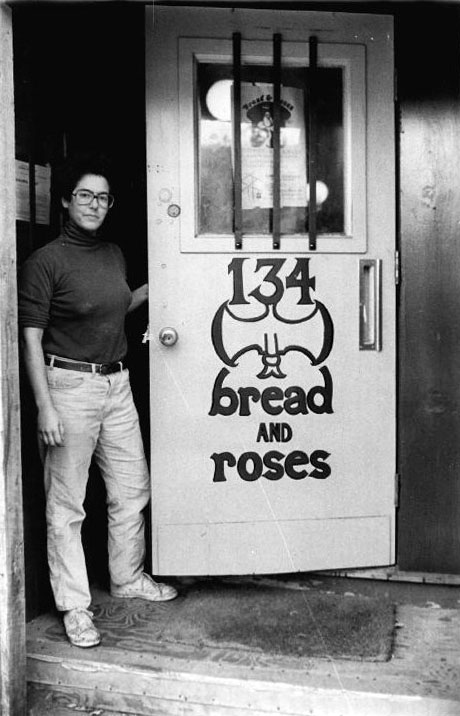
The first feminist restaurant, NYC’s Mother Courage, was founded in April of 1972. (Its co-founder Dolores Alexander discussed it in 2004-2005 interviews.) Others established in the 1970s included Susan B. Restaurant, Chicago; Bread & Roses, Cambridge MA; The Brick Hut, Berkeley CA; Los Angeles Women’s Saloon and Parlor, Hollywood CA; and Bloodroot, Bridgeport CT). Undoubtedly there were more, especially in college towns. In the 1980s a number of women’s coffeehouses appeared, but they were performance spaces more than eating places.

As part of the counterculture, 1970s feminist restaurants typically aimed at a broad set of goals. Women’s equal position in society was paramount but it was embedded in a project of establishing a more peaceful and egalitarian world. Feminist restaurants rotated jobs and paid everyone the same wages. They raised capital by small donations from friends. Staffs were entirely female and women also did most of the renovating. Their decor was spare, with exposed brick walls, mismatched furniture, and chalkboard menus. They served simple peasant-style food, usually prepared from scratch. Some served wine and beer. More often than not menus were vegetarian, or at least beef-less. The L. A. Women’s Saloon and Parlor supported farm workers and would not serve grapes or lettuce. The Brick Hut boycotted Florida orange juice during the anti-gay campaign of spokesperson Anita Bryant. The Women’s Saloon avoided diet plates and sodas, deeming them insulting to large-sized women.
Many proponents of feminist restaurants felt that women were often treated poorly in restaurants, many of which regarded men as their prime customers. Feminist restaurants made a point of presenting women dining with men with the check and wine to sample. But for many women patrons, perhaps especially lesbians, the enjoyment of a non-hostile space was more significant.
At some point each feminist restaurant confronted the touchy question of whether they would serve men. Considerable acrimony erupted around this question at the Susan B. Restaurant in Chicago and Bread & Roses in Cambridge, resulting in the former restaurant’s closure after only a few months. At Bread & Roses a co-founder exercised non-consensus managerial power and fired a server who made men and some heterosexual women feel unwelcome, setting off rounds of group meetings. The restaurant, opened in 1974, was put up for sale and in 1978 became the short-lived “women only” Amaranth restaurant and performance space.
Today Bloodroot may be the sole survivor of the feminist restaurant era.
© Jan Whitaker, 2013
Women's Restaurants
Not all restaurants have been purely, or even mainly, commercial ventures. This was particularly true of women’s suffrage eating places and those of the 1970s feminist movement.
Although the women’s restaurants of these two periods were quite different in some ways, they shared a dedication to furthering women’s causes and giving women spaces of their own in which to eat meals, hold meetings, and in the 1970s, to enjoy music and poetry by women.
In the 1910s most major U.S. cities had at least one suffrage restaurant, tea room, or lunch room sponsored by an organization such as the National American Woman Suffrage Association (NAWSA).
As was true of later feminist restaurants, those of the suffrage era tended to be small and undercapitalized. An exception was the suffrage restaurant financed by the wealthy socialite Alva Belmont in NYC. In terms of patronage, it was almost certainly the most successful women’s restaurant of either era. It reportedly served 900 meals per day from a low-priced menu on which most items were 5 or 10 cents and consisted of soup, fish cakes, baked beans, and home-made pie.
Suffrage restaurants admitted men and welcomed the opportunity to ply them with leaflets and home-made soups, salads, and fritters that would incline them to support the cause. An aged Philadelphia activist recalled in 1988, “I worked at a suffrage tea room. We lured men in, for a good, cheap business lunch. Then you could hand them literature and talk.” In the NYC restaurant operated by NAWSA in 1911, it was impossible to ignore the suffrage issue since every dish, glass, and napkin bore script saying Votes for Women.
Though dedicated to women’s causes, women’s restaurants were not free of conflict. Many suffragists objected to how Alva Belmont ruled with an iron fist, brusquely ordering servers around until they walked out on strike, followed by the dishwashers. Belmont was ridiculed when she brought in her butler and footman to fill the gap. Her footman quit too. Some feminist restaurants experienced discord over cooperative management and, especially, whether or not to serve men.
The first feminist restaurant, NYC’s Mother Courage, was founded in April of 1972. (Its co-founder Dolores Alexander discussed it in 2004-2005 interviews.) Others established in the 1970s included Susan B. Restaurant, Chicago; Bread & Roses, Cambridge MA; The Brick Hut, Berkeley CA; Los Angeles Women’s Saloon and Parlor, Hollywood CA; and Bloodroot, Bridgeport CT). Undoubtedly there were more, especially in college towns. In the 1980s a number of women’s coffeehouses appeared, but they were performance spaces more than eating places.
As part of the counterculture, 1970s feminist restaurants typically aimed at a broad set of goals. Women’s equal position in society was paramount but it was embedded in a project of establishing a more peaceful and egalitarian world. Feminist restaurants rotated jobs and paid everyone the same wages. They raised capital by small donations from friends. Staffs were entirely female and women also did most of the renovating. Their decor was spare, with exposed brick walls, mismatched furniture, and chalkboard menus. They served simple peasant-style food, usually prepared from scratch. Some served wine and beer. More often than not menus were vegetarian, or at least beef-less. The L. A. Women’s Saloon and Parlor supported farm workers and would not serve grapes or lettuce. The Brick Hut boycotted Florida orange juice during the anti-gay campaign of spokesperson Anita Bryant. The Women’s Saloon avoided diet plates and sodas, deeming them insulting to large-sized women.
Many proponents of feminist restaurants felt that women were often treated poorly in restaurants, many of which regarded men as their prime customers. Feminist restaurants made a point of presenting women dining with men with the check and wine to sample. But for many women patrons, perhaps especially lesbians, the enjoyment of a non-hostile space was more significant.
At some point each feminist restaurant confronted the touchy question of whether they would serve men. Considerable acrimony erupted around this question at the Susan B. Restaurant in Chicago and Bread & Roses in Cambridge, resulting in the former restaurant’s closure after only a few months. At Bread & Roses a co-founder exercised non-consensus managerial power and fired a server who made men and some heterosexual women feel unwelcome, setting off rounds of group meetings. The restaurant, opened in 1974, was put up for sale and in 1978 became the short-lived “women only” Amaranth restaurant and performance space.
Today Bloodroot may be the sole survivor of the feminist restaurant era.
© Jan Whitaker, 2013
Subscribe to:
Posts (Atom)


.jpg)