Showing posts with label Cambridge. Show all posts

Wednesday, November 12, 2014

The Marquee

Phoenix Landing at 512 Massachusetts
Avenue, the former Marquee
The Marquee

Location: 512 Massachusetts Avenue, Cambridge, Massachusetts, USA

Opened/Closed: 1970s - mid 80s?

The Marquee shows up in a lot of random memories. This one is from QWIMB, in an interview with Marcia Deihl:

In Cambridge in the 1970s, there were Lesbian Feminist Music Collectives and women’s bars within which to showcase their talents. Bars like the Marquee in Cambridge, Sneakers in Somerville, and Somewhere Else in Boston. Imagine having a bar in the city exclusively dedicated to serving gay women? Boston has not had a women’s bar in over two decades.

From www.marciadiehl.com
Then there is mention in a 2008 interview done for Actup Oral History Project. (JH is Jill Harris, SS is Sarah Schulman):

SS: What was your community involvement at that time? What was the name of that big famous lesbian bar in Boston? It was called like Our Place or –

JH: Somewhere.

SS: Somewhere. That’s right.

JH: Somewhere. I worked there.

SS: What?

JH: I worked there.

SS: You worked at Somewhere?

JH: I worked at Somewhere.

SS: So you were in Lesbian Central.

JH: Yeah, yeah. I was a waitress at Somewhere between college and law school. I stayed in the Boston area for a couple years after I got out of college, and I worked at – the Marquee in Cambridge was a big bar, I was a bartender there, and I was a waitress at Somewhere. It must have been like ’80. It was fun. It was a blast.

Here's a recollection from Elizabeth Stephens:

My next significant relationship was sealed when this hot woman who I had last seen at the skuzzy lesbian bar called the Marquee caught my eye at the AA meeting Crossroads on Tuesday nights. After the meeting Fredericka invited me to go apple picking with her. It was when we were both up the same apple tree that she revealed her gift of being able to pick apples with her toes. Being the latent ecosexual that I was, I was hooked. She picked apple after apple, as I got more and more turned on. After neither one of us could take it any more we climbed down the tree and took a roll in the hay that turned into a three-year relationship. Fredericka was fun when we weren’t in some fucked up power struggle. She too had ecosexual tendencies and must have sensed that we could explore them together.

Then there is this 1983 yahoo discussion where a lot of dudebro's are pontificating on whether a lesbian bar is "discriminatory," with specific mention of the Marquee. But I find it so annoying I can't bring myself to quote any of it. Do so at your own risk.

Today the site houses Phoenix Landing, an "alternative Irish bar."

Tuesday, June 18, 2013

Women's Restaurants

This is a fantastic post on women's restaurants that I found at Restaurant-ing Through History, one of my favorite blogs. Reproduced with the author's permission.

Women's Restaurants

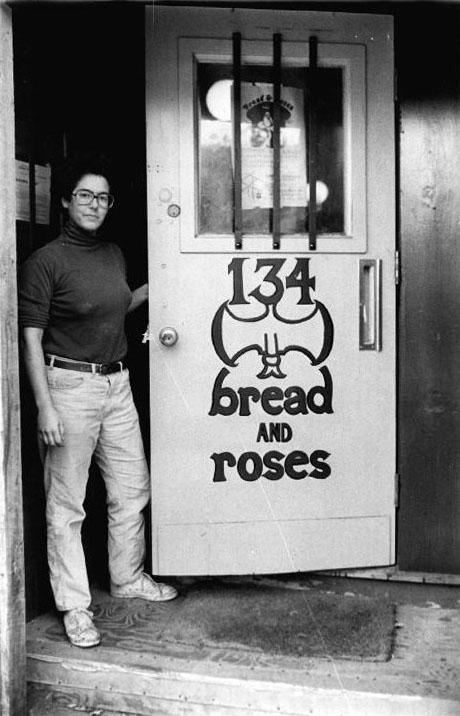
feministBreadandRosesBarbaraFried1976

Not all restaurants have been purely, or even mainly, commercial ventures. This was particularly true of women’s suffrage eating places and those of the 1970s feminist movement.

Although the women’s restaurants of these two periods were quite different in some ways, they shared a dedication to furthering women’s causes and giving women spaces of their own in which to eat meals, hold meetings, and in the 1970s, to enjoy music and poetry by women.

SuffrageLunchBoston1918

In the 1910s most major U.S. cities had at least one suffrage restaurant, tea room, or lunch room sponsored by an organization such as the National American Woman Suffrage Association (NAWSA).

As was true of later feminist restaurants, those of the suffrage era tended to be small and undercapitalized. An exception was the suffrage restaurant financed by the wealthy socialite Alva Belmont in NYC. In terms of patronage, it was almost certainly the most successful women’s restaurant of either era. It reportedly served 900 meals per day from a low-priced menu on which most items were 5 or 10 cents and consisted of soup, fish cakes, baked beans, and home-made pie.

Suffrage restaurants admitted men and welcomed the opportunity to ply them with leaflets and home-made soups, salads, and fritters that would incline them to support the cause. An aged Philadelphia activist recalled in 1988, “I worked at a suffrage tea room. We lured men in, for a good, cheap business lunch. Then you could hand them literature and talk.” In the NYC restaurant operated by NAWSA in 1911, it was impossible to ignore the suffrage issue since every dish, glass, and napkin bore script saying Votes for Women.

suffrageRestaurant1912

Though dedicated to women’s causes, women’s restaurants were not free of conflict. Many suffragists objected to how Alva Belmont ruled with an iron fist, brusquely ordering servers around until they walked out on strike, followed by the dishwashers. Belmont was ridiculed when she brought in her butler and footman to fill the gap. Her footman quit too. Some feminist restaurants experienced discord over cooperative management and, especially, whether or not to serve men.

The first feminist restaurant, NYC’s Mother Courage, was founded in April of 1972. (Its co-founder Dolores Alexander discussed it in 2004-2005 interviews.) Others established in the 1970s included Susan B. Restaurant, Chicago; Bread & Roses, Cambridge MA; The Brick Hut, Berkeley CA; Los Angeles Women’s Saloon and Parlor, Hollywood CA; and Bloodroot, Bridgeport CT). Undoubtedly there were more, especially in college towns. In the 1980s a number of women’s coffeehouses appeared, but they were performance spaces more than eating places.

FeministBloodroot1981

As part of the counterculture, 1970s feminist restaurants typically aimed at a broad set of goals. Women’s equal position in society was paramount but it was embedded in a project of establishing a more peaceful and egalitarian world. Feminist restaurants rotated jobs and paid everyone the same wages. They raised capital by small donations from friends. Staffs were entirely female and women also did most of the renovating. Their decor was spare, with exposed brick walls, mismatched furniture, and chalkboard menus. They served simple peasant-style food, usually prepared from scratch. Some served wine and beer. More often than not menus were vegetarian, or at least beef-less. The L. A. Women’s Saloon and Parlor supported farm workers and would not serve grapes or lettuce. The Brick Hut boycotted Florida orange juice during the anti-gay campaign of spokesperson Anita Bryant. The Women’s Saloon avoided diet plates and sodas, deeming them insulting to large-sized women.

Many proponents of feminist restaurants felt that women were often treated poorly in restaurants, many of which regarded men as their prime customers. Feminist restaurants made a point of presenting women dining with men with the check and wine to sample. But for many women patrons, perhaps especially lesbians, the enjoyment of a non-hostile space was more significant.

At some point each feminist restaurant confronted the touchy question of whether they would serve men. Considerable acrimony erupted around this question at the Susan B. Restaurant in Chicago and Bread & Roses in Cambridge, resulting in the former restaurant’s closure after only a few months. At Bread & Roses a co-founder exercised non-consensus managerial power and fired a server who made men and some heterosexual women feel unwelcome, setting off rounds of group meetings. The restaurant, opened in 1974, was put up for sale and in 1978 became the short-lived “women only” Amaranth restaurant and performance space.

Today Bloodroot may be the sole survivor of the feminist restaurant era.

© Jan Whitaker, 2013

Wednesday, September 28, 2011

New Words bookstore


New Words co-founder Gilda Bruckman

New Words bookstore  

Location: 186 Hampshire Street, Inman Square, Cambridge, Massachusetts, USA

Opened: April 1974

Closed: October 6, 2002

I actually remember going here back in the 1980s....

Here's a selection from the obituary for New Words bookstore--from The Phoenix. (The same article also discusses the demise of Sojourner's, a feminist newspaper that started in 1975.)

FROM THE DAY it opened its doors in April 1974 through the next 28 years, New Words bookstore, in Cambridge, offered its customers what they could not get anywhere else. Not just novels by Latina writers, or essays and historical analyses by feminist academics, or national, regional, and local periodicals. And not just a large selection of women’s music, a true alternative in the era before Melissa Etheridge, k.d. lang, and Tori Amos became household names. For nearly three decades, New Words has been the city and region’s de facto community center and feminist-resource network. In the not-so-long-ago era before women cracked the gender barrier on the Supreme Court, on the playing fields, on Wall Street, and even in the local political arena, New Words was one oasis where no one snickered when a customer asked for a book about breast cancer, or inquired where one might find shelter for battered women or a support group for lesbians with kids. In the late ’70s and through the ’80s, long before the Internet, long before "gay and lesbian listings" were a routine part of the mainstream media’s "lifestyle" pages, New Words was the place where a lesbian new to Boston could learn where to find the local women’s bar or a poetry reading or a pot luck. It was, for many, a lifeline.

Just as important, New Words was the only place that sought links among women’s literature, political writing, and the nascent feminist movement. While mainstream bookstores, even sophisticated ones, boasted at best a shelf or two of "women’s books," New Words championed rising feminist authors such as Dorothy Allison, Marge Piercy, and Alice Walker, and poets such as June Jordan and Adrienne Rich, according their work the same respect and cultural importance that the mainstream routinely bestowed upon, say, Norman Mailer, John Updike, or Hunter Thompson.

These days, New Words, true to form, is still offering something its customers would never find at Barnes & Noble or even Amazon.com: "Grief counseling," says management, only half-joking. That’s because on October 6, New Words closed the doors of its long-time digs at 186 Hampshire Street in Inman Square. It is the end of an era for the oldest continuously operating women’s bookstore in the US. But its founders, who still run the store, stress that it is also a new beginning for New Words. The management is in the middle of a long-term plan to transform the bookstore into the Center for New Words (CNW), a nonprofit literary, educational, and cultural center that, for now, continues to offer readings and live performances in its old space. By next year, plans call for a new, bigger, and more accessible CNW somewhere in Cambridge, where readings and events will be the focus.