Showing posts with label Pennsylvania. Show all posts

Wednesday, June 5, 2019

Pittsburgh Dyke and Trans March, Revisited

With it being Pride Month and all, I started to wonder about the state of the Dyke March this year.  And that got me thinking about what is now called the Pittsburgh's Dyke and Trans March, a topic I posted on back in 2014.

Just how is this great expression of solidarity working out these days? You know, the parade where all of us who are "non-manly men" (you know, anybody who isn't a conventional masculine "cis" male) are supposedly diverted, so as to not muss up the "real" Pride events?

Well, there's a Facebook page. And what do you know. It's held in September now. Why I don't know. You'll have to ask them.

And even though we're told that numerically, lesbians outnumber trans people, you would know it by the postings. There are lots of postings for trans events/issues, one for bi visibility, a few general, all-purpose "queer" ones.

Where are the postings related to dykes and lesbians? Well, I scrolled all the say to December 2017, and didn't FIND ONE posting that used either word.

Huh. So much for equal visibility. But really, we knew that, right? It was always about coopting an event started for lesbians by lesbians and eliminating the same. At least as anything other than the "supportive" and basically deferential role you often see in...

Well, I hate to say it. The Men's Rights Movement. A movement I spent years studying and writing about as an advocate for victims of domestic violence.

Far fetched you say?

I went back and looked at some of the postings of their main propagandist, someone named Sue.

Sue often makes a big to do about "the media" in rural Pennsylvania "misgendering" various transgender "victims" of law enforcement, and how they don't follow best practices.

The same blogger absolutely ignores best practices for covering domestic violence though - when it involves transgender persons being violent and abusive in their interactions with women within their families.

In fact, she actively covers up any history of domestic violence or violence directed towards women when it suits her purposes.

Let's explore further.

Here is one set one of suggestions on how to cover domestic violence:

QUESTIONS TO CONSIDER WHEN COVERING A DOMESTIC VIOLENCE STORY

1) Have there been prior incidents? Acts of violence are often portrayed as an isolated incidents when, in reality, they are part of a pattern of conduct. Particularly if family members express surprise at the attack, it is easy to slip into a suggestion that the person just “snapped” or had an uncharacteristic lapse of control. A more accurate and complete story will result if prior conduct is also reported. Look for a history of controlling behavior. Review court records for prior criminal, divorce, child custody, parental rights and Temporary Protection Order (TPO) cases. Check law enforcement records for prior arrests and police response to allegations of domestic violence involving the same persons or address.

2) Who can speak for the victim? An abuser’s justification for violence commonly involves blaming the victim or the “system.” The victim and the “system” may not be free to dispute the abuser’s allegations because of fear, or because of physical or legal constraints. Presentation solely of the abuser’s point of view implies that the abuser’s violence was justified or motivated by the behavior of someone else.

3) Why did this happen? Warning signs of domestic violence are understood. Victims can be protected. Abuse is a learned behavior. Any implication that the crime was inexplicable is likely incorrect. Contact an expert to give you insight.

4) What’s the true portrait? It is incorrect to imply that “normal” or successful people aren’t typical perpetrators of domestic violence. In fact, domestic abusers often present two images: skillful in social and business settings but controlling and obsessive in intimate relationships.

5) What language should describe domestic violence? It is good practice to use the term “domestic violence” in describing the crime. Give the public a vocabulary with which to identify a social issue. The United States and most of its communities have been engaged in a massive effort for more than three decades to provide resources to address the societal problem of domestic violence. Acknowledge the existence of that effort and the availability of those resources by correctly labeling the conduct you are reporting.

 6) Are authoritative points of view available? Seek a statement from, or consult with, a local domestic violence advocate or a recognized domestic violence expert.

7) How much do friends and neighbors really know? Use statements from associates of the abuser with caution. Domestic violence is often unknown to friends and neighbors until it becomes murder. Balance statements that express surprise at the abuser’s conduct with any record of past controlling behavior and information about domestic violence.

8) Were they separating? Was she pregnant? Domestic violence often is worst when the victim tries to separate or during pregnancy because the abuser’s control of the victim’s behavior is threatened.

9) Where can more contextual information be obtained? Information from this media guide may be used to add context and depth to a story about domestic violence.

10) What is the impact beyond this victim? Experts can help describe the impact of the domestic violence on children, families, employers, the community and the larger society.

11) How can victims get help? Include local contact information for domestic violence services. Many victims are unaware of the available support and, except through your reporting, may by unable to safely access this information.

12) How can abusers get help? One way to help prevent future domestic violence is by providing information to allow present and potential abusers to identify themselves, to understand that change is possible and to seek help to change their behaviors.

13) Can a story make things worse? Reporters should be aware that abusers use news reports to threaten their victims with similar fates or to reinforce the belief that, like the victim in the reporter’s story, the victim will be humiliated and not believed. Reporters can reduce the likelihood of this perversion of their reporting by following these suggestions.

So how does Sue absolutely violate these suggestions, in a way that actually suggests men's rights coverage?

Here is one story. Later, I may post about another case of Sue wrote about. It involves covering up the domestic violence history of a workforce shooter, a trans woman named Claire McClimans. Not to mention deliberate playing down of the shooting victim's injuries, and insinuating the victim deserved to be shot because he was supposedly insensitive to the shooter's wishes.

STORY ONE: SEAN HAKES

Sean Hakes was a transgender man shot and killed by the police in Sharon, PA (Mercer County) in January 2017.

Here's what she said about it:

Sean Hake reportedly lived with his mother in the residence. Details are very limited at this time, but I will follow this story. We don’t know Sean’s role in the domestic call or what led up to his death by shooting. We certainly do know that the death of a 23-year-old is terrible and tragic.

And then she goes into how awful the coverage was for HIM in terms of inconsistent pronoun use and so forth.

Well, we live in the age of Google so it's not that hard to find out Sean's mysterious role in this domestic call.

Here's what Penn Live said:

A domestic disturbance at a Sharon, Pa., home ended with a 23-year-old being fatally shot by police on Friday, the Associated Press reports.

According to the wire service, the mother of Sean Marie Hake called 911 shortly before midnight Friday to report an assault at their Sharon residence.

And according to CBS:

According to investigators, Hake threatened to put a razor blade to his mother’s throat and repeatedly refused police orders to put down a utility knife he was holding after he got out of his car. He was shot three times by a police officer when he began to move toward one of the officers, still holding the knife.

And this from WFMJ:

The district attorney says when Sharon police responded to a domestic disturbance call made by Hakes' mother on January 6th, they found Hake in a car, a utility knife in his hand and blood dripping from his wrist.
Police, who responded to the area of the 23-year-old's Tamplin Street home, said they tried to talk calmly to him, but he refused to put the knife down and exited the car and aggressively charged towards officers.
"Hake stated that you are going to have to kill me or I am going to kill you," said District Attorney Karson.
One of three officers, for at least the third time according to authorities, yelled at Hake to drop the weapon and again he refused and continued to advance towards the officers.  That's when he was shot twice.  Hake continued to advance towards police still holding the knife according to the district attorney and that's when one of the officers fired a third shot and Hake fell to the ground.

So how many rules were broken here?

Rule 1. Prior Incidents? Not only does Sue refuse to bring up prior incidents of domestic violence or research the same, she refuses to acknowledge the domestic violence incident behind this particular altercation with the police. It's as if Hakes is inexplicably shot by the police for no reason at all. 

Rule 2. Who speaks for the victim? Sue refuses to acknowledge there was a victim other than Hakes. Doesn't own up to what Hakes did to his mother or even acknowledge the mother's name. But there is lots of blame for "the system" and the police and the media for "misgendering."

Rule 3. Why did this happen? Was there mental illness? Maybe. But violent abusers typically know what they are doing and do it anyway. At any rate, Sue doesn't express much interest in all that. Notwhen we can worry about the pronoun preferences of a person threatening people with a knife. 

Rule 4. What's the true portrait? Sue is so committed to being an advocate for transgender persons that she covers up for a domestic abuser. So we get some idea that this is the same as some poor black kid shot by the police for simply walking the streets. That is not the case at all and it's highly misleading to suggest that it is. 

Rule 5. What language? Well, Sue refuses to call this out as domestic violence at all. So there's that. So of course, why even bother with rule 6? That would just muddy the issue which is all about the shooting of a transgender man and media misgendering. So absolutely sweep under the rug the story of this person threatening to slash his mother's throat. And God knows what else she and others in the family have gone through. Apparently Sue can't even pretend to have compassion or interest in their plight. And so on for the rest of the rules. 

This is what MRAs typically do--and media influenced by the same. It's all about the pain of the batterer. What a "good guy" he was. How he was "forced" to do what he did--though it's often vague what exactly forced him. How he--the violent one--is somehow the real victim. As for the real victims? Barely mentioned. Or erased altogether. 

So are we surprised that dykes barely have a nominal existence in the Dyke and Trans March? 

Monday, October 15, 2018

Stouffer's Ladies Restaurant

Stouffer's Ladies Restaurant

Location: 4 North Court Street, Harrisburg, Pennsylvania, USA

Opened/Closed: c. 1916

Here's an ad for a ladies restaurant that appeared in the Harrisburg Daily Independent, June 16, 1916:


Stouffer's at least appeared to have a strict code about admitting men, even relative to other local restaurants: "It is the only one of its kind in the city where a Gentleman must be accompanied by a Lady to be admitted. It is, therefore, practically a private Ladies' Restaurant...." 

Wonder what was on the menu? 

And, most importantly, do you take reservations???


Saturday, September 29, 2018

Mr. M. M'Ginley's Ladies Restaurant

Mr. M. M'Ginley's Ladies' Restaurant

Location: Fifth Street, Pittsburgh, Pennsylvania, USA

Opened/Closed: c. 1858

I wasn't even trying to do research on ladies restaurants when I happened to stumble across this little item. It's from the Pittsburgh Daily Post, Oct. 29, 1858:

Ladies Restaurant.--Mr. M. M'Ginley's Ladies' Restaurant, on Fifth Street, opposite the Exchange Bank, is a great public convenience. He has fitted up his rooms in elegant style, and the ladies can enjoy a dish of "stewed, fried or roasted" in the most complete privacy. When at a distance from their residences at meal time, the ladies will find this establishment fully prepared to furnish them with good things.


Thursday, March 9, 2017

Henry S. Jacob's Cafe

Henry S. Jacob's Café

Location: 25 Graeme Street (a/k/a West Diamond Street), Pittsburgh, Pennsylvania, USA

Open/Closed: c. 1914

As part of a fairly extensive research project, I have been looking into the history of the saloons and cafe's that used to exist around Pittsburgh's former Diamond Square (now Market Square). One of the best sources of information are the proceedings from License Court, which allowed citizens and other groups to contest the renewal of liquor licenses for various establishments. Imagine my surprise when I found the following complaints lodged against Henry S. Jacob's place. This report is from the Pittsburgh Daily Post, March 20, 1914:


Wow. Where to even start. During the same era, New York had its Café des Beaux Arts, a ladies drinking establishment opened in 1911. But the press emphasized that this was a genteel place. (Regular readers here will remember that saloons and bars of this era were nearly entirely identified as male-only spaces.)
Mr. Jacob's place apparently wasn't. It was somehow predominantly or primarily women, without appearing to be a genteel place for ladies. In fact, we're told that many of the women are of "bad repute" or "strange." But if they were "prostitutes" looking for customers, why go to a bar that's "primarily" women? After all, logically, you are not going to find many men there. And though detectives claimed that these "strange women" had "asked them to go out," you got to wonder what most of these women were up to....


Tuesday, January 17, 2017

Barone's Variety Room

Barones matchesBarone's Variety Room

Location: 1116 Walnut Street, Philadelphia, Pennsylvania, USA

Opened/Closed: 1963

Since it appears that the old days are coming back, it's important to remind folks, especially our younger readers, just how the powerful responded to lesbian space.

This excerpt is from the Philadelphia Inquirer, May 12, 1974. The quoted material is from Byrna Aronson, who was then an administrative assistant with the American Civil Liberties Union.

"We were in Barone's Variety Room (a lesbian bar) in March, 1968, and plainclothes police came in. I didn't see them. I leaned down to kiss my girlfriend on the cheek, and Captain Clarence Ferguson, in a pork-pie hat, tapped me on the shoulder and said 'You're under arrest.' And I said, 'What for?' He said, 'Sodomy.' I just started to laugh.

Twelve women were carted off in a paddywagon that night, Ms. Aronson among them. They were booked on a variety of charges. It was alleged (in graphic language) that several women had been making love on the floor, that others were drunk and disorderly, and that some had resisted arrest.

The next morning at their arraignment, a magistrate dismissed the charges. "But we were left with an arrest record. In Philadelphia, if you're booked, your records go to the FBI. And so anytime you apply for a job that requires any kind of security clearance, you're out of luck. One of the women arrested had such a job, and she lost it.

Barone's was closely associated with another lesbian bar named Rusty's. See our previous post on Rusty's here.

Saturday, February 20, 2016

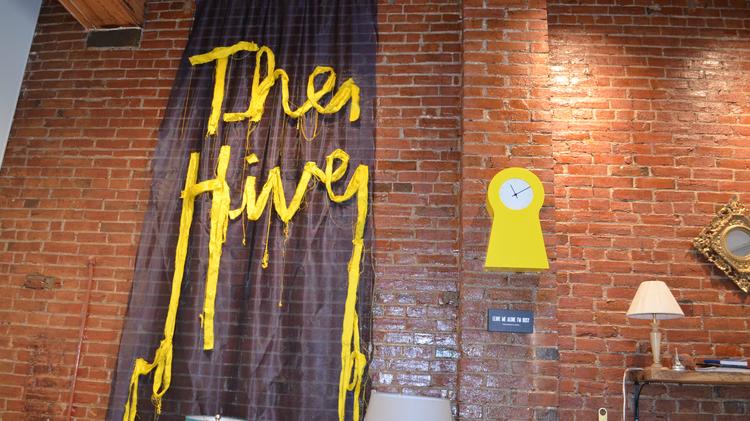
The Hive

The Hive.
The Hive
The Hive

Location: Race Street, Philadelphia, Pennsylvania, USA

Opened 2014

Closed: 2016

What a cool idea. Sorry to see this go.

From Philadelphia Business Journal:

Local coworking space for women shuts down

Jan 13, 2016, 2:09pm EST
Dan Norton Reporter
Philadelphia Business Journal

The Hive, an Old City coworking space fixed toward women entrepreneurs, will shut down at the end of January, Technical.ly Philly reports.

Melissa Alam, The Hive's founder, wants to shift her attention to other projects, but she will continue to produce programming under The Hive's brand.

Alam opened The Hive's doors more than a year ago, but now she wants to spend more time working on her quarterly food publication called Spoonful Magazine. She sat down for a Q&A with the Business Journal right before she signed the lease in September 2014 on the 200 block of Race Street.

Alam graduated from Temple with a marketing degree in 2010. After a couple of years at a digital agency job, she quit in favor of a life in entrepreneurship and freelancing.

The co-working space's closure is nothing new in Philadelphia.

Several coworking spaces and incubators haven't been able to sustain certain business models in the region, including Venturef0rth, Impact Hub and Seed Philly.

Saturday, May 30, 2015

Club Libations

Club Libations
Club Libations
Location: 231 North Broad Street (some sites say South Broad Street), Philadelphia, Pennsylvania, USA.

Opened: 1998 or before?

Closed: 2009?

From what has become my gold mine for lost lesbian bars, Clubfly:

Type: Lesbian Club
In a nutshell: A rare find and dance club for lesbians of color. Open Friday and Saturday nights...


This truly is a "rare find" as I seldom find lesbian space that is predominantly for Black women or women of color. Of course, Clubfly reports that it is now "closed," but with no date.

Here is more from Philly2Night:

A rare find and dance club for those who range from gay to straight with everything in between. This upstairs hideaway is the ultimate girls for girls' night scene. Not your typical underground finding above a Northern Italian restaurant. Known as Libations, it is a local change from popular LGBT night spots.

So we also find out that not only was this lesbian space limited in time (Friday and Saturdays only), it was limited in space, i.e. confined to the second floor--a familiar location for dedicated readers here at Lost Womyn's Space. This is a very familiar pattern existing from at least the nineteenth century and the era of ladies restaurants and ladies dining rooms, which were nearly always placed on the second floor above the "main" (men's) facilities. Also reminiscent of racial segregation in general, and the way in which Black patrons were often limited to the balconies in movie theaters.

The more things change, the more they stay the same. We may have the right to vote, the right to go to college (if you are willing to go deeply in debt), but the overall spatial pattern of pushing (limited) women's space to more marginal real estate (i.e. the second floor, which may be accessible by stairs only) remains.

GayCities adds a few more details:

Upstairs women's bar and nightclub
Dark and dive-y, this bar, upstairs from a Northern Italian restaurant is popular with ladies on the weekends. The dress is upscale.

Tags: Mostly Women, 20-somethings, 30-somethings, African American, Dancing
 
Fortunately, GayCities also has some customer reviews which are always nice to have. Sadly, they also document the entrenched racism/sexism that still exists in the GLBT community:
 
From October 2009:
 
coming to philly
IM COMING TO PHILLY THIS WEEKEND AND I BEEN TOLD THIS IS THE SPOT FOR LESBIAN WOMEN OF COLOR...LET ME KNO WHATS UP
 
From January 2008 (PhillyStud9):
 
Not what it used to be
Libations has now become the kiddie club to hang out at on Friday and Saturday night. Back in the day(1998-1999) it was great, all races, all ages. Not is just the menatlly young black crowd that is not worth the $5 cover charge....
 
Also from January 2008 (SoulSista):
 
Can we do better ?
First, Libations isn't a nightclub...its a bar that's gay on the weekend. This bar is definitely not for the mature crowd and the people there are not social at all. Most just stand against the wall with a scowl on their face. While I waited for my sweety to get her drink, I looked around the bar at all the depressed faces. My fiance and I went because we wanted to get out of the house...bored as we usually are in this city. Sadly Libations and Sister's shows the racial divide in the community. if you are looking for fun, smiling faces, diversity and great atmosphere..skip this club.
 
Sister's was another lesbian bar in Philadelphia--now lost as well (2013). 
 
And finally, here is a great narrative from April 2007 by Nigia at uwishunu:
 
The dramatically narrow, dark staircase at the top of Philadelphia restaurant Upstairs At Varalli, reveals that the underground scene has emerged. Located at Broad and Locust, it is a light at the end of the tunnel for Black and Latino lesbians looking for an underground scene. This upstairs hideaway is the ultimate girls for girls’ night scene. Not your typical underground finding above a Northern Italian restaurant. Known as Libations, it is a local change from popular LGBT night spots. The night club is also an alternative scene for hip-hop and R&B lovers. This club mixes up the local Philadelphia LGBT scene and puts a definite twist on Philadelphia night life.

Libations is an experience of real underground Philadelphia nightlife. The life that many thought only existed in cities like New York, D.C and Atlanta. The club blends the intimacy of a small 21 plus venue with the atmosphere of a dance heavy mega-club. The walls sweat in hip-hop and R&B rhythms that keep the crowd moving and when it dies down to a simple two-step, female bar tenders serve up the best, only to rejuvenate the crowd who always finds its way back to its dance floor.

So yeah, it is definitely not an ambiance for the mild with a cultural scene that exudes of modishly chic women and flair. This Friday and Saturday night hang-out has a sound and a style that calls for you to roll out of the house in only the best and latest attire. A style that creates a fashion playground that can range from diva avant garde to edgy androgynous. Let’s just say that with its pulsating realm and indulgence for eye catching ladies, Libations night club keeps its girls fully aroused.


Wednesday, October 1, 2014

The lies that are spread about the destruction of women's colleges

I found this notice at the savechatham site. For those of you know may not know, the administration at Chatham College (located in Pittsburgh, PA) recently made the decision to go coed. And as we see again and again, it was a decision made with a great deal of subterfuge and lying. The disinformation continues as history is rewritten--the new line being that the decision wasn't "controversial" with current students and alumnae. That is demonstrably false:

On September 29th, Time.com posted an article originally sourced from a website called The Hechinger Report. The article highlighted the fight against the Wilson College co-ed decision, but also commented on Chatham’s decision. In that article, Bill Campbell, VP of Communications and Marketing for Chatham, is quoted as saying the decision to go co-ed at Chatham wasn’t controversial [like Wilson]. We disagree.

In response to this misrepresentation, we have drafted a letter to the editor that will be sent both to the Time.com and The Hechinger Report to let them know that Chatham’s decision was indeed controversial and that we, as alumnae, still disagree with Chatham’s decision as well as the way in which the decision was presented, made, and alumnae relations were soured purposefully over many months.

We have included the text of our letter below, including the signatures already gathered from supportive alumnae. If you would like to add your name to this letter, please do so either through comments here or on our corresponding Facebook post.

Here is the link to the original article. 

Dear Editor,
In your September 29 article, “Why Women’s Colleges are Opening the Door for Men,” it was suggested that “At Chatham University, the decision to admit men was much less controversial” than the decision by Wilson College to become a coeducational institution. Chatham’s administration continues to believe that the opposition to their decision was limited to a “small, but passionate, group of alumnae,” but the momentum the Save Chatham movement built in a short time proves otherwise.

The Save Chatham movement, consisting of more than 2,100 alumnae and supporters, launched on social media just hours after alumnae and current students received an email from Chatham announcing the resolution. Save Chatham’s mission brought these women together to brainstorm ways to fundraise, increase enrollment, and to continue to provide future generations of women the option to become World Ready Women at Chatham. The short-term mission of Save Chatham quickly changed to focusing on delaying the June vote as Chatham’s administration increasingly disrespected and disregarded alumnae and refused to have open and honest discussions.

Chatham’s administration, particularly President Esther Barazzone, has unsuccessfully attempted to make this decision “much less controversial.” During the town hall meetings in March, Dr. Barazzone dismissed alumnae lines of questioning and obfuscated the facts when she did not want to answer questions. She rejected outright many of the solutions offered by alumnae, giving many alumnae the impression that the decision already had been made, a belief that was strengthened when promotional materials for the decision and its tenets were made public immediately after the vote. Peaceful protests on campus on April 23 resulted in alumnae being threatened with arrest and escorted off-campus by campus security. On May 1, the day of the Board of Trustees vote, alumnae, current students, and supporters were corralled into a “Free Speech Zone” by the very institution that taught many of us how to use our voices to stand up for what we believe to be right. Following the vote in favor of a coed Chatham, Save Chatham transitioned to the Chatham College Independent Alumnae Association in order to provide a safe space for alumnae to process the decision while still identifying with the former college. When it became clear that the new alumnae group would not be disbanding, Chatham University issued “cease & desist” letters to Chatham College Independent Alumnae Association administrators and threatened legal action if the group did not immediately discontinue using the name “Chatham” in its title, further alienating alumnae.

The Save Chatham/Chatham College Independent Alumnae Association lives on today as the Filiae Nostrae Society (FNS). The name is derived from the Chatham College motto “Filiae nostrae sicut antarii lapides: that our daughters may be as cornerstones.” The FNS provides disenfranchised alumnae of Chatham College for Women a place to call home and gives alumnae an opportunity to network, to shine the spotlight on them and their successes, to support institutions that value a women’s-only environment, to reinvigorate former relationships and to build new ones with women from former and current women’s colleges – all part of alumnae engagement that Chatham abandoned long before the vote.

Additional information, including documentation supporting the information outlined above, can be found at www.savechatham.com or Save Chatham’s Facebook page. Information about the Filiae Nostrae Society can be found at ourdaughtersourfuture.com.

Sincerely,

The Filiae Nostrae Society and supporting alumnae

Monday, August 4, 2014

Wild Sisters Coffee House

Wild Sisters Coffee House

Location: 2700 Jane Street, Pittsburgh, Pennsylvania, USA

Opened: 1982

Closed: 1985

Wow! Not often that you open your local paper and find an article about a former womyn's space.

From the Pittsburgh Post-Gazette, July 31, 2014:

1982: Pittsburgh’s first feminist bar, bistro and cabaret

Pittsburgh residents have always had a thirst for ale, good coffee and strong spirits.
James O’Hara, one of the city’s early settlers, was a successful businessman and real estate investor who, by 1803, was operating the Point Brewery on land now occupied by Point State Park.
In 1969, gay men and lesbians rioted outside the Stonewall inn in New York’s Greenwich Village. The women’s rights movement was in full flower and by the spring of 1975, local feminists wanted a place where women’s art could be seen and their voices heard.
So, they organized the Wild Sisters Coffeehouse to provide a performance venue that would showcase women artists, poets and musicians. Among the 15 founders were Dana Ventriglia, a trained carpenter, local lawyer Ann Begler and Felice Newman, then a University of Pittsburgh student and published poet. The coffeehouses were staged in various locations, including the Chatham College Chapel.
By July of 1982, the dedicated, determined women had raised nearly $55,000, enough to buy a liquor license and a South Side building located at 2700 Jane Street. The women invested lots of sweat equity by painting, sanding and plastering their new property.  Interior designer Janice Lott did the floor plan for the new establishment. Wild Sisters,  the first feminist bar, cabaret and restaurant in Pittsburgh, opened in 1982 .
Mary Pat Donegan, a psychotherapist, was president.
"When we first started, we put one ad in the newspapers — ‘Women Artists Wanted’ — and since that time we’ve been flooded by requests," Ms. Donegan told the Pittsburgh Post-Gazette in a 1982 interview.
Wild Sisters welcomed women and men. Patrons could get a drink, a bowl of soup, a piece of quiche or a sandwich and listen to music. The venue opened long before the letters LGBT entered the daily vernacular of American language.
John G. Craig Jr., the late editor of the Pittsburgh Post-Gazette, mentioned Wild Sisters in a column he wrote on July 27, 1985.
He called it “a South Side bistro with a sympathy for a liberated clientele.”
Wild Sisters closed in 1985 and became Bloomer’s, a bar, music venue and space for women’s art.  Next, the building hosted two Italian restaurants and a Mexican taqueria. Today, it is home to the Hot Metal Bridge Faith Community.
— Marylynne Pitz

Tuesday, June 17, 2014

Pittsburgh Dyke March

Pittsburgh Dyke March
Poster from the second Pittsburgh
Dyke March 2007

Location: Pittsburgh, Pennsylvania, USA

Opened: 2006

Closed: 2011

Here's a partial description of the first 2006 Dyke March here in Pittsburgh. From Sue at Pittsburgh Lesbian Correspondents:

Nearly 125 women of all ages, ethnicities, sizes and shapes turned out Friday evening for Pittsburgh's first-ever dyke march, a grassroots effort organized by two local queer women in less than one month.

The event kicked off with a rallyesque bang at the CMU lawn with some spoken word, a few djs and a lot of lady mingling.  We marched from CMU to Pitt and back along the Forbes/Fifth corridor.  The pace was a little fast for those of us who aren't uber-physical, but the energy was high as the parade participants chanted, cheered and enjoyed the delicious feeling of being amongst a crowd of women laying claim to the dyke mantle.

The organizers expected/hoped for about 40 participants especially as they relied mainly on word of mouth to promote the event.  They got well over 100 women, some reportedly driving in from West Virginia to attend.

The event grew out of frustration that most spaces in the local community are defined by men, either the men who attend or the men who own the actual space.  This holds particularly true for PrideFest where some sense that queer women are invisible.  Some women just opt not to participate in the LGBT community or travel out of state to attend dyke-friendly events.  Eli and Khalia, the organizers, chose to create dyke affirming spaces and settled on a dyke march to coincide with PrideFest.

***
I spent some time talking with both Eli and Khalia to get their perspectives on the value of creating dyke friendly spaces.  I found them both to be articulate, passionate and -- perhaps most importantly -- willing to take action to build the dynamics they think will strengthen the community.

What I did not find was any sense of man-hating or male-bashing or desire to completely disengage from the male homodynamic.  I did an informal survey at PrideFest about the Dyke March and found that a lot of the women who did not attend had heard these sort of rumors about the event and the organizers. Fortunately, they were willing to listen to our experience and expressed a genuine interest in participating in the future once we reassured them that no one was planning to castrate gay boys. 

These women have done a good job creating a dyke-affirming event.  The next challenge is to reach out beyond their circles of genderqueer women to all those dykes who didn't attend, didn't hear about it and are pretty much mainstream.  Their voices should be part of the dialogue because they too are being disregarded by those in power. There are lots and lots of suburban dykes in Pittsburgh complete with minivans, car seats and years of misogeny on thier backs (my emphasis). 


More on that later when I discuss why being labeled an assimilationist is not cool ...


Note that we are already seeing signs of trouble in Dyke March land--even in 2006. Dykes are "mainstream" and "misogynist" if they've ever had a kid or owned a car seat? But "genderqueer" white dudes with eyeliner (on the weekends) working in highly paid STEM jobs somehow aren't? Wow. Just wow.  Not to mention the tremendous anxiety about appearing "man hating." As if mainstream gay guys really give a f*** about woman hating or being inclusive in their bars, clubs, and organizations.

Let's skip forward two years to the description of the 2008 Dyke March. Contrary to the expressed wishes of the organizers, it doesn't sound like they have reached beyond the circles of "genderqueer women" to what are somewhat patronizingly referred to as "mainstream" dykes.


Pittsburgh Dyke March 2008
We will march down 5th ave, make a right on Liberty, right on William Penn Place, then head back around to Mellon Square park *Trans family welcome* *This march will be accessible, we will have a truck for those who would like to ride the march* After party At Donny's and Weezie's Brought to you by THE PINK PARTY PRODUCTIONS! With special performances by: Colelea Bekezela Joey Murphy Smells Like Gina Ya Lioness Homemade/Dyke made teeshirts and bags available Come on out! Let's make some noise and take up space! Visibility! Spread the word! Any questions, please message us at our myspace page The Pittsburgh Dyke March is personal, it's political. We are claiming celebratory feminist space for LBTQ (lesbian, bisexual, trans, queer) wimmin. Our realities and issues have been set to the side of the larger "inclusive" GLBT umbrella, and we've been told we must compromise. We've been told to assimilate to appropriation by corporate advertisers and sacrifice our interests to further the "greater good" of the gay community. As womyn loving womyn we are claiming this loving and political space, not only to celebrate the fierce radical spirit of the Stonewall Riots, but to remind ourselves that dykes are, and will continue to be, a revolutionary force to be reckoned with. How we organize and celebrate with one another matters, our love matters, our art matters, and dyke lives matter

Let's hop forward another two years to 2010. Even though it's still called the "Dyke March" there is reference to the "Dyke and Trans March" organizing committee. Also note, that leader/kick-off speaker is now a transwoman. So much for getting those uncool "mainstream" lesbians  involved. The ones who might have given birth or who have functioning vaginas or something icky like that:

This was one of my favorite LGBTQ events of all time. It was joyful, fierce, unified and humbling to wind our way through Bloomfield yesterday afternoon. 

Miranda Vey at Dyke March 2010
The event kicked off with a call to action from Dykes on Bikes founder, Miranda Vey.  She uses the term "queer patriot" to describe the power within dykes and other LGBT persons to claim their rightful place in society at large as well as the local gay hierarchy. I've heard Miranda speak before and she is very open as a transwoman (my emphasis) to name the privilege she took for granted as a white man before she began transitioning.  She's not afraid to talk about it and she's not intimidated in the least to turn around and call out those who continue to use it to hold down women, queers and other disenfranchised communities.

Miranda has been a longtime supporter of this event, helping to raise funds and bringing the dykes on their bikes to protect the march route when the police failed to show up.  She is a dyke hero, a powerful woman and a force to be reckoned with.

The march kicked off a few minutes before 3 PM and wound its way through Bloomfield, attracting a signifcant degree of attention from residents and business patrons alike.  People took pictures, video and simply stood watching as this colorful, eclectic group of women strode through the streets with signs, banners and a fierce determination to demand they be seen. 

I intentionally monitored the reacton along the sidewalks and it was a mixture of "you go girls" and amusement.  There was very little animosity with the sad exception of a ten year old child screaming "Git out of here yinz bitches." I think most people had no idea what was going on other than a group of very interestingly clad gay women were suddenly visible in a way Bloomfield never experienced.  (There were plenty of signs though).

In 2011, they were still giving lip service to this being a dyke march.

But by 2012, the pretense was dropped.


Pittsburgh Dyke & Trans March 2012

According to our sage LGBTQ&A March organizers here in Pittsburgh, dykes will no longer be granted space at Pride just for dykes. Instead of the Dyke March, we have the Dyke and Trans March. Which to my way of thinking is basically Everybody-Who-Is-Not-A-Standard-XY-Masculine-Gay Dude. Basically a dumping ground for all the "other" people. So much for a uniquely dyke visibility.

Thanks, guys! You want your sandwich yet?

And in this post I finally found out that the Dyke March organizer mentioned above, the one called "Eli," now identifies as a HE.  Not even as a "queer woman."

In 2005, queer activist Eli Kuti helped launch our region’s first-ever Dyke March. It was my first Dyke March and the first time I met Eli – megaphone in hand, urging folks to make some noise all the while keeping a keen eye out for safety issues. Over the years, the march has evolved to include Pittsburgh’s trans community – and is now officially the Pittsburgh Dyke and Trans March. Eli is a pretty awesome activist – he isn’t afraid to stick his neck out (my emphasis) and challenge the “cool” queers when he feels they present a threat of some type to more vulnerable folks in our community. At the same time, he is concerned that the dyke parents attending the march with their stroller and little kids feel safe and welcomed. That’s a good balance and it suggests why Pittsburgh may be one of the few cities in the nation that successfully fuses dyke identity with trans identities and comes up with a positive, powerful event that respects everyone. We aren’t the only city to have a blended type of march, but it is new terrain for many people.

So maybe we should just drop the "dyke" altogether. Because I'm not seeing much dyke leadership (much less dyke respect) in this thing at all. Just a lot of the same old queer rhetoric that once again succeeds in erasing and burying "mainstream" lesbians in the Giant Queer Melting Pot.

And notice how we have  come full circle. The first Dyke March was organized because of "frustration that most spaces in the local community are defined by men, either the men who attend or the men who own the actual space.  This holds particularly true for PrideFest where some sense that queer women are invisible."

And what do ya know. We end of with the most prominent leadership positions being held by a "queer woman" who now identifies as a man, and a transwoman who was raised and socialized as a man.

So much for an alternative.


Friday, June 13, 2014

The Vanishing: Why are lesbian places disappearing?

Important article. Lost womyn's space is getting more and more attention...for good reasons.

The Vanishing

Why are lesbian spaces disappearing, and what can be done to preserve our collective history?

The Vanishing
                
In the past two years alone, many cities have seen their last or only lesbian bar close up shop forever. If you can believe it, London, England, only had one, Candy Bar, and it closed late last year. At the end of last summer, Philadelphia lost its well-known, multi-floor bar, Sisters, after losing the less well-known Roy’s Comfort Zone the year previous. And early this year it was announced that The Palms, the nearly 50-year-old bar in West Hollywood, was closing. More last call stories stretch from Portland, Oregon, to Houston, Texas, to Chicago, Illinois. And yet, Oklahoma City keeps two lesbian bars up and running.

Read the rest here.

Thursday, May 1, 2014

Chatham College for Women

Chatham College for Women

Location: Woodland Road, Pittsburgh, Pennsylvania, USA

Opened: 1869

Closed: May 1, 2014

After all the debate and op-eds and protests, it finally happened. The Board of Trustees killed off Chatham College for Women today.  From today's Post-Gazette:

Chatham University to admit male undergraduates
     

Chatham University trustees this afternoon voted to end 145 years of tradition by opening the school’s undergraduate college to men, a controversial step that administrators say is vital to the institution’s long-term survival.

The college, founded in 1869, will see its first male students recruited for fall 2015.
The board made the decision during a meeting on campus, while 20 or more protesters in a "free speech zone" outside voiced their opposition to the move.

The board's action includes a reorganization of Chatham University by academic units and the creation of a new Women's Institute with $8.5 million in funding.

In a news release, Chatham President Esther Barazzone said, "Our thinking has been inspired by a more contemporary interpretation of Chatham's mission in serving society's educational needs while also honoring our commitment to women with the establishment of our Chatham University Women's Institute to address critical challenges for women in the areas of business, politics, health and leadership development."

The university declined to release the vote, but at a news conference later, Ms. Barazzone said it "was not unanimous but near unanimous." Five trustees were also at the news conference to express their support for the decision, including Jane Burger who called it "courageous."

The Women's Institute this year will start with $8.5 million, made up of various endowments, current funds and $2 million in newly raised commitments.

The announcement, however, was met with some disappointment.

Emily Newport Woodward, 45, of Carnegie, a member of the Class of 1990, was asked what she would say to the trustees and Ms. Barazzone if she had the chance. She responded that she would ask, "Why? What is the plan of our alma mater to succeed, because going coed is not an easy fix.

"Chatham is no longer special in this saturated market of colleges and universities. I find it extremely ironic that Dr. Barazzone was brought here to save Chatham in 1990, and now her legacy will be to have basically undone what she saved."

"The president that I had back then in the 1990s would throw this Esther Barazzone off the Rachel Carson Bridge," said Amanda Nedley, 37, of Upper S. Clair, Class of 1990. "They're too different, period. Bought and paid."

The announced resignation Tuesday of the college’s dean, Karol Dean, added to a sense among members of a group calling itself the Save Chatham movement that the vote was not likely to go their way. Its leaders posted a message Wednesday night on Twitter aimed at some 2,000 graduates who have signed petitions, offered research or provided other support since the proposal was announced in February.

“You stood up and spoke at town hall meetings with conviction, passion and grace about how alumnae could change the future of Chatham College for Women, had only we been given the chance,” it read.

Susan George, a Point Breeze resident who is a member of the Class of 1975, wanted the board to vote down the coed proposal or delay the vote. Joining other protesters in the "free speech zone," she said alumnae were not given enough notice that the college had an enrollment problem.

"This is a failure of leadership on the part of the president and the board," she said.
She said it was important to save the women's college.

"Going to an all-women's college was one of the most important things I ever did," she said. "It gave me the confidence and feelings of self-worth to go on and go to law school and become an attorney and practice law," said Ms. George, a former alumnae trustee.

As the board meeting time neared, the demonstrators decorated a cremation box with a purple and white Chatham banner from the days when it was a college and promoted the theme of "world ready women."

Jane Kelly of Sheraden, a 2012 Chatham grad who was wearing a purple #savechatham pin, said, "I'm here because I believe an educational environment with all women helps women."

Maria Lepre, a Regent Square resident who is a member of the Class of 1987, wanted the vote to be delayed so more alumnae can become involved.

"I'm here to help preserve single-sex education as an option," she said. "I have a 5-year-old daughter. I want her to grow up knowing she has a strong voice."

She said women's colleges are needed, noting women still don't have pay equality with men. "There's still progress to be made."

Some of those walking across campus were men enrolled in graduate programs.
Eric Rodriguez of Shadyside, who is working on a master's degree in biology, said he sees the economic necessity.

"The university is going to go away or they have to let men in," he said.

He said he wished the women's college could remain, saying it provides a "unique environment for females" who take their classes only with women.

However, of going coed, he said, "If they didn't need to, they wouldn't do it."

The members of Save Chatham have said alumnae stand ready to help raise additional funds for the all-women’s college, but some also  vowed to shift their donations to other women’s colleges if the vote to go coed was approved.

The coed idea is one component of a three-part proposal that trustees of the private campus reviewed in a closed session in the Eddy Theatre. The other elements included:

• Reorganizing the university by academic units and enabling undergraduates to secure spots upon admission into graduate programs.

• Creating a new Women’s Institute by combining existing centers for women’s entrepreneurship and women in politics with a new Women and Health program and the university’s Department of Women and Gender Studies.

Officials said the institute would include, among other facets, a women’s leadership certificate program, an all-women's residence hall with a focus on leadership, and research.

Chatham was founded under the name Pennsylvania Female College not long after the Civil War.

It has enrolled male graduate students for decades but kept its undergraduate college single sex, even as Chatham evolved into a university and as undergraduate females came to represent a shrinking part of the overall institution.

The college’s enrollment, which peaked at about 750 in 2008, is now closer to 500, a small fraction of the university’s nearly 2,200 students, officials said. The number of first-time full-time freshmen is half what it was in 2008 and is continuing to decline, of particular worry for a tuition-dependent campus already using its growing graduate programs to offset undergraduate losses.

In February, when Chatham announced that its board was pondering a move to coed, Ms. Barazzone cited “the difficulty of reaching a critical mass of students in contemporary times and the philosophical question of whether educating women alone continues to be the best way to give women a quality education in the 21st century."

Women are now in the majority on the nation’s college campuses. And only 2 to 4 percent of college-bound high school females say they want to attend a women’s college, a preference evident in the decline of women’s colleges across the U.S. from 200 in the 1960s to fewer than 50, Ms. Barazzone said.

Compounding matters were the recession of 2008 and population losses that have hit single-sex colleges especially hard.


Thursday, March 13, 2014

Roy's Comfort Zone

Roy's Comfort Zone (2007)
Roy's Comfort Zone

Location: 1412 West Huntington Park Avenue, Philadelphia, Pennsylvania, USA

Opened: At least as early as 2005

Closed: Till at least 2012

If you go by Clubfly, Roy's Comfort Zone was a clearly a lesbian place, no doubt about it--though now out of business:

Roy’s Comfort Zone Roy’s Comfort Zone Philadelphia (CLOSED)
1412 W Hunting Park Ave
Philadelphia, Pennsylvania 19140 
tel(215)324-7562
Type: Lesbian Bar
In a nutshell: Friday night watering hole for the ladies. The music is fair for the average gal just needing a drink to end a hectic week. Warning - parking is on the street, and it is on the north side...


Just one problem. There are not a lot of formal reviews that implicitly call this a lesbian place. Or even a gay place necessarily.

For instance, here's what Clubplanet has to say:

Roy's Comfort Zone is the type of place you start off your night. The drinks are cheap and strong but the crowd isn’t the type to get the party started. Grab a quick drink here and then head out to the real party. 

This place has/had such a low profile, that there are no reviews at yelp. Just mention of its existence.

Ah. Here's a clue. It was apparently still in existence during Pride Week 2012. And it appeared to cater to Black "sexy females":

Philly Black Pride Party

Friday Apr 27, 2012 8:00PM-01:00AM in Philadelphia   

Its that time of year PHILLY PRIDE, Sweeties is setting if off with old & new skool music, putting it down again. If you missed last years party, then you dont want to miss this years, if you want to see some of the hottest, sexiest females from Delaware, D.C., New York, and Atlanta then Phillys Black Pride is the place to be Roys Comfort Zone.
 
Oh. And then there's this news story. Not good.
 
Police are on the lookout for a man who opened fire in Hunting Park.  Investigators say the 38-year-old victim was hit in the leg at about 1 a.m. while he played video games inside Roy's Comfort Zone on the 1400 block of West Hunting Park Avenue.
The man who fired the gun then ran out of the bar and police are looking for him.

There's no word on any motive in the shooting.

Pay dirt. We finally locate some customer reviews at yahoo local from what appear to be Black lesbians. Here's what they say:
 
JewelzOhSoSexii 08/09/05:
 
I LIKE ROY'S JUST GET SICK OF SEEING THE SAME PPL!
 
buttercup 01/25/06:
                  
It was ok in there. I went there for the first time last fri and it was alright. It was very hot in there and not enough space but there were definitely alot of sexy ladies in the spot. Not to mention the music was aight!!!!
 
Mssweet31 04/30/06: 
                  
Yes I finally made and I had a ball!!!!!!!!!!! The music was good and the people were nice!!!! It was a good atmosphere and I definately will be goin again!
 
TreasureT 01/13/12:
                 
Wow I hear that something new is coming, the reopening of ROY'S COMFORT ZONE. P&C Productions wll be presentng a place for you to party again on every first[1st] and third[3rd] Friday of every month catering to the LGBT community. Starting Feb. 3, 2012 9pm to 2am. I hear from 9 to 10 its free but $10 to get in SO I SAY GET YOUR PARTY ON, you know get the party started some place for the family to party again:]
 
A lesser trafficked review site called gayscom also notes that Roy's is "Mostly Women."

We also hear that the food was good solid down-home cooking (no vegan quinoa sliders!). From foursquare:

 Sakinah T.· December 29, 2011

Turkey wings mac and yams 10$ best platter

Yum!

As far as I can tell, no business has replaced Roy's at this location. So is it still in operation? Given the lack of any reviews since 2012 and the clubfly notation, I'm going to assume not. If I'm wrong, y'all let me know.

Given the rarity of Black lesbian space, it was a real treat to stumble upon this one.

Wednesday, February 19, 2014

Chatham College for Women?

Chatham University
Chatham College for Women

Location: Woodland Road, Pittsburgh, Pennsylvania, USA

Opened: 1869

Closed: Could be co-ed in Fall 2015

Chatham College for Women isn't a lost womyn's space yet, but it is supremely endangered.

From yesterday's Pittsburgh Post-Gazette:

Chatham University considers enrolling men as undergraduate students


Chatham University, whose undergraduate college has been female-only since the school's founding in 1869, is considering admitting men for the first time in that college's history, officials confirmed Tuesday evening.

University president Esther Barazzone cited economic pressures and enrollment realities in telling a campuswide meeting of students and employees why Chatham has become the latest women's institution in Pennsylvania and beyond to consider going coed.

The university's trustees, meeting Friday behind closed doors, unanimously approved a resolution allowing for a period of study that could lead to a board vote by June, officials said. If the trustees approve the idea, the first men in Chatham's undergraduate programs could be enrolled by fall 2015.

Read the rest at the link for the Pittsburgh Post-Gazette above.

Last year, Pennsylvania lost another educational institution for women, Wilson College. (We posted about that here.) Seton Hall University began accepting male students in 1986. So women's colleges within the Keystone State are rapidly dwindling in number, leaving women students with fewer and fewer choices.

If this prospect concerns you, especially if you are a current Chatham student or alumna, make sure you contact the school and express your opinion now. Here is the email and phone for
Chatham president, Esther Barazonne:

Phone : (412) 365-1160
Email : barazzone@chatham.edu