Showing posts with label women's college. Show all posts

Wednesday, May 18, 2016

Midway College

Image result for midway collegeMidway College

Location: Midway, Kentucky, USA

Opened: 1847

Closed: 2016

The die-off of women's colleges continues. And once again, how alumnae feel about it is ignored.

From Inside Higher Ed:

Midway U Will Become Completely Coeducational

May 17, 2016

Midway University announced Monday that it will admit men to all programs. The Kentucky institution was founded as a women's college and already admits men to online, graduate and evening programs. The change will admit men to residential undergraduate programs that have until now remained for women only. The announcement from the university, which was until 2015 known as Midway College, noted the difficulty of attracting young women to single-sex colleges, and said that the undergraduate programs need more students.
On the college's Facebook page, many alumnae criticized the move. Wrote one: "As a second-generation Midway College graduate, I am very sad to hear that the Midway I knew and loved will never be the same again. And I am afraid this is not a good change."

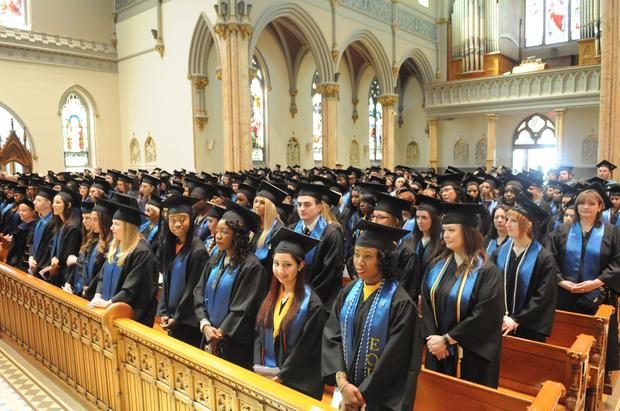
College of St. Elizabeth

CSE 2016 graduation
Students gather in the Holy Family Chapel on the campus
of the College of Saint Elizabeth
for a blessing before the 114th Commencement exercises.
             (Courtesy of the College of St. Elizabeth)
College of St. Elizabeth

Location: Florham, New Jersey, USA

Opened: 1899

Closed: 2016

And still, the number of women's colleges dwindles to just a few survivors....

From NJCom:

FLORHAM PARK — The College of St. Elizabeth's 2016 commencement on Saturday graduated the school's last class as an all-women's college.
Starting this fall, the only remaining all women's college in New Jersey will become co-ed.
Three hundred seventy-eight graduates including doctoral students in educational leadership received their degrees at the 114th Commencement on Saturday.
Col. Ingrid A. Parker, garrison commander at Picatinny Arsenal, gave the commencement address in which she challenged the Class of 2016 to make a difference in the world.
"As you leave the College of Saint Elizabeth today, you take with you your education and your place in society, as one of the fortunate people, who were able to attain a college degree,"€ she said. "The first thing is I encourage you to be strong, be audacious, and have a little tenacity. Go into your career fearlessly. Look for people who will help you along the way, you will need a network of support."
Maame Quainoo and Meredith Palmer, both of the Class of 20€™16, were selected from among their peers to deliver the student addresses.
Awards of Distinction were conferred upon the following students: Marissa Gioffre of Morristown received the Sister Elizabeth Ann Maloney Award; Marlyne Lamour of Maplewood received the Sister Jacqueline Burns Award; Sister Florence Akhimien of Ibadan, Nigeria received the Sister Elizabeth Houlihan Memorial Award; and Ashley Pledger of Randolph received the Hildegarde Marie Mahoney Award for General Excellence.

Wednesday, April 6, 2016

Simmons College MBA Program

The Main College Building on Simmons campus. (Hadley Green for WBUR).
Simmons College
Simmons College MBA program

Location: Boston, Massachusetts, USA

Opened:1975

Closed: 2015

Somehow I missed this at the end of last summer.

From WBUR:

Simmons College Closing Nation’s Only All-Women’s Campus MBA Program

August 27, 2015

By Curt Nickisch BOSTON

Simmons College in Boston is closing its campus MBA program, the nation’s only graduate management school solely for women.

School Dean Cathy Minehan told students and graduates at a campus meeting Tuesday that other MBA programs are aggressively recruiting women, and that Simmons is not big enough to compete in Boston as a brick-and-mortar business school. Instead, Simmons will offer an online MBA, for women and men, through an outside company, 2U.

Since 1975, Simmons’ School of Management has been giving women business skills, but also an understanding of how gender dynamics shape their opportunities.

College President Helen Drinan attended the Tuesday meeting and says while the incoming undergraduate class is the largest in the school’s history, admissions to the graduate business school have been falling.

One recent alumna at the meeting, Erin McElrath, called it “contentious and emotional” as dozens of graduates and some current students expressed shock at the move.

Some of them say that, considering the dearth of women on corporate boards and in technology companies, shuttering a women-only business school on the ground in the U.S.’ second-largest tech sector is a mistake.

C.A. Webb, a 2006 Simmons MBA and outgoing head of the New England Venture Capital Association, wrote in an email to Simmons administrators: “You’ll ignore the school’s founding mission and the fact that women are still woefully underrepresented in MBA programs and you’ll join the pack offering an online MBA, but with no strong differentiated brand to stand on. Good luck!”

But Dean Minehan, the former head of the Federal Reserve Bank of Boston, says transitioning to online by next year will help the management school bring its unique education around the country.

And Simmons Provost Katie Conboy said this week in an online message to alumnae: “An ongoing challenge for businesswomen is their very busy schedules, which require balancing many demands and can complicate their ability to travel to a campus to complete their degree. Many men face these challenges as well. In the national context, there are thousands of people who simply have no accessible campus-based options for an MBA. Our new online MBA programs will address this challenge directly.”

Tuesday, March 3, 2015

Sweet Briar College

Sweet Briar College
Sweet Briar College


Location: 134 Chapel Road, Sweet Briar, Virginia, USA

Opened: 1901

Closed: 2015

Another women's college has died.

A portion of a longer article from Inside Higher Ed:

Sweet Briar Will Close

March 3, 2015
By Scott Jaschik 
Sweet Briar College announced today that it is shutting down at the end of this academic year.

Small colleges close or merge from time to time, more frequently since the economic downturn started in 2008. But the move is unusual in that Sweet Briar still has a $94 million endowment, regional accreditation and some well-respected programs. But college officials said that the trend lines were too unfavorable, and that efforts to consider different strategies didn't yield any viable options. So the college decided to close now, with some sense of order, rather than dragging out the process for several more years, as it could have done.

Paul G. Rice, board chair, said in an interview that he realized some would ask, "Why don't you keep going until the lights go out?"

But he said that doing so would be wrong. "We have moral and legal obligations to our students and faculties and to our staff and to our alumnae. If you take up this decision too late, you won't be able to meet those obligations," he said. "People will carve up what's left -- it will not be orderly, nor fair."
 
While all employees will lose their jobs, the college hopes to offer severance and other support. Students (including those accepted for enrollment in the fall) will receive help transferring. This semester will be the last one at the college, but it will remain officially open through the summer so that students can earn credit elsewhere and transfer it back to Sweet Briar to leave either with degrees or more credit toward degrees.

Sweet Briar officials cited overarching challenges that the college has been unable to handle: the lack of interest from female high school students in attending a women's college like Sweet Briar, declining interest in liberal arts colleges generally and declining interest in attending colleges in rural areas. Sweet Briar is in the foothills of the Blue Ridge Mountains in Virginia. "We are 30 minutes from a Starbucks," said James F. Jones Jr., president of the college.
"We have moral and legal obligations to our students and faculties and to our staff and to our alumnae. If you take up this decision too late, you won't be able to meet those obligations."
--Paul G. Rice, Sweet Briar board chair
Jones said that these challenges intersected. Attracting students to a residential liberal arts college may require institutions to have extensive internship opportunities and nearby attractions. He stressed that the college's leaders and board considered every possible alternative -- including coeducation -- and concluded nothing would help in any way other than to delay the inevitable.

Sweet Briar was founded in 1901, and has operated as a women's liberal arts college throughout its history, known for small class sizes and close student-faculty interaction. The college is considered a pioneer in study abroad and operates a leading study abroad program in France. Sweet Briar's equestrian program is also nationally acclaimed.

Wednesday, October 1, 2014

The lies that are spread about the destruction of women's colleges

I found this notice at the savechatham site. For those of you know may not know, the administration at Chatham College (located in Pittsburgh, PA) recently made the decision to go coed. And as we see again and again, it was a decision made with a great deal of subterfuge and lying. The disinformation continues as history is rewritten--the new line being that the decision wasn't "controversial" with current students and alumnae. That is demonstrably false:

On September 29th, Time.com posted an article originally sourced from a website called The Hechinger Report. The article highlighted the fight against the Wilson College co-ed decision, but also commented on Chatham’s decision. In that article, Bill Campbell, VP of Communications and Marketing for Chatham, is quoted as saying the decision to go co-ed at Chatham wasn’t controversial [like Wilson]. We disagree.

In response to this misrepresentation, we have drafted a letter to the editor that will be sent both to the Time.com and The Hechinger Report to let them know that Chatham’s decision was indeed controversial and that we, as alumnae, still disagree with Chatham’s decision as well as the way in which the decision was presented, made, and alumnae relations were soured purposefully over many months.

We have included the text of our letter below, including the signatures already gathered from supportive alumnae. If you would like to add your name to this letter, please do so either through comments here or on our corresponding Facebook post.

Here is the link to the original article. 

Dear Editor,
In your September 29 article, “Why Women’s Colleges are Opening the Door for Men,” it was suggested that “At Chatham University, the decision to admit men was much less controversial” than the decision by Wilson College to become a coeducational institution. Chatham’s administration continues to believe that the opposition to their decision was limited to a “small, but passionate, group of alumnae,” but the momentum the Save Chatham movement built in a short time proves otherwise.

The Save Chatham movement, consisting of more than 2,100 alumnae and supporters, launched on social media just hours after alumnae and current students received an email from Chatham announcing the resolution. Save Chatham’s mission brought these women together to brainstorm ways to fundraise, increase enrollment, and to continue to provide future generations of women the option to become World Ready Women at Chatham. The short-term mission of Save Chatham quickly changed to focusing on delaying the June vote as Chatham’s administration increasingly disrespected and disregarded alumnae and refused to have open and honest discussions.

Chatham’s administration, particularly President Esther Barazzone, has unsuccessfully attempted to make this decision “much less controversial.” During the town hall meetings in March, Dr. Barazzone dismissed alumnae lines of questioning and obfuscated the facts when she did not want to answer questions. She rejected outright many of the solutions offered by alumnae, giving many alumnae the impression that the decision already had been made, a belief that was strengthened when promotional materials for the decision and its tenets were made public immediately after the vote. Peaceful protests on campus on April 23 resulted in alumnae being threatened with arrest and escorted off-campus by campus security. On May 1, the day of the Board of Trustees vote, alumnae, current students, and supporters were corralled into a “Free Speech Zone” by the very institution that taught many of us how to use our voices to stand up for what we believe to be right. Following the vote in favor of a coed Chatham, Save Chatham transitioned to the Chatham College Independent Alumnae Association in order to provide a safe space for alumnae to process the decision while still identifying with the former college. When it became clear that the new alumnae group would not be disbanding, Chatham University issued “cease & desist” letters to Chatham College Independent Alumnae Association administrators and threatened legal action if the group did not immediately discontinue using the name “Chatham” in its title, further alienating alumnae.

The Save Chatham/Chatham College Independent Alumnae Association lives on today as the Filiae Nostrae Society (FNS). The name is derived from the Chatham College motto “Filiae nostrae sicut antarii lapides: that our daughters may be as cornerstones.” The FNS provides disenfranchised alumnae of Chatham College for Women a place to call home and gives alumnae an opportunity to network, to shine the spotlight on them and their successes, to support institutions that value a women’s-only environment, to reinvigorate former relationships and to build new ones with women from former and current women’s colleges – all part of alumnae engagement that Chatham abandoned long before the vote.

Additional information, including documentation supporting the information outlined above, can be found at www.savechatham.com or Save Chatham’s Facebook page. Information about the Filiae Nostrae Society can be found at ourdaughtersourfuture.com.

Sincerely,

The Filiae Nostrae Society and supporting alumnae

Tuesday, July 22, 2014

Ewart College

Ewart College
Ernescliff College, the former
Ewart College

Location: Toronto, Ontario, Canada

Opened: October 11, 1897

Closed: September 1991, when it merged with Knox College, University of Toronto

The standard description of Ewart College provides the barest outline of the College's history:

Ewart College was a historical women's college located in Toronto, Ontario, Canada, affiliated with the Presbyterian Church in Canada. In September 1991, it merged with Knox College, University of Toronto.

Founded on October 11, 1897, it was then called the Ewart Missionary Training Home, later to be renamed the Presbyterian Missionary and Deaconess Training School. After a new building was constructed in 1960, it was renamed for Catherine Seaton Ewart; that building, located at 156 St. George Street, is now home to Ernescliff College.

Founded by women, the original purpose of Ewart was to prepare women for missionary service. In later years, it focused on diaconal ministry and Christian and lay education. Following the Presbyterian Church in Canada's decision to ordain women as Ministers in 1966, the college admitted male students in the 1970s, and in 1991, along with the merger with Knox College, many Ewart graduates have taken further studies to become ordained within the Presbyterian Church.

Ewart Chapel, housed within the Chapel at Knox College, is named after Ewart College, along with the McKay Educational Resource Room. The Ewart Centre for Lay Education at Knox College, an adult education program, is also named after the institution. It offers a certificate program in Christian Faith and Life.

Pam McCarroll-Butler tells us more about what Ewart College meant for women. According to McCarroll-Butler, women founded the school after "recognizing the Spirit's call to action." They challenged the Church's male monopoly on the "Ministry of Word and Sacrament" by providing women with training in Christian education and other specialized professions such as therapy, social work, and chaplaincy. Until women were finally allowed to be ordained in 1966, Ewart College provided a nurturing place where women could carve out their own niche of influence and power within the church:

The facts remain, however, that Ewart, in its final decades, was in the forefront of Christian education ecumenically, continued to be a safe place for women and was the central institution in the PCC [Presbyterian Church in Canada] wherein reflection on women's ministries occurred.

The extent to which the PCC devalues and patronizes the diaconal ministry, particularly the ministry of Christian education (the most central element to deep and meaningful faith) amazes me. I surmise that the voicelessness within the church courts imposed upon the diaconal order until 1991 was primarily a gender issue. Because the majority of diaconal ministers were women, the church tolerated their silence. This was, at best, a sin of omission for which, I believe, the church must seek forgiveness.

As McCarroll-Butler concludes,

In 1991, when the General Assembly voted to amalgamate Ewart and Knox colleges, the adopted motion read: "That the amalgamated college be known as Knox College." Ewart's gift passed unacknowledged, the name erased. The forgetting of the story had begun.

The story of Ewart needs to be named, celebrated and remembered both in its own right and for the transformative challenges it offers now. It is a story of the prophetic vision of women of the church. It is a story of women's lay and professional ministry within the PCC. It is a story which has shaped Christian education and educational methodology as we now know it. It is a story that witnesses to the Spirit's liveliness here in Canada. It is a story which includes many voices and experiences. It is a story of women who, at times against all odds, dared to heed the Spirit's call.


Once again, we see how critical a women's space was for not only allowing women to pursue their own spiritual path and learning, but in also providing a platform for challenging institutionalized male authority. We also see how by "merging" into a male-dominated institution--which included the erasure of the very name of that former women's space--that platform and that history and energy have been lost.

Friday, June 13, 2014

The Vanishing: Why are lesbian places disappearing?

Important article. Lost womyn's space is getting more and more attention...for good reasons.

The Vanishing

Why are lesbian spaces disappearing, and what can be done to preserve our collective history?

The Vanishing
                
In the past two years alone, many cities have seen their last or only lesbian bar close up shop forever. If you can believe it, London, England, only had one, Candy Bar, and it closed late last year. At the end of last summer, Philadelphia lost its well-known, multi-floor bar, Sisters, after losing the less well-known Roy’s Comfort Zone the year previous. And early this year it was announced that The Palms, the nearly 50-year-old bar in West Hollywood, was closing. More last call stories stretch from Portland, Oregon, to Houston, Texas, to Chicago, Illinois. And yet, Oklahoma City keeps two lesbian bars up and running.

Read the rest here.

Thursday, May 1, 2014

Chatham College for Women

Chatham College for Women

Location: Woodland Road, Pittsburgh, Pennsylvania, USA

Opened: 1869

Closed: May 1, 2014

After all the debate and op-eds and protests, it finally happened. The Board of Trustees killed off Chatham College for Women today.  From today's Post-Gazette:

Chatham University to admit male undergraduates
     

Chatham University trustees this afternoon voted to end 145 years of tradition by opening the school’s undergraduate college to men, a controversial step that administrators say is vital to the institution’s long-term survival.

The college, founded in 1869, will see its first male students recruited for fall 2015.
The board made the decision during a meeting on campus, while 20 or more protesters in a "free speech zone" outside voiced their opposition to the move.

The board's action includes a reorganization of Chatham University by academic units and the creation of a new Women's Institute with $8.5 million in funding.

In a news release, Chatham President Esther Barazzone said, "Our thinking has been inspired by a more contemporary interpretation of Chatham's mission in serving society's educational needs while also honoring our commitment to women with the establishment of our Chatham University Women's Institute to address critical challenges for women in the areas of business, politics, health and leadership development."

The university declined to release the vote, but at a news conference later, Ms. Barazzone said it "was not unanimous but near unanimous." Five trustees were also at the news conference to express their support for the decision, including Jane Burger who called it "courageous."

The Women's Institute this year will start with $8.5 million, made up of various endowments, current funds and $2 million in newly raised commitments.

The announcement, however, was met with some disappointment.

Emily Newport Woodward, 45, of Carnegie, a member of the Class of 1990, was asked what she would say to the trustees and Ms. Barazzone if she had the chance. She responded that she would ask, "Why? What is the plan of our alma mater to succeed, because going coed is not an easy fix.

"Chatham is no longer special in this saturated market of colleges and universities. I find it extremely ironic that Dr. Barazzone was brought here to save Chatham in 1990, and now her legacy will be to have basically undone what she saved."

"The president that I had back then in the 1990s would throw this Esther Barazzone off the Rachel Carson Bridge," said Amanda Nedley, 37, of Upper S. Clair, Class of 1990. "They're too different, period. Bought and paid."

The announced resignation Tuesday of the college’s dean, Karol Dean, added to a sense among members of a group calling itself the Save Chatham movement that the vote was not likely to go their way. Its leaders posted a message Wednesday night on Twitter aimed at some 2,000 graduates who have signed petitions, offered research or provided other support since the proposal was announced in February.

“You stood up and spoke at town hall meetings with conviction, passion and grace about how alumnae could change the future of Chatham College for Women, had only we been given the chance,” it read.

Susan George, a Point Breeze resident who is a member of the Class of 1975, wanted the board to vote down the coed proposal or delay the vote. Joining other protesters in the "free speech zone," she said alumnae were not given enough notice that the college had an enrollment problem.

"This is a failure of leadership on the part of the president and the board," she said.
She said it was important to save the women's college.

"Going to an all-women's college was one of the most important things I ever did," she said. "It gave me the confidence and feelings of self-worth to go on and go to law school and become an attorney and practice law," said Ms. George, a former alumnae trustee.

As the board meeting time neared, the demonstrators decorated a cremation box with a purple and white Chatham banner from the days when it was a college and promoted the theme of "world ready women."

Jane Kelly of Sheraden, a 2012 Chatham grad who was wearing a purple #savechatham pin, said, "I'm here because I believe an educational environment with all women helps women."

Maria Lepre, a Regent Square resident who is a member of the Class of 1987, wanted the vote to be delayed so more alumnae can become involved.

"I'm here to help preserve single-sex education as an option," she said. "I have a 5-year-old daughter. I want her to grow up knowing she has a strong voice."

She said women's colleges are needed, noting women still don't have pay equality with men. "There's still progress to be made."

Some of those walking across campus were men enrolled in graduate programs.
Eric Rodriguez of Shadyside, who is working on a master's degree in biology, said he sees the economic necessity.

"The university is going to go away or they have to let men in," he said.

He said he wished the women's college could remain, saying it provides a "unique environment for females" who take their classes only with women.

However, of going coed, he said, "If they didn't need to, they wouldn't do it."

The members of Save Chatham have said alumnae stand ready to help raise additional funds for the all-women’s college, but some also  vowed to shift their donations to other women’s colleges if the vote to go coed was approved.

The coed idea is one component of a three-part proposal that trustees of the private campus reviewed in a closed session in the Eddy Theatre. The other elements included:

• Reorganizing the university by academic units and enabling undergraduates to secure spots upon admission into graduate programs.

• Creating a new Women’s Institute by combining existing centers for women’s entrepreneurship and women in politics with a new Women and Health program and the university’s Department of Women and Gender Studies.

Officials said the institute would include, among other facets, a women’s leadership certificate program, an all-women's residence hall with a focus on leadership, and research.

Chatham was founded under the name Pennsylvania Female College not long after the Civil War.

It has enrolled male graduate students for decades but kept its undergraduate college single sex, even as Chatham evolved into a university and as undergraduate females came to represent a shrinking part of the overall institution.

The college’s enrollment, which peaked at about 750 in 2008, is now closer to 500, a small fraction of the university’s nearly 2,200 students, officials said. The number of first-time full-time freshmen is half what it was in 2008 and is continuing to decline, of particular worry for a tuition-dependent campus already using its growing graduate programs to offset undergraduate losses.

In February, when Chatham announced that its board was pondering a move to coed, Ms. Barazzone cited “the difficulty of reaching a critical mass of students in contemporary times and the philosophical question of whether educating women alone continues to be the best way to give women a quality education in the 21st century."

Women are now in the majority on the nation’s college campuses. And only 2 to 4 percent of college-bound high school females say they want to attend a women’s college, a preference evident in the decline of women’s colleges across the U.S. from 200 in the 1960s to fewer than 50, Ms. Barazzone said.

Compounding matters were the recession of 2008 and population losses that have hit single-sex colleges especially hard.


Sunday, February 23, 2014

Ottumwa Heights College

Ottumwa Heights College

Location: Ottumwa, Iowa, USA

Opened: 1864, as the Visitation Academy

Closed: Went coed in 1967, closed 1980

Once again, we see that going coed doesn't save a women's college from going out of business. From Wikipedia:

Ottumwa Heights College began as a liberal arts women's college based in Ottumwa, Iowa. It became coed in 1967. The school was affiliated with the Roman Catholic Church and was operated by the Sisters of Humility of Mary. Although the student body of the college was originally mostly Roman Catholic by the end of its existence a majority of its students were Protestant.
The institution was founded in 1864 as the Visitation Academy. In 1925, it was renamed the St. Joseph Academy. It received its first collegiate accreditation in 1928 and became known as the Saint Joseph Junior College, taking its final name Ottumwa Heights College in 1930. In 1936 St. Joseph School of Nursing became affiliated with Ottumwa Heights College. In 1957 the facility was destroyed in a fire and was rebuilt over the next 4 years. In 1967 male students were admitted to the college. Following this many more students lived off campus and in 1969 for the first time a majority of students were Protestants.
Ottumwa Heights merged with Indian Hills Community College in 1979 and was deemed officially inactive in 1980.

Wednesday, February 19, 2014

Chatham College for Women?

Chatham University
Chatham College for Women

Location: Woodland Road, Pittsburgh, Pennsylvania, USA

Opened: 1869

Closed: Could be co-ed in Fall 2015

Chatham College for Women isn't a lost womyn's space yet, but it is supremely endangered.

From yesterday's Pittsburgh Post-Gazette:

Chatham University considers enrolling men as undergraduate students


Chatham University, whose undergraduate college has been female-only since the school's founding in 1869, is considering admitting men for the first time in that college's history, officials confirmed Tuesday evening.

University president Esther Barazzone cited economic pressures and enrollment realities in telling a campuswide meeting of students and employees why Chatham has become the latest women's institution in Pennsylvania and beyond to consider going coed.

The university's trustees, meeting Friday behind closed doors, unanimously approved a resolution allowing for a period of study that could lead to a board vote by June, officials said. If the trustees approve the idea, the first men in Chatham's undergraduate programs could be enrolled by fall 2015.

Read the rest at the link for the Pittsburgh Post-Gazette above.

Last year, Pennsylvania lost another educational institution for women, Wilson College. (We posted about that here.) Seton Hall University began accepting male students in 1986. So women's colleges within the Keystone State are rapidly dwindling in number, leaving women students with fewer and fewer choices.

If this prospect concerns you, especially if you are a current Chatham student or alumna, make sure you contact the school and express your opinion now. Here is the email and phone for
Chatham president, Esther Barazonne:

Phone : (412) 365-1160
Email : barazzone@chatham.edu
 

Tuesday, February 18, 2014

St. Joseph's Female College

Patee Female College

St. Joseph's Female College

Location: St. Joseph, Missouri, USA

Opened: 1875

Closed: 1881

The Patee House, which was built in 1858 as a hotel, now operates as a  National Historic Landmark and museum. The location has had a variety of usages over the years, but what we're interested in here is that it once housed two private women's colleges: The Patee Female College (1865-1868) and the St. Joseph Female College (1875-1881).

Here's the standard write-up on St. Joseph derived from that "free encyclopedia":
 
Affiliated with the Baptist Church, St. Joseph Female College was opened in 1875 by the English-born Rev. Elijah S. Dulin. The college was located for most of its operating years in the Patee House, a hotel and office building. It had previously housed the Patee Female College from 1865 to 1868.
 
Patee House today
Patee House has historically been most commonly associated with the founding of the Pony Express in 1860, and the death of outlaw Jesse James nearby in 1882.

The college moved out of Patee House in 1880 and constructed its own building at a cost of $100,000 on a hill near the city's center. According to The Baptist Encyclopedia, the board of trustees was composed of the state's leading men, with Rev. Dulin serving as president throughout the college's life.

It's a pattern we've seen before with 19th-century women's colleges: no signs of any actual women! The president is a dude. The Board of Trustees were dudes. And it was short-lived. Big surprise. We often see this too, as the dudes really don't have much motivation for keeping a women's college afloat through all the challenges.

Mary Alicia Owen
And yet women students often transcended the oppressive educational and religious limitations put upon these schools, and creatively reworked the educational opportunities to their own advantage. 

One of these students was Mary Alicia Owen (1850-1935), who attended Patee Female College for three years. Most unusual for a Missouri frontier girl of the time (even a white girl from a fairly prosperous family), Mary then proceeded on to Vassar College, which was one of the few women's colleges of the time that offered women a liberal arts education that was comparable to the ones offered by the men's schools. (Alas, Vassar is no longer a women's college as it began admitting men in 1969.)  

Mary was intent on remaining independent and never married. She later became a writer and renowned folklorist, with a particular interest in local Native American and African-American folklore and "voodoo" (as it was called at the time). She has been described as "the most famous American Woman Folklorist of her time."

While growing up, her family owned slaves. According to the State Historical Society of Missouri,  

Mary would recall how she loved to listen to the myths and stories told by the slaves.  As an adult, she wrote about one slave in the household, Mymee Whitehead, who was a conjurer.  Conjure, or Hoodoo as it is sometimes called, is the African American folk practice of using spells or creating potions to ask the spirit world for help.  Mary loved to watch “Aunt” Mymee prepare special potions.  She sometimes helped by getting needed ingredients from her grandmother’s kitchen.

Mary says more about Mymee here:

Mary Alicia Owen around 20
Aunt Mymee gave me the first glimpse of her secret business by importuning me to get from my grandmother some amaranth seeds. When I insisted on knowing what she wanted with them, she acknowledged she wished to make them into a little cake which would make any who ate it love the one who handed it to him. That sounded reasonable enough to anyone as fond of all sorts of sweeties as I was, so I procured the seeds, and had the cake made up.

Not long after I heard other servants of the family say that Mymee had surely conjured me, for I followed at her heels like a dog that had eaten shoebread.

What she learned from Mymee Whitehead and later from another area conjurer named King Alexander, who was part African American and part Cherokee, was recorded in her first book: Old Rabbit, the Voodoo, and Other Sorcerers (1893).

Mary's life has been written up in a recent book by Greg Olson, Voodoo Priests, Noble Savages, and Ozark Gypsies: The Life of Folklorist Mary Alicia Owen (2012), so I'm not going to summarize it all here. Nor do I want to minimize the legitimate criticism that her work has received in recent years for its racist assumptions and connotations--though the same could be argued about all the other white anthropologists and archaeologists of the time, since these "disciplines" were essentially constructed around the exotic "other".

But as a woman who is little known today outside American folklore circles, it is still important to recognize her contributions and the role that women's schools played in sustaining her life.

Still, I wish we could hear Mymee Whitehead in her own voice, and that she could have had a school of her own....

Sunday, August 25, 2013

Michigan Female College

Michigan Female College 
Michigan Female College

Location: Lansing, Michigan 

Opened:1855

Closed: By 1880 at latest, when the property was turned into Michigan School for the Blind. Probably shortly after founder Abigail Roger's death in 1869.

Michigan Female College was founded by Abigail Rogers (1818-1860), a first-wave feminist. Unfortunatly, the College did not survive much beond the founder's lifetime--apparently because the school had no vision for sustaining itself beyond the time when women were finally admitted into the state universities. As Frank M. Turner states: "Her great work, the work on which she spent her whole life was the admission of women in to the University of Michigan and the Michigan Agricultural College on an equal basis with men." It appears, then, that the Michigan Female College was not much more than a means to that end. 

From the Michigan Women's Historical Center and Hall of Fame: 

Abigail Rogers was one of Michigan’s most distinguished and admired women of the 19th century. Her great work to which she dedicated her whole life was the admission of women into the state’s universities.

Educated and experienced in the administration of college-level education, Abigail and her sister Delia Rogers determined to open a school of the highest grade for young women in Lansing, “to keep before the public mind as constantly as they could, the duty of the State to provide for the education of its daughters as it had already provided for the education of its sons.”

Abigail Rogers
The Michigan Female College was founded in 1855, holding daily sessions in the capitol for two years until a permanent building could be obtained. By 1867, Abigail Rogers had helped to educate more than a thousand women from Michigan and nine other states, in both classical and scientific matters.

Thorough attention was given to instruction in all areas including mathematics, philosophy, and political economy, and the inability to pay was never an impediment. According to historian Eliza Smith, “No young woman anxious for improvement, but lacking means to meet the expense of tuition, ever stated her case in vain to [Rogers,] this true earnest friend of all who wished to help themselves.”

Upon her death in 1869, the Lansing Republican newspaper called Rogers “the acknowledged and leading champion of the higher education of women in Michigan.” Later that year, Michigan Agricultural College (now Michigan State University) admitted its first female student. The University of Michigan followed suit in 1870. 

Here's a description of the college course from 1858. Abigail and her sister obviously believed in academic rigor: 

Young Ladies applying for admission to the Classical Course, will be required to pass an examination in the following preparatory studies: Arithmetic (Stoddard's); Algebra, (through the sixth chapter of Davies' Bourdon); English Grammar, (Welch's Analysis); Geography; Physiology; History of the United States; Andrews & Stoddard's Latin Grammar; Arnold's First Latin Book, (Harkness edition); Arnold's Latin Prose Composition, (through forty exercises); Cornelius Nepos or Q. Curtius; Caesar, and Cicero's Select Orations; Kuhner's Elementary Greek Grammar; Xenophon's Anabasis, (Boise edition) to the Fourth Book; and Arnold's Greek Prose Composition.

In the Scientific Course, candidates for admission will be examined in all the studies preparatory to the Classical Department, except the Latin and Greek. Fifty Exercises in Fasquelle's French Method, the regular Verbs; and fifty Exercises in Woodbury's German Method will also be required.

The study of the Holy Scriptures will form a regular part of the whole Course, both Preparatory and Collegiate. The Text-Books named, are those which are used in the Institution, but an equivalent amount of knowledge is all that will be required of candidates for admission.

The entire expense of Board, including Fuel, Lights, &c., for the College year of forty weeks is.....$130.00

Tuition in the Preparatory Department, for English Branches, per term.....$10.00
Tuition in the Preparatory Department, for each of the Languages, per term.....$4.00
Tuition in the College Department, per term.....$18.00
"     "     Drawing, per term.....$4.00
"     "     Painting in Oil Colors, per term.....$16.00
"     on Piano or Guitar, per term.....$20.00
Use of Instrument, per term.....$5.00

The only extra charge will be twenty cents per dozen for washing.

Young Ladies are expected to furnish their own towels, table-napkins, napkin-rings and forks, and will be required to provide themselves with umbrellas and overshoes.

Sunday, June 16, 2013

Hellmuth Ladies' College


Hellmuth Ladies' College (c. 1895)

Hellmuth Ladies' College 

Location: Richmond Street North, London, Ontario, Canada

Opened: September 23, 1869

Closed: 1899

Hellmuth Ladies' College (aka Hellmuth College for Young Ladies) was a private college for women in London, Ontario. The college, founded by Reverend Isaac Hellmuth, was devoted to the study of arts and sciences. The college was complemented with Hellmuth College (for young men, founded 1865), also of London, Ontario. The ladies college closed in 1899, was purchased by the Sisters of St. Joseph, and transformed into Mount St. Joseph Orphanage. By the 1950s, it had become the Mount St. Joseph Academy for girls. The building was demolished in 1976.
Closing Exercises at
Hellmuth Ladies College (1886)

According to a short piece in the Scholastic Register (1869), classes were conducted in French though the school was run on "sound Protestant Christian principles." And while there were classes in the arts and sciences, all this had to be watered down with traditional training in femininity:

All the useful branches of female learning and "accomplishment" are provided, with the promise of special attention being given to moral and religious training. The old saying about national character being influenced by the education of the mothers applies more in a new than in an old country. 

Few names come up in the official accounts other than Reverend Hellmuth's. However, we are informed that the teachers would be headed by "Mrs. Mills, lately Lady Principal of Queen's College, London." (Queen's College, London--which opened in 1853--was England's first girls' school to be granted a Royal Charter for the furtherance of women's education. It still exists.)