Showing posts with label Missouri. Show all posts

Wednesday, March 20, 2019

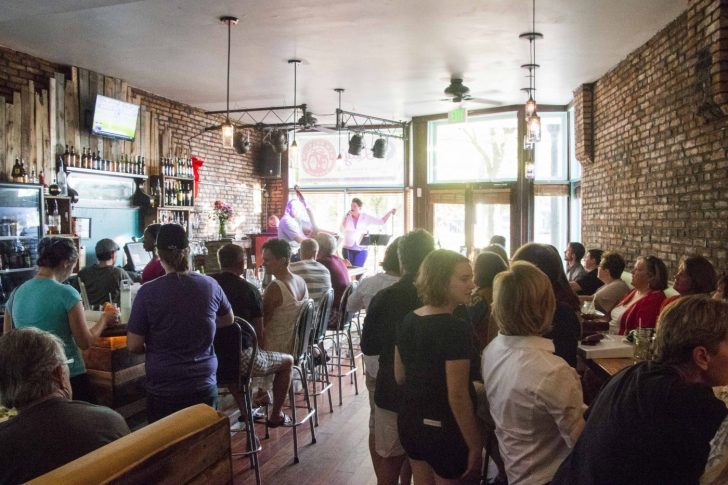
Lilly's Music and Social House

Lilly's Music and Social House

Location: 2321 Arsenal Street, St. Louis, Missouri, USA

Opened: July 2015

Closed: May 2016

From out in stl:

Excerpt from interview with Kristin Goodman: 

Can you tell me about the idea behind Lilly’s Music & Social House?
When we were getting ready to open Lilly’s, Novak’s had already been closed for two years. People — women in particular — were sort of at a loss, especially women who are in their late 30s and 40s and 50s. A lot of women in that age group are not out at work, or they’re not out to their families yet, so LGBT bars and spaces are really important for that age group.
When we were thinking about opening a place, I wanted it to feature a lot of light music and make it a place where that lesbian who lives out in Ballwin or Crestwood would feel totally comfortable.
Kristen Goodman singing at Lilly’s. (Photo by Sandy Gutierrez)
When we were brainstorming with the staff about our mission, we landed on “safe space for women, welcoming space for all.” That really was the driver for all of the decisions we made, from menu items to price points on cocktails to the atmosphere.
We probably were in the wrong-sized space for what we were trying to do. We’d have an awesome band on Friday night and be slammed, and people would come in and hunker down and maybe order dinner or a cocktail and then sit there and watch the band the whole night. With only about 40 seats in the place, we weren’t getting the volume that we needed to sustain us on a slow Tuesday or Wednesday night.
It was an amazing learning experience, and I was sad when it closed, but I don’t regret it. It connected people to other friends that they didn’t know before, and now they’re all still hanging out and doing their own parties and social gatherings.


Sunday, December 21, 2014

The Planter's House Ladies Restaurant

The Planter's House (1841-1887)
The Planter's House Ladies Restaurant

Location: Fourth and Pine, St. Louis, Missouri, USA

Opened: Hotel opened in March 1841

Closed: Hotel severely damaged by fire in 1887 and closed. Demolished in 1891 and rebuilt on the same site.

In an 1885 publication including St. Louis business cards, we find the following advertisement:


THE FINEST RESTAURANT IN THE WEST.
Is undoubtedly the Planters' House Ladies Restaurant. The MESSRS. GERARDI, Proprietors of the Planters' House, have taken special pride in furnishing it. It is exclusively for ladies, or ladies and their escorts. Ladies when alone feel entirely "at home" here, as they, perhaps, do not at any other restaurant in the city, and when on shopping tours from the suburbs find this a most desirable place. Try our strawberry shortcake and other delicacies.

Here we see a lot of common themes with women's spaces that bear mentioning.

First, is that the space is under the proprietorship (control) of men, not women. Women's spaces that are under the ownership, control, and/or management of women are a comparative historical rarity.

Second, this is not "exclusively" a women's space but is basically "coed"--this despite the name and the (deliberately) confusing use of the word "exclusively." How often do we see similar gas lighting and obfuscation around so-called women's spaces to this day?

This is in contrast to the hotel bar and other dining areas which were most likely reserved exclusively for men.

As we see again and again, the "ladies restaurant" is not just for ladies. It is (presumably) for ladies and their escorts, though we have also seen many examples where men who were not in the company of ladies tried to crash the place (see this example from Boston). Or men who seemed to somehow manage to dominate the "ladies café" anyway despite the so-called restrictions (see this complaint from a New York City lady and this analysis of a Chicago hotel ladies café.) Again, we see echoes of this in customer reviews for "lesbian bars" where reviewers note more men than women present.

And third, notice the subtle acknowledgement of how women, especially women alone, are threatened by men in public spaces including eating and drinking establishments. Though the emphasis is shifted away from women's realistic perception of danger to one of psychology (i.e. of "feeling" comfortable or "at home" here--as if this were a familiar women's domestic space, and not the men's public realm.)

Still, I'd love to sample the strawberry shortcake....Just for fun, here is one of the first recorded recipes for what we would call strawberry shortcake today. It was published by "Miss Leslie" in 1847--one of history's many forgotten women cooks.

In this history of the Planter's House (or Planter's Hotel), we're told that the hotel built after the 1887 fire also included a ladies dining room:

The main restaurant was considered the most elegant room in the city. It had many Doric columns and was decorated in tones of Empire green and silver. The hotel offered other elegant public rooms — the ladies' dining room, a sumptuous Moorish room, and various meeting and banquet rooms were much admired.

This last hotel closed in 1922.

Saturday, December 13, 2014

Fayetteville Female Seminary

Fayetteville Female Seminary

Location: Fayetteville, Arkansas, USA

Opened: 1841

Closed: 1862

Though the Fayetteville Female Seminary may not have been progressive in every way, it appears that Miss Sophia Sawyer was very principled when it came to equal opportunity for her students.  From the Fayetteville, Arkansas site:


Sophia Sawyer (1792-1854)
It [the Fayetteville Female Seminary] was founded by Miss Sophia Sawyer, a missionary teacher who had worked with the Cherokees in Georgia and then in the Indian Territory that would one day become Oklahoma. A private tutor for the Ridge family, she first came with them to Missouri and the Indian Territory, and then after John Ridge was killed, she came here with John's widow, Sarah.

David and Jane Walker gave the land for Miss Sawyer to open her new school. Miss Sawyer was very religious and apparently quite the taskmaster, but she adamantly insisted on teaching young girls regardless if they were white or Cherokee and by 1854 there were 103 students.

She was once confronted by the Georgia militia for teaching African-American slave children of the Cherokees to read. She told them in no uncertain terms to go away, saying she was not subject to Georgia law since she was in Indian Territory and that the Cherokees were too civilized to have such a law.


The school catered to young ladies of distinguished families from all over the region, and offered classes in music, literature, French, and embroidery. The seminary was one of the most influential institutions in early Arkansas, and is often mentioned as one of the factors leading to the location of the state's land-grant university, the University of Arkansas. One of the music teachers was Ferdinand Zellner, a Prussian violinist with P.T. Barnum's nationwide tour of the Swedish Nightingale, Jenny Lind. In 1856 he composed and published "The Fayetteville Polka", and later went on to conduct the San Francisco Symphony.


In spite of their best efforts to save them, the school buildings were also burned in the Civil War and the school never recovered.

See more about the life of Sophia Sawyer here.

Tuesday, February 18, 2014

St. Joseph's Female College

Patee Female College

St. Joseph's Female College

Location: St. Joseph, Missouri, USA

Opened: 1875

Closed: 1881

The Patee House, which was built in 1858 as a hotel, now operates as a  National Historic Landmark and museum. The location has had a variety of usages over the years, but what we're interested in here is that it once housed two private women's colleges: The Patee Female College (1865-1868) and the St. Joseph Female College (1875-1881).

Here's the standard write-up on St. Joseph derived from that "free encyclopedia":
 
Affiliated with the Baptist Church, St. Joseph Female College was opened in 1875 by the English-born Rev. Elijah S. Dulin. The college was located for most of its operating years in the Patee House, a hotel and office building. It had previously housed the Patee Female College from 1865 to 1868.
 
Patee House today
Patee House has historically been most commonly associated with the founding of the Pony Express in 1860, and the death of outlaw Jesse James nearby in 1882.

The college moved out of Patee House in 1880 and constructed its own building at a cost of $100,000 on a hill near the city's center. According to The Baptist Encyclopedia, the board of trustees was composed of the state's leading men, with Rev. Dulin serving as president throughout the college's life.

It's a pattern we've seen before with 19th-century women's colleges: no signs of any actual women! The president is a dude. The Board of Trustees were dudes. And it was short-lived. Big surprise. We often see this too, as the dudes really don't have much motivation for keeping a women's college afloat through all the challenges.

Mary Alicia Owen
And yet women students often transcended the oppressive educational and religious limitations put upon these schools, and creatively reworked the educational opportunities to their own advantage. 

One of these students was Mary Alicia Owen (1850-1935), who attended Patee Female College for three years. Most unusual for a Missouri frontier girl of the time (even a white girl from a fairly prosperous family), Mary then proceeded on to Vassar College, which was one of the few women's colleges of the time that offered women a liberal arts education that was comparable to the ones offered by the men's schools. (Alas, Vassar is no longer a women's college as it began admitting men in 1969.)  

Mary was intent on remaining independent and never married. She later became a writer and renowned folklorist, with a particular interest in local Native American and African-American folklore and "voodoo" (as it was called at the time). She has been described as "the most famous American Woman Folklorist of her time."

While growing up, her family owned slaves. According to the State Historical Society of Missouri,  

Mary would recall how she loved to listen to the myths and stories told by the slaves.  As an adult, she wrote about one slave in the household, Mymee Whitehead, who was a conjurer.  Conjure, or Hoodoo as it is sometimes called, is the African American folk practice of using spells or creating potions to ask the spirit world for help.  Mary loved to watch “Aunt” Mymee prepare special potions.  She sometimes helped by getting needed ingredients from her grandmother’s kitchen.

Mary says more about Mymee here:

Mary Alicia Owen around 20
Aunt Mymee gave me the first glimpse of her secret business by importuning me to get from my grandmother some amaranth seeds. When I insisted on knowing what she wanted with them, she acknowledged she wished to make them into a little cake which would make any who ate it love the one who handed it to him. That sounded reasonable enough to anyone as fond of all sorts of sweeties as I was, so I procured the seeds, and had the cake made up.

Not long after I heard other servants of the family say that Mymee had surely conjured me, for I followed at her heels like a dog that had eaten shoebread.

What she learned from Mymee Whitehead and later from another area conjurer named King Alexander, who was part African American and part Cherokee, was recorded in her first book: Old Rabbit, the Voodoo, and Other Sorcerers (1893).

Mary's life has been written up in a recent book by Greg Olson, Voodoo Priests, Noble Savages, and Ozark Gypsies: The Life of Folklorist Mary Alicia Owen (2012), so I'm not going to summarize it all here. Nor do I want to minimize the legitimate criticism that her work has received in recent years for its racist assumptions and connotations--though the same could be argued about all the other white anthropologists and archaeologists of the time, since these "disciplines" were essentially constructed around the exotic "other".

But as a woman who is little known today outside American folklore circles, it is still important to recognize her contributions and the role that women's schools played in sustaining her life.

Still, I wish we could hear Mymee Whitehead in her own voice, and that she could have had a school of her own....

Monday, October 14, 2013

Novak's

Novak's 

Location: 4121 Manchester Avenue, St. Louis, Missouri, USA

Opened: 1996

Closed: June 30, 2013

More from the Great Lesbian Bar Die-Off. Although I have read in other sources that Novak's had pretty much ceased to function as a lesbian bar by the end. From the STL Beacon:


Reflection: Novak's bar steps out -- with DOMA and in history

In Nation
6:42 am on Thu, 06.27.13
When Novak’s lesbian bar opened in 1996, same-sex sex was illegal, marriage equality was unheard of and I was a suburban stay-at-home mom, married to a man.
Curiosity compelled me to drive my white Aerostar minivan from Town and Country to Manchester Avenue in the city to see it for myself. The shame around even being curious about lesbian relationships made me bear down on the gas pedal a little harder as I whizzed past what was then known as Novak’s Fox Hole.
It would be a year before Ellen DeGeneres came out. And around the time Ellen declared, "Yep, I’m Gay!" on the cover of "Time" magazine, I declared "Maybe, I’m Gay!" — to myself.
Soon after, I strolled through the lesbian-looking glass of Novak’s, at 4121 Manchester Ave., to actually experience this wondrous, scary place where women danced and drank together and even kissed.
On Sunday, June 30 — Pride weekend Sunday — we will kiss this fabled institution goodbye. St. Louis’ iconic lesbian gathering place is shutting its doors. “I’m retiring,” Nancy Novak posted on the bar and grill’s Facebook page. Closing the post, Novak declares, “Let’s celebrate!!”
The celebration, the fun, the games were always at Novak’s. Drag shows, washer tournaments, karaoke, Pride brunch, Valentine’s Day, beer pong, celebrity dunking-booth fundraisers — you name it, it happened there. The fun began to draw gay men, straight friends and eventually everyone.
Nancy Novak
Nancy Novak
Novak’s was also the scene of countless individual dramas. Many a "You-kissed-my-girlfriend!" fight broke out on Novak’s dance floor. Many a good cry was had in the bathroom. Many a "Who’s THAT girl?" turned into a romantic evening, perhaps a relationship.
Hundreds, maybe thousands, of photos of Novak’s regulars literally framed the good — and bad — times, recording Novak’s history on its walls. It’s a history that dovetails with the nation’s.

When Vermont became the first state to legalize civil unions in 2000, it was drinks all around at Novak’s. When the U.S. Supreme Court in 2003 struck down the laws that criminalized same-sex relations, the beer flowed and the crowds cheered at Novak’s.
When Massachusetts legalized same-sex marriage in 2004, the clink-clink of glasses reverberated at the new across-the-street location of Novak’s. When Don’t Ask, Don’t Tell went down in 2010, it was bottoms up at Novak’s.
And Wednesday, when the U.S. Supreme Court overturned a portion of DOMA (Defense of Marriage Act), the liquor again flowed at Novak’s — in a kind of a circle. DOMA, enacted the year Novak’s opened in 1996, met its demise just days before Novak’s will.
Like a cultural bookend, DOMA defines the age of Novak’s. From the early days of this one-man/one-woman legislation to the legal recognition of same-sex marriage in 12 states and counting and the District of Columbia, Novak’s has borne witness to, and provided refuge from, the roller coaster of what it means to be lesbian, gay, bisexual and transgender in this country and in Missouri.
Now that Novak’s will be no more, it’s not clear where we’ll go to one day celebrate the legalization of same-sex marriage in Missouri. Maybe a new owner will re-open it, maybe they’ll even keep the name. But it will be a different place. Nancy Novak, the heart of Novak’s, first opened the bar at the urging of friends who knew the party was always at Nancy’s.
So Novak’s is closing. Ellen’s California marriage to Portia will be legal at the federal level after Wednesday's high court ruling. My Canadian marriage to my partner still doesn’t mean anything in Missouri but it will someday. Progress marches forward, leaving behind the joy, the sorrow, the bittersweetness — and a whole lot of great memories. And photos.
Tuesday, November 6, 2012

Baird College

Baird College
Baird College

Location: Clinton, Missouri, USA

Opened: 1885

Closed: 1898

Baird College was founded by Mr. and Mrs. Homer T. Baird in 1885 as a nonsectarian college for women. Classes began in 1890. The school was established on the scholarship plan, and the building was considered one of the best of its kind in the State of Missouri. For twelve years Baird College was regarded as one of the leading schools for young ladies in the West, the average enrollment being about 150. For reasons that are not identified, Baird College closed in 1898.

The school reopened in 1902 as the Clinton College for Young Ladies. But this school only lasted for a few years too. With the end of Clinton College came the end of this location as a womyn's space. The buildings were soon acquired by the Seventh Day Adventists, who set up the Clinton Theological Seminary (German Seminary). This existed from 1910 to 1925.

Despite the credit given to Mr. Baird in the official histories, Mrs. Baird was apparently the real moving force behind this school. In a 1904 obituary which does not provide her first name, we learn a bit about her life and the network of girl's schools and women's colleges that sustained her. We also learn that this woman was very experienced and accomplished as a professional educator and administrator. She was not a mere wife tagging along after a "Great Man." These are themes we've often seen here at Lost Womyn's Space.

She was a lifelong teacher of young women....Kentucky was her native state. The most famous school for young women in Kentucky when Mrs. Baird was a girl was that of Mrs. Tevis, at Shelbyville. In this school, she was educated. Missouri became her home. During the civil war she conducted a school at Springfield, Ill. After her return to adopted state she served four years as principal of Clay seminary, at Liberty. For six years she was president of Ingleside college, at Palmyra, and for a like period of time she served Hardin college, Mexico, Mo, as its chief executive officer. Baird College, Clinton, Mo, is so called in honor of this great woman.

Read more about Hardin College, another lost women's college, here.

Monday, April 9, 2012

Ladies Dining Room, St. Nicholas Hotel

Ladies Dining Room, St. Nicholas Hotel (c. 1905)
Ladies Dining Room, St. Nicholas Hotel (Victoria Building)

Location: 407 North Eighth Street (or 819 Locust Street), St. Louis, Missouri, USA

Opened: Built in 1893, remodeled in 1905 after severe fire

Closed: Not clear when ladies dining room closed, but building was demolished in 1974 for a parking lot.

St. Nicholas Hotel - before 1905 fire
To date, we've visited a variety of ladies dining rooms or cafes associated with some of  the "better" hotels and restaurants. So far, most of these have been in Chicago (Hotel Bismarck, Hotel Kaiserhof, Tom Jones Restaurant) or New York (Hotel McAlpin), but not all of them. As we've explained, women--especially unescorted women--were typically not welcomed in nineteenth century eating and drinking establishments. This was true whether it was a working man's saloon or a gentleman's club. As a result, separate facilities for the ladies arose.

But these were not strictly women-only spaces. In fact, illustrations and at least one woman's testimony suggest that these spaces were filled with their fair share of male "escorts"--"escorts" who may have outnumbered the women on at least some ocassions.

However, I still like to peer into old photographs or drawings of these places, these dining rooms where women (of the carriage class to be sure) were sequestered off from the "main" (male) dining areas. As this hotel was designed by the famous architect Louis Sullivan, the ladies dining room is certainly an elegant and lovely affair. And if I imagine taking tea there with my closest lady friends, I certainly sense that a perfectly pleasant afternoon is at hand. Even if it's in a room borne from segregation and the male domination of public space. An interesting paradox, that....Even a bird cage can be beautiful.

Billie Jean's

5012 Main Street today - a parking lot
Billie Jean's

Location: 5012 Main Street, Kansas City, Missouri, USA

Opened/Closed: 1980s

I don't know a lot about Billie Jean's, other than that it's mentioned in a March 20, 1994 article on the local gay community published in the Kansas City Star:

Jamie Straley, now a 27-year-old college student, remembers the first time she sneaked into the old Bille Jean's lesbian bar near 51st and Main streets.

"When the door opened and I stepped in, all of a sudden I felt like I wasn't alone anymore," she said. "It was like if you were in a foreign country and everybody spoke another language and you walked into a room where there were a bunch of Americans.
Billie Jeans logo
Billie Jean's logo - from GLAMA

It was just something that said: 'This part of you is normal.'"

In David W. Jackson's Changing Times, a history of Kansas City's gay and lesbian community, Billie Jean's is also briefly noted. He reports that this site was originally Le Bistro, another gay watering hole, but as of 2011, was a  parking lot for Andre's Confiserie.

Tuesday, April 3, 2012

Budd Park

Budd Park (1913)
Budd Park

Location: St. John Avenue and Brighton Avenue, Kansas City, Missouri, USA

Opened: Budd Park opened in 1891; section of park became women-only in 1916

Closed: Park still exists; when women-only section was eliminated has yet to be determined

The herstory of womyn's spaces tends to be one of elimination, burial, and subsequent amnesia. Budd Park's history as a woman-only space is a near perfect example.

Frankly, even I was astonished when I found this particular herstory nugget, as up until now I hadn't heard of any "official" women-only public parks outside the Middle East. And to practically trip over one in my own backyard, right here in my own hometown, was little less than jaw-dropping.

Needless to say, the official Kansas City Parks and Recreation narrative offers no clue:

Budd Park

Judge Azariah Budd moved to Kansas City with his wife, Nancy, in 1879 after working several years in law. He acquired 40 acres of land and spent his time clearing and cultivating it as well as raising cattle. Budd passed away in 1889 and willed 20 acres of his property to the City, if they paid his widow $3,000 annually until her death. The City accepted the property in 1891 and transformed it into Kansas City’s second park (the first being West Prospect Triangle, now known as Andrew Drips Park).

Nancy Budd donated four additional acres to the park 10 years later, and the City acquired two more after that. In 1896, John and Adriance Van Brunt designed a distinctive frame shelter building near
center of the park. Following this construction trees, maintenance buildings and steps were added to the park. A children's play area, tennis courts, roque courts and a wading pool and a swimming basin were later added.

From here, the official history skips to 1927, and how the Van Brunt frame shelter was torn down and replaced by one of native stone designed by Edward Buehler Delk.


Budd Park Shelter (constructed 1927)

Well, it turns out that a LOT that took place here between 1896 and 1927 has been slashed from the record.  

The first indication that there was a missing story here was this article (I stumbled up this while looking for information on the aforementioned women-only parks in the Middle East):

From the Crawfordsville Review, August 8, 1916:

PARK FOR WOMEN ONLY.

No Chance for Spooning in Kansas City Playground.

Kansas City, Mo.--A park exclusively for women was established by the Kansas City park board following the pleas of a business women's organization for a recreation and rest ground where women can enjoy themselves unmolested.

The site was chosen on a high point overlooking the Missouri river, where tennis courts, croquet grounds and a "Dutch oven" will be constructed and a shelter house built.

Wow! What was going on here? Where the heck was this park anyway? Shifting gears, I redirected my focus away from the Middle East and back to the Midwest so as to search anew.

Then I located this article. From the Telegraph-Republican, August 16, 1916:

KANSAS CITY CONDUCTS PARK FOR WOMEN ONLY

(By Special Leased Wire)

Kansas City, August Mo. 16. [sic] -Kansas City's park for women has just opened. The park board is about to have a temporary shelter house erected and other improvements installed in the section of Budd park set aside for the women.

Entrance to Budd Park (no date)
The Business Women's council has employed a young woman to remain at the park and minister to the comfort of the young women who come there for recreation. The secretary will see that the girls coming to the park become acquainted and enjoy themselves. She will pay special attention to lonely girls.

Double wow. Unfortunately, I can find nothing more from the comforts of home. May be heading into the dusty archives to follow up on this. Stay tuned.

But do take note of the very heterosexual imagery in the historic postcard reproduced above. This is a classic example of the great chasm between how public spaces are typically depicted (i.e. male-female couple strolling arm-in-arm, etc.) and what actually took place in and around these spaces. The actual story is one of women organizing to create a safe space for women within an urban public park, where women would be free from the sexual harassment and violence of men. Of women fighting for and winning official authorization and funding to construct recreational facilities and shelters for the exclusive use of women and girls, and even hiring a woman to befriend "lonely girls" and facilitate social connections between female park visitors. And all this before American women had the right to vote! But there is no pretty picture illustrating all that...

Monday, March 12, 2012

Kansas City Ladies' College

1500 North Liberty Street
Kansas City Ladies College

Location: Independence, Missouri, USA

Opened: 1871 as the Independence Female College

Closed: 1905

Very little information is readily available on the Kansas City Ladies' College.

However, we do have several names attached to the history of the Kansas City Ladies' College--and they all belong to men.

Civic leader William McCoy was one of these men. According to the Dictionary of Missouri Biography, McCoy "was one of the petitioners and board members for the Independence Female College, established in 1871 and subsequently known as as the Kansas City Ladies' College until its closing in 1905."

We're also told that William Chrisman, a successful Independence lawyer and banker, helped found the Kansas City Ladies' College and paid for the financing of the college’s principal buildings. However, no dates are given, though it is implied that this took place sometime between 1867 and 1875.

The Kansas City Public Library Missouri Valley Special Collections has a Catalog for the Kansas City Ladies' College for 1886-1887 and announcements for the 1888-1889 academic year. These documents are found in the rear of the Independence city directory for 1888-1889. Unfortunately, the contents are not available on-line.

Dr. James McDonald Chaney, an ordained Presbyterian minister, became president of the Kansas City Ladies' College in 1885. He left in 1891 when he assumed the presidency of Independence Academy of Missouri. According to his 1909 obituary in the Kansas City Journal, "Rev. Chaney, after severing his connection with the Kansas City Ladies' college, promoted an academy for young men at Independence, making a feature of higher mathematics." Implying I suppose, at least in the mind of Reverend Chaney, that higher mathematics wasn't an entirely suitable subject for young ladies.

The Boston Evening Transcript  reports that a Reverend George Frederick Ayres served as president of the Kansas City Ladies' College for a time, but the dates are not provided. However, it appears that it was just for a brief time after Dr. Chaney left, as Reverend Ayres assumed the presidency of  Lindenwood College (another lost womyn's space) in 1902, and for four years before that, he was a pastor in Poplar Bluff, Missouri. Reverend Ayres died in 1913.
Ad for Kansas City Ladies' College, Kansas City Journal, July 22, 1897

In addition, it appears that George Porterfield Gates, the grandfather of Bess Wallace Truman (Harry's wife), had dealings with the Kansas City Ladies' College, as there is mention of the college in his financial affairs records. Those records can be found at the Harry S. Truman Library in Independence.

In 1894, Colonel Harvey M. Vaile of Independence passed away and left his mansion (pictured above) to the Kansas City Ladies' College. The College promptly auctioned off the house's content to raise money. But it turned out that Colonel Vaile's gift turned out to be something of a Trojan horse. According to the Kansas City Journal (December 10, 1897),

The Vaile estate, which was bequeathed to the Kansas City Ladies' college, on condition that the institution be called Vaile Institute, is still in the hands of the administrator, and will likely continue to do so for some time to come. Since Colonel Vaile died, claims have been filed against the estate to such an amount that if the provisions of the will are carried out, Colonel Vaile's bequest will be his name without any financial aid. According to the terms of the will the institution was to assume the name of "Vaile Institute" within five years of the death of the testator. The time will expire within a year and unless the conditions are complied with the heirs may get a small percentage of the estate, which was once considered large. The estate is far from being settled up, and friends of the institution are of the opinion that after the administrator's fees and claims are paid nothing will be left for the college.  

According to this site, the Vaile mansion, which was constructed in 1881, is "rumored to be haunted."

Few juicy details are provided--other than that Mrs. Harvey Vaile apparently committed suicide in the home in 1883. It is claimed that her ghost can still seen looking out the windows.

Hmm....

Tuesday, February 14, 2012

Attitudes

Attitudes
Attitudes

Location: 4100 Manchester Avenue, St. Louis, Missouri, USA

Opened: 1988

Closed: Early 2012?

Playing with a title here. The Life of a Lesbian Bar in Three Acts: As Illlustrated by the "Best Lesbian Bar" Awards She Wins.

All right, I know. The title's not catchy in the slightest. Definitely needs to be tinkered with. But I think you get the gist of the idea.

In looking at the "Best Lesbian Bar" awards that Attitudes won in 2006, 2008, and 2010--and the write-ups that came with them--there seems to be a strong narrative progression: from strongly lesbian identified to, eh, maybe not so much. It's a pattern we've seen with lesbian bars before, either in response to financial pressures, changing socializing patterns, or just out-and-out invasion by other groups. 

You know what I mean by invasion, right? Straight men looking for a place to party and hassle the queer girls. Or to pick up bi/straight girls, since the bi/straight girls migrated to the lesbian bar to find a place to dance without being groped. Or gay/bi men looking for a novel place to go, 'cause God knows, having 25 gay male bars for every lesbian bar is just not enough! And before you know it, the lesbians are squeezed out, and the place becomes a lesbian bar in name only. Worse than that, it becomes a bar that some young or inexperienced lesbians think is a lesbian bar, so they develop a false sense of security. That can lead to problems with violence that are even worse than the straight bars. Why? Because the claim that they are "lesbian" can attract predators like moths to a backporch light.

So let's look at those Three Acts, shall we?

Back in 2006, when Attitudes first won the "Best Lesbian Bar" award from Riverfront Times, she was seemingly a lesbian bar from the tips of her chipped fingernails right down to her grubby little toes:

Attitudes is the Sandra Bernhard of lesbian bars: A little bit dirty and a little bit crass. Untamed and wild-eyed, teeth smudged with lipstick. When legs curl around its go-go cage bars it exudes sexiness, but it can intimidate, too, what with its raised-seating perimeter, which allows patrons to judge the moves on the scuffed dance floor. It has a cult following and a sense of humor; it's comical in its abrasiveness. It owns its kitsch and smirks at those who take themselves too damn seriously. It probably made out with Madonna in the '80s. It makes a commentary on sexuality but then breaks into a Britney Spears medley before the crowd grows weary. It's an excuse for bad behavior. It's St. Louis' best lesbian bar.

When she won the same award in 2008, however, it sounds like she was veering towards the "mixed" end of the spectrum:

Drag shows. Free darts and pool on Wednesdays, $2 beers all night on Tuesdays. The go-to watering hole for generations of the St. Louis gay/lesbian/transgender community. Despite its longevity, Attitudes ain't no stuffy old museum of queer culture. The old girl still vibrates with hip-hop and a diverse spectrum of lesbian clientele, from the urban to the old-school Melissa Etheridge T-shirt-wearing crowd. And make no mistake: Attitudes welcomes all comers. Especially if you like to dance.

And as she passed her 20-year mark, and was picking up the 2010 "Best Lesbian Bar" award from the Riverfront Times, a certain irony is immediately evident: Attitudes was sounding less and less "lesbian" as such.

This old girl, which has been comfortably ensconced in the Manchester strip in the Grove for more than twenty years, is about as friendly as a place can be, even if it's got a cage hanging in the back of the room. That's for dancing, by the way, which is what you come to Attitudes to do — that, and drink. Here, it doesn't matter if you're young or old, straight or gay, a drag king or queen or someone who just likes sparkly shoes. Even on weeknights, the place is jumping, one of the best parties in town.

So what do other sources tell us? Basically we see the same range of responses. When GayCities reviewed her, Attitudes was unambiguously lesbian, though of course "open to everyone."

Lesbian pub, cafe, and club
This neighborhood bar and dance club has a great energy and a diverse crowd. It is open to everyone, and features themed nights including karaoke and country line dancing.

We see something similar at clubplanet, though it appears that the drag queens are starting to muscle in on the scene. And there's a special "themed" night for the boys, because lord knows, the poor dears are so underserved in the St. Louis community: 

Attitudes - That’s right, for you ladies who like the ladies, and even for some of their fans, here's where you can go to meet your fellows. There's a C&W-themed night for the boys but this place is primarily for the girls. Drink specials, a dance floor and drag queens abound.

Then there's this description from citysearch:

The Scene – Though Attitudes is primarily a lesbian bar, the boys are more than welcome and the crowd is usually mixed. Inside you'll find a pub, a cafe and a club, though the dance floor's not huge. – – What to Do – Tuesday features darts, Wednesday has karaoke and Thursday's pool tournament night. There's a happy hour on the weekends, plus more karaoke and country line dancing on Friday night. All this and food, too--the cafe's got a new menu and serves from 7pm-1am.

Pondering this now....Is there a subtle difference or shift between being 1) a "lesbian" bar but "open to everyone" and 2) a "primarily lesbian" bar where "the boys are more than welcome" and "the crowd is usually mixed"? The latter doesn't even make a lot of intuitive sense. How can your be "primarily" lesbian if you're "usually mixed"? Even if lesbians make up of a numerical majority of patrons most of the time--and that's a big if--that doesn't necessarily make the bar "primarily" lesbian. To me, "primarily" sets a tone, a mood, and an expectation--it's not just an arbitrary standard of arithmetic. In other words, I'm not sure that 51 - 55 percent lesbian would necessarily get the job done. It may not represent enough critical mass.

This review from napkinnights shows a similar ambivalence and confusion:

Geared mostly toward a lesbian clientele, gay and straights are also welcome to this St. Louis bar. The club is sectioned off for a café, bar and dance area which makes it convenient to wander around to scope out the crowd without anyone knowing. Each night features a different activity from darts and pool to karaoke and country line dancing. St. Louis gays and lesbians come every night to enjoy the live DJ spinning great dance music after all the events end in the early evening. The drinks taste good and are strong at the same time, plus there's a cage to dance in. Those two things might not seem to go together, but give the drinks a try and it will make sense.

But in this review, we don't even bother to go through the hair-splitting, and ultimately metaphysical definitions of a "lesbian" bar (i.e. if only two lesbians are left in a bar, can it still be called "lesbian"? What if they're dancing on the head of pin?) We just report that Attitudes is a LGBT bar or "Gay and Lesbian Night Club" and call it a day:

The Grove is host to many alternative night clubs, but none quite like Attitudes. As St. Louis' oldest LGBT nightclub, this veteran hotspot certainly knows how to throw a party. Wednesday nights feature karaoke and a $10 all-you-can-drink special, while hip-hop night is the best way to bounce 'til 3 a.m. on Thursdays; Friday night drag shows are followed by a non-stop all night dance party on Saturdays. Between rounds of cutting a rug in the cage or on the dance floor, try the "Dueling DJ" or the "Diamond," two of the wettest, wildest concoctions 'tudes has to offer. There's a reason why Attitude's has oft been voted "St. Louis' Best Gay and Lesbian Night Club" -- it's a consistently energetic place for party people of all ages and orientations. Any of the uber-friendly staff members can tell you that. Just make sure that you keep any drama under wraps, or you might see an even sassier side of them. After all, it is called "Attitudes" for a reason.

The yahoo (travel) review is very similar to the one above, except we just say "gay and lesbian" bar (i.e. mixed) with a "large" crowd of straights (well, at least we're truthful):

One of St. Louis' most popular gay and lesbian bars, Attitudes also attracts a large straight crowd. It's a great place to relax and is a favorite after-work stop. The bar hosts eight televisions for sports fans to watch while relaxing over a glass of frosty beer. The large dance floor invites everyone to unwind and move to the music played by the disc jockey. Surrounding the dance floor are raised seats, mirrors and many lights. There's music here for everyone, from country to rock to golden oldies. For those who are not into dancing, there are dart games, a jukebox and karaoke. A small kitchen serves a few light items and burgers until closing on the weekends. Entry is restricted to persons over the age of 21.

So let's go down to the grassroots and see what the patrons report. Who was really at this bar, and how many of them were there? Just what was this place? Apart from all the complicated syntax and qualifiers, did anybody in the trenches ever consider this place a plain old lesbian bar? This time, just to mix it up a bit, we'll do this in reverse chronological order:

From GayCities, December 2011:

Its a mixed crowd with equal guys and girls.

From GayCities, June 2011:

GHETTO- HOT MESS- RUDE- PEOPLE!!!! ENOUGH SAID!!!!

From GayCities, June 2011:

over the years slowly fallen down hill and is now a wee bit getto

From yelp, April 2010:

There were transvestites -- lots of them!  I saw a large cross-dresser wearing an bright orange halter top, in which his man-boobs served the place of female boobs.  It was pretty glorious.  People were very uninhibited and just doin all sorts of wild stuff on the dancefloor.

From yelp, February 2010:

Though I'm straight and this is a gay bar, I've spent numerous a drunken nights dancing with the transvestites, some of which who look better than me, an authentic woman... and drinking with my girlfriends and gay friends and dancing the night away.

From yahoo (local), February 2010:

The bar seems to cater now towards the hip hop ethnic crowd.

From Voice Places, May 2009:

go-to watering hole for generations of the St. Louis gay/lesbian/transgender community

From Voice Places, January 2009

very welcoming gay bar. lots of straight people go here

From yelp, September 2008:

The crowd is very eclectic

From yahoo (travel), February 2008:

the people are great weather you are straight or gay or bi like me

From GayCities, February 2008:

The crowd was a little bit of everything--men and women of all ages.

From yahoo (local), December 2007:

Go in drag or in all leather it doesn't matter

From yahoo (travel), April 2005:

awesome place for gays/lesbians

From Citysearch, March 2004:

Crowded, broad age and orientational diversity

Lots of changes over the years...seems that over time, Attitudes acquired more gay men, transgender folks, and straights, and became somewhat more popular with African Americans (note quasi-veiled, racist references to "getto" and "hip hop" crowd). 

What you DON'T much see is that this was a lesbian place of any ethnicity or race. In fact, about  the only grassroots acknowledgement I have found that this was once a lesbian place comes from hawkeyes. By her account, Attitudes was no longer a lesbian place by June 2008:

i used to love attitudes but it has gone down hill,it used to be mostly lesbians and now it is to much of a mix of straight people and are younger and clickish and they dont make new people very welcome,you are losing alot of buissness to novak's we need to keep the lesbian bars alive because they are to few and far between. they need to cater more to the lesbian crowd with lesbian shows and events

Of course, the management did not heed hawkeyes' advise, as I see no real evidence that they ever courted or catered to their lesbian clientele in subsequent years.

According to a couple of websites, Attitudes is now closed, but no closing date is provided.

Monday, February 6, 2012

Kitty Kat Klub

Kitty Kat Klub
  
Kitty Kat Klub poster

Location: St. Louis, Missouri, USA

Opened: 1962?

Closed: 1960s? 70s?

I discovered the Kitty Kat Klub in a 2011 Riverfront Times article entitled "Treasure Hunters Seeking LGBT History." Unfortunately, nothing is really said about the Kitty Kat Klub. We're only provided with a reproduction of this wonderful poster (which we show here). The only explanation is a single caption accompanying the poster: "An old St. Louis lesbian bar poster."

Documentation of this place is sorely lacking. The St. Louis LGBT History Project includes the Kitty Kat Klub in its list of former St. Louis lesbian and gay bars and clubs, but no additional information is provided.

The only real discussion I have found of the St. Louis Kitty Kat Klub--not to be confused with the Minneapolis Kitty Kat Klub--is this one from November 2005, by a blogger named Rebecca:

Tuesday the 8th my Best friend Carrie came from St. Louis, Missouri to see me here in Michigan.  It was awesome just to hang out with her!  It is so cool how we haven't seen each other in like a year and everything is still the same with us!  I loved reminising with her about our old days with the Kitty Kat Klub....or maybe we should call it Citty Cat Club cause if we do it with K's it spells out KKK lol :)

Sharon at St. Louis Lesbian History mentions a lesbian bar called the Kit Kat that was founded in 1962. Regretfully, there are no other details. Same place?

Saturday, February 4, 2012

Push

823 Walnut Street
Push

Location: 823 Walnut Street, Kansas City, Missouri, USA

Opened: March 1, 2002

Closed: 2003

Push is one elusive lesbian bar. She shows up on some out-of-date websites listing (usually defunct) Kansas City gay watering holes, but not on others.

GLBTcentral does mention Push--along with a lot of other dead Kansas City lesbian bars like Tootsie's and Wetherbee's--but unfortunately all they tell us is that she's "Mostly Women; Lesbian Owned/Operated." Come on, people! We need details! Have some pity on the herstorians of tomorrow! Show us some love!

Gaytalk does a slightly better job. By navigating through their swarm of confusing symbols, we can decipher that Push is mostly women, that there is a dance floor, that it's a sports bar, that it has pool tables, that it has darts, and that its primary music is techno. Any questions?

But then the confusion starts. Gaygetter tells us that Push is a (mixed) "gay karaoke bar." Really?

So. Must dig deeper.

Oh! Here's an interesting factoid. The structure in which Push was located, the Waltower Building, was placed on the National Registry of Historical Places in 2001. Given that so many lesbian bars are stuck in raggedy @$$ ugly buildings, that is certainly noteworthy indeed.

A 2002 Kansas City Business Journal article on downtown Kansas City's reviving nightlife provides us with a few more useful details. We now know when Push opened for business--and the name of one of the co-owners:

"There'd been nothing to do Downtown for such a long time that people didn't consider coming down here at night," said Jill Schultze, co-owner of Push, which opened March 1 at 823 Walnut St. "But that's definitely changing."

But apparently the downtown scene wasn't changing fast enough to support a lesbian bar. (Though to be fair, a non-GLBT drinking establishment, the Stark Bar, had previously struggled and failed at that location.) Within a year or so, Push was out the door.

In a Kansas City forum, an interested citizen inquired as to her fate. This was in September 2003:

I noticed this week that the first floor-level space at 823 Walnut, formerly PUSH Bar, has been completely gutted. Does anyone know what's happening with that building? It's next to Scarritt Arcade and across the street from the old Fidelity/federal office building that is being converted into high-end apartments.

The correct answer, as it turns out, was that 823 Walnut was also being turned into housing. It is now Waltower Lofts.

Friday, February 3, 2012

Wetherbee's

Wetherbee's

Wetherbee's

Location: 2510 Northeast Vivion Road, Kansas City, Missouri, USA

Opened: 2004 at latest, and probably earlier

Closed: Around 2010 or 2011

Gaycities informs us that Wetherbee's is "mostly women" and that it's "a good place to hang out, shoot some pool and enjoy a few drinks." Kind of a Kansas City neighborhood dyke dive north of the river.

Fair enough. But it's hard to find many reviewers who concur with these points.

In a Gaycities customer review from September 2009, two local gay men seemingly affirm that yes, this was a women's bar. But as a drinking establishment, Weatherbee's didn't measure up to their exacting standards--though it might be "okay" enough for dykes (thanks, guys!):

If your a lesbian, then this bar is okay, but for gay men, forget it. It is located a LONG way North from downtown Kansas City and from all the other gay bars. Have been there three times and never again. They also have a cover (for absolutely NO reason).

As a point of geography, this is actually a noteworthy observation. Especially in the American midwest, lesbian bars are often pushed out of the "more desirable" (expensive) downtown "gayborhood" locations where the boys' bars are located. So they end up in "less desirable" (cheaper) sites in rundown strip malls on the outskirts of the city or in the deteriorating inner-ring suburbs.

Despite all that, it's interesting that other Gaycities reviewers didn't necessarily recognize Wetherbee's as a lesbian bar at all.
Wetherbee's interior (2010)

Take this assessment from March 2009:

There is a mixed could [crowd?] of people there's gay, lesbian, and straight. Only thing is the club is very grouped and every group stays to themselves.

Or this one from August 2009:

younger crowd very mixed group, straight

Over at Clubplanet, the reviewers weren't sure what kind of bar Wetherbee's was...since the spot was often deserted.

From April 2008:

went there about 9:30 stayed until 10:30 or so bartender was very nice but place was empty and i do mean empty bartender tolld me they wouldnt get people realy until midnight or so then would be busy till 3am closeing so if your an early bird like me it wont be worth it if you can hold out for midnight looked like it could be a fun spot

(The comment above reads more like free verse poetry than a bar review, but I digress....)

From August 2009:

I don't know what this place is. Some say it is a gay joint. I think the only way you would know for sure is if anyone showed up at this place. For a nightclub of whatever kind it is just about as dead as it gets.

There is some evidence that Wetherbee's was more popular as a lesbian bar earlier in the decade. For example, it gets an affirmative nod in a butch-femme forum in August 2004:

if you live (or are) up north of the river, check out Weatherbee's. I've certainly had some fun times there....although, I never can seem to get a pool table. ;)

Nearly two years later, it was still rated as a "great Lesbian hangout." From yahoo in May 2006:

Great Lesbian hangout: This is THE place for lesbians in KC. There are all types of us there. It's great to have a fun, energetic social sceene. Food, drink, pool, darts, dancing, and the occasional show!

So what happened? Like Tootsie's, another former Kansas City lesbian bar, it seems that Wetherbee's was overtaken by sleezy straight dudes and the lesbians stopped coming. A commenter from August 2006--just three months later--documented the transition. This is also from yahoo:

Its not the safest place to go.: The club use to a be a great place to go and dance with no worries of of anyone bothering you or any problems. But lately I dont go because of all the guns and fight. I dont like to go out and have someone just grab me. I dont feel safe any more. And that is sad because a like the staff and the music. Now its more straight men. And they need to go to there own bars and let us have a few bars that we can be ourselves.

It's enough to make you throw up your hands in despair.

Gaycities does report that Wetherbee's is now closed, though no date is provided. The last customer comment I find is dated 2011; the earliest are from 2004. So I presume that Wetherbee's existence spanned those years at a minimum.