Showing posts with label Boston. Show all posts

Tuesday, January 15, 2019

Harvard University Women's Organizations

Harvard University Women's Organizations

For background, see this article: Harvard Cracks Down on All-Male Clubs. But It’s Women’s Groups That Have Vanished, by Sarah Brown. 


Women at Harvard protested the administration's effort to discourage
membership on gender-exclusive student groups.

Here are the first few paragraphs from Brown's article: 

Just over a year ago, Harvard University's leaders made an announcement that they hoped would be the final word, for the time being, in a lengthy debate over the future of campus social life.

Starting with the freshman class in 2017, any student who joined a single-gender social group — like one of the university's exclusive final clubs, or a fraternity or sorority — would face restrictions. Members wouldn't be able to hold leadership positions on campus, serve as captains of athletic teams, or receive Harvard's endorsement for postgraduate scholarships like the Rhodes and the Marshall. The groups could avoid the sanctions only if they went coed.

Technically, the policy had been unveiled in May 2016. But after 18 months of contentious conversations, Harvard's governing board finally voted to approve the restrictions. The board's action would, in theory, institute the policy beyond the tenure of Drew Gilpin Faust, the president at the time, who stepped down this summer.

To some observers, the demise of exclusionary social groups on college campuses makes a lot of sense. As student populations diversify, administrators are growing more aware of the need to foster inclusive environments, not ones segregated by gender and class. At Harvard, the men's final clubs in particular seem like vestiges of a university from an earlier era, when the student body was whiter and wealthier than it is today.

So on the surface, it would be easy to dismiss the lawsuits filed against Harvard by Greek organizations last month as a last-gasp effort. Privileged people are digging in their heels in the face of threats to their privilege, the argument goes. The suits are accompanied by a national campaign and petition, with an extensive website that purports to tell "the Truth" about single-gender social organizations. Some sorority chapters at other colleges have encouraged members and alumni to sign on.

But the sorority members who have become the loudest voice in favor of the lawsuits argue that their fight isn't about protecting privilege at all. It's about protecting women.

Harvard officials have said their crackdown on social groups was designed to do just that. In their view, all-male final clubs encourage misogynistic behaviors and create problematic environments for women. The solution? To discourage the behavior at the source.

Since the university couldn't singlehandedly eliminate private, unrecognized, off-campus organizations, administrators put in place the strongest disincentives to joining that they could come up with — and that would, they hoped, pass legal muster.

The women, on the other hand, say that the administration's approach to halting gender discrimination has endangered gender-exclusive spaces that weren't part of the problem. In fact, those women say, such groups remain necessary on a campus where issues like sexual misconduct persist.


Since the policy took effect, it's the sororities and women's final clubs that have disappeared, while most of the men-only groups continue to operate. This fall, all four of Harvard's sororities shut down. One recently reopened, but with a small fraction of its former membership. The six female-only final clubs have all started the process of going coed. (EMPHASIS ADDED)

This is a phenomenon often seen with regard to women's space. When push comes to shove, liberal feminist efforts to allow women into centers of male power will be countered by a male backlash of the same. The end result: nodules of men's spatial power remains, while any remnant of female space, no matter how apparently innocuous (like a sorority) will be destroyed. 

Here are additional points brought out in the article that are worthy of note: 

* "The current social scene at the College revolves around deeply entrenched systems of power," reads the February 2017 report of a committee convened to figure out how to carry out the policy. "Men's final clubs in particular can leverage the historical dominance of gender, class, and race to preserve that power."

No kidding. And notice that efforts to help support the women within this unequal playing field were cancelled:

* One committee suggested that Harvard have a five-year "bridge" period for women's groups, during which they could continue to "operate with gender-focused missions" and make the transition to an arrangement in which they were recognized by the university and yet "entirely unconnected from the typical Greek system." But last March, administrators canceled the "bridge" program.

Of course. Not surprised. 
Then we have the "you girls have to suck it up because that's the only way to achieve our feminist goals" argument. Never mind that the boys aren't sacrificing much of anything, while the women are asked to give up everything. 

* A November 2017 statement signed by 23 female students said Harvard's premise "has been that women must not be allowed to join groups without men — for their own good — because it is the only way to 'get at' men's final clubs." Women's protests of the policy, they wrote, "have been met with the response that women groups are unfortunate collateral damage for a more noble cause — this cause of protecting them. This is egregious."

And then the result. We kill off women's groups, a few men's institutions go coed, and the rest of the men's organizations thrive. Because they are men, and they don't have to obey any rules made by freaking liberals or feminists. Right?

* In the spring, interest in sorority recruitment dropped by 60 percent, according to the Crimson. By August, the newspaper reported, there were no longer any women-only social organizations. One, Alpha Phi, has since reopened; the sorority is part of one of the lawsuits against Harvard. The chapter's membership peaked at 160 women in 2017, according to the suit. Now there are eleven women who "have rejoined or expressed interest in rejoining." Four men-only groups have gone coed over the last couple of years. But nine others, mostly final clubs, continue to operate.

At least some sort of get it, though they kind of tip toe around the central issues. 

* Why was the impact on women's groups so much greater? Women's groups weren't as well established in Cambridge, said Emma Quinn-Judge, a Boston lawyer who is lead counsel for one of the lawsuits against Harvard. Men's final clubs have been around for centuries and have large alumni networks and resources that can help them survive in challenging circumstances.

But still the central problem remains. Integrating a few women within male power centers without a strategy for dealing with, diffusing, or eliminating male power generally results in a backlash/mess. The result: the boys still have their exclusive power clubs where they can be groomed for entry into the elite halls of governmental/corporate power. Whereas women can't even have a little A Capella singing group. 

Wednesday, April 6, 2016

Simmons College MBA Program

The Main College Building on Simmons campus. (Hadley Green for WBUR).
Simmons College
Simmons College MBA program

Location: Boston, Massachusetts, USA

Opened:1975

Closed: 2015

Somehow I missed this at the end of last summer.

From WBUR:

Simmons College Closing Nation’s Only All-Women’s Campus MBA Program

August 27, 2015

By Curt Nickisch BOSTON

Simmons College in Boston is closing its campus MBA program, the nation’s only graduate management school solely for women.

School Dean Cathy Minehan told students and graduates at a campus meeting Tuesday that other MBA programs are aggressively recruiting women, and that Simmons is not big enough to compete in Boston as a brick-and-mortar business school. Instead, Simmons will offer an online MBA, for women and men, through an outside company, 2U.

Since 1975, Simmons’ School of Management has been giving women business skills, but also an understanding of how gender dynamics shape their opportunities.

College President Helen Drinan attended the Tuesday meeting and says while the incoming undergraduate class is the largest in the school’s history, admissions to the graduate business school have been falling.

One recent alumna at the meeting, Erin McElrath, called it “contentious and emotional” as dozens of graduates and some current students expressed shock at the move.

Some of them say that, considering the dearth of women on corporate boards and in technology companies, shuttering a women-only business school on the ground in the U.S.’ second-largest tech sector is a mistake.

C.A. Webb, a 2006 Simmons MBA and outgoing head of the New England Venture Capital Association, wrote in an email to Simmons administrators: “You’ll ignore the school’s founding mission and the fact that women are still woefully underrepresented in MBA programs and you’ll join the pack offering an online MBA, but with no strong differentiated brand to stand on. Good luck!”

But Dean Minehan, the former head of the Federal Reserve Bank of Boston, says transitioning to online by next year will help the management school bring its unique education around the country.

And Simmons Provost Katie Conboy said this week in an online message to alumnae: “An ongoing challenge for businesswomen is their very busy schedules, which require balancing many demands and can complicate their ability to travel to a campus to complete their degree. Many men face these challenges as well. In the national context, there are thousands of people who simply have no accessible campus-based options for an MBA. Our new online MBA programs will address this challenge directly.”

Wednesday, March 4, 2015

Jacque's

Jacque's
Jacques - with 3 dudes out front


Location: 79 Broadway, Boston, Massachusetts, USA 

Opened: 1938/1939

Closed: Still open

Jacque's is a prime example of a space that was once, briefly, for lesbians--but was "appropriated" by gay men, drag queens, and trans women. This was despite the fact that it was the only lesbian bar in Boston at the time. Which just goes to show how merciless men are staking out territory for themselves while systematically squeezing out women.

And as for the time it was for men before it was for women? Generally my research has shown that this was because the location/neighborhood was considered "undesirable" by the men, so they lost interest. But as soon as the location was "hot" again, out go the women.

Notice in this first account the use of the term "evolved," which suggests their was no actual agency here. Men didn't actually make decisions that stripped lesbians of this club. It just sort of "happened"--I guess in the same way that humans became bipedal?

Nevertheless, the fact that women back in 1971 fought against the appropriation of their space is still recorded here. Which just goes to show that the women didn't see these events as some product of natural or inevitable evolution.

From (the ironically named?) Boston Equality Trail:

Opened in 1938, Jacques became a gay bar in the mid-1940s. In 1965, its owner also opened, directly across the street, The Other Side, the first discotheque in the city to allow same-sex dancing. After serving as the city's only lesbian bar from the late 1960s to the early 1970s, Jacques evolved into a venue for drag performers, which remains its focus to today.

The reason Boston's first Gay Pride March started here was to confront a number of community concerns directed at what is now the city's oldest surviving GLBT establishment, Jacques. Of primary importance to the march's organizers was the club's increasing problem with misogyny and the ill treatment of lesbian patrons.

 List of Demands read outside Jacques:

  1. That the upstairs be for women only and that all men there must be accompanied by a woman
  2. There should be easily accessible fire escapes-without locks on them.
  3. That conditions, especially in bathrooms, be made more sanitary.
  4. That we be allowed to disseminate literature of interest to the gay community inside the bar.
  5. That there be a woman bartender.
  6. That we have control of the music played in Jacques; that we be allowed to choose records to go the jukebox.
  7. That Jacques recognize a negotiation committee to implement these demands and others that come up in the future.
Perhaps without even realizing it, the lesbians were calling for a space that was very much like the 19th century "ladies restaurants." Which, tellingly, were also typically delegated to the second floor and also admitted men so long as they were "escorted" by a woman. And it's extremely distressing that women even had to demand basic health and safety code compliance--like unlocked fire doors and clean bathrooms. But even this outrage doesn't elicit any comment from our "equality trail" writer.

This second account from an article called Historians retrace Boston's LGBT history manages to depoliticize this "evolution" even further. It simply "became" a place that excluded women, without that fact being specifically acknowledged:

Jacque’s in the Bay Village opened in 1939 and was originally a bar for lesbians. It later became known for its drag shows, which it still hosts regularly. Right across the street, the owner of Jacque’s opened Boston’s first gay disco, the Other Side, which has since been torn down.

Of course, most of the venue guides bury that this was ever a lesbian bar at all. This is a typical example:

You like dressing up? How about dressing up in drag? Check out the only place in Boston to see a true drag show. There’s always something to see at Jacque’s every night of the week.

I'm not particularly surprised that (male-oriented) venue guides erase the women's history part. But the same thing even happens in guides that are supposedly designed for "queer girls." For example, this piece from Autostraddle:

If you’re looking for drag, Jacques Cabaret features drag every night of the week.

Very sad that the "queer girl" guides turn into very anemic defenses for the lack of any really lesbian-specific venues, except, perhaps, for a few nomadic parties. So we end up with lists of gay men's bars and straight places where you supposedly won't get beat up. And not a word as to how this happened or who was responsible. Just a static, empirical description of "what is" with no analysis of how "it" came to be.

Tuesday, November 25, 2014

Shakespearean Inn Ladies Cafe

Shakespearean Inn Ladies Café
Beach Street today


Location: Beach Street, Boston, Massachusetts,USA

Opened/Closed: Early 1900s

Men showing disrespect for women's spaces is nothing new. Their urge to crash any space set aside for (or forcibly claimed by) women is seen in all times and all places.

Realize that the ladies cafes of the 19th century/early 20th century were largely in the former (i.e. set aside) category, as many eating and drinking establishments of the time were male-only either by law or by custom. In most cases, ladies cafes were an afterthought, a sop if you will. And in fact, ladies cafes did not typically exclude men per se (even though the men's ones excluded women), but they usually "preferred" that gentlemen be accompanied by ladies (sounds like the unofficial policy of a lot of lesbian bars, another example of a fragile and increasingly endangered women's space. And a policy that men complain about endlessly, despite the plethora of spaces catering to gay and straight males).

And yet even though there were (and are) male only/and or male-dominated establishments in abundance, they gentlemen couldn't help themselves from intruding on Shakespearean Inn Ladies Café. At least in this case, they got push-back from the management. From the Boston Post, March 19, 1901:

Landlord William Hennessy of the Shakespearean Inn in denying admission to teh [sic] Rev. Herbert S. Johnson and his party to the ladies' café because they were not accompanied by ladies followed a rule that has been in vogue at his hotel ever since he opened. It is known to the frequenters of the Inn that no hotel in the city is conducted more carefully, and that, too, in a neighborhood where every effort is made to break down rules of propriety and decorum. Mr. Hennessy has established the reputation of meeting all difficulties and conforming to the laws and police regulations as well, if not better, than any other hotel proprietor in the city.

Unfortunately, it appears that Mr. Hennessy's reputation for a well-run house ran into a bit of trouble less than a year later. A man shot another man through the head (killing him instantly), just outside the Shakespearean Inn. It seems it all started as a brawl while the two men were in "the barroom at the Shakespearean Inn." According to this article, the killer was "driven to desperation" by the victim's "insulting language"-- though the insult seems pretty mild by modern standards. We're informed that a "dozen men were standing about the bar" when the "trouble began," so this obviously took place in the men's bar. The killer later committed suicide.

So I can kind of see how the ladies preferred to do their imbibing without a lot of menfolk about.

The former Shakespearean Inn is now part of Boston's Chinatown, specifically within the tiny (six building) Beach-Knapp Historical district. I'm unable to identify the specific building.

Wednesday, November 12, 2014

The Marquee

Phoenix Landing at 512 Massachusetts
Avenue, the former Marquee
The Marquee

Location: 512 Massachusetts Avenue, Cambridge, Massachusetts, USA

Opened/Closed: 1970s - mid 80s?

The Marquee shows up in a lot of random memories. This one is from QWIMB, in an interview with Marcia Deihl:

In Cambridge in the 1970s, there were Lesbian Feminist Music Collectives and women’s bars within which to showcase their talents. Bars like the Marquee in Cambridge, Sneakers in Somerville, and Somewhere Else in Boston. Imagine having a bar in the city exclusively dedicated to serving gay women? Boston has not had a women’s bar in over two decades.

From www.marciadiehl.com
Then there is mention in a 2008 interview done for Actup Oral History Project. (JH is Jill Harris, SS is Sarah Schulman):

SS: What was your community involvement at that time? What was the name of that big famous lesbian bar in Boston? It was called like Our Place or –

JH: Somewhere.

SS: Somewhere. That’s right.

JH: Somewhere. I worked there.

SS: What?

JH: I worked there.

SS: You worked at Somewhere?

JH: I worked at Somewhere.

SS: So you were in Lesbian Central.

JH: Yeah, yeah. I was a waitress at Somewhere between college and law school. I stayed in the Boston area for a couple years after I got out of college, and I worked at – the Marquee in Cambridge was a big bar, I was a bartender there, and I was a waitress at Somewhere. It must have been like ’80. It was fun. It was a blast.

Here's a recollection from Elizabeth Stephens:

My next significant relationship was sealed when this hot woman who I had last seen at the skuzzy lesbian bar called the Marquee caught my eye at the AA meeting Crossroads on Tuesday nights. After the meeting Fredericka invited me to go apple picking with her. It was when we were both up the same apple tree that she revealed her gift of being able to pick apples with her toes. Being the latent ecosexual that I was, I was hooked. She picked apple after apple, as I got more and more turned on. After neither one of us could take it any more we climbed down the tree and took a roll in the hay that turned into a three-year relationship. Fredericka was fun when we weren’t in some fucked up power struggle. She too had ecosexual tendencies and must have sensed that we could explore them together.

Then there is this 1983 yahoo discussion where a lot of dudebro's are pontificating on whether a lesbian bar is "discriminatory," with specific mention of the Marquee. But I find it so annoying I can't bring myself to quote any of it. Do so at your own risk.

Today the site houses Phoenix Landing, an "alternative Irish bar."

Tuesday, June 18, 2013

Women's Restaurants

This is a fantastic post on women's restaurants that I found at Restaurant-ing Through History, one of my favorite blogs. Reproduced with the author's permission.

Women's Restaurants

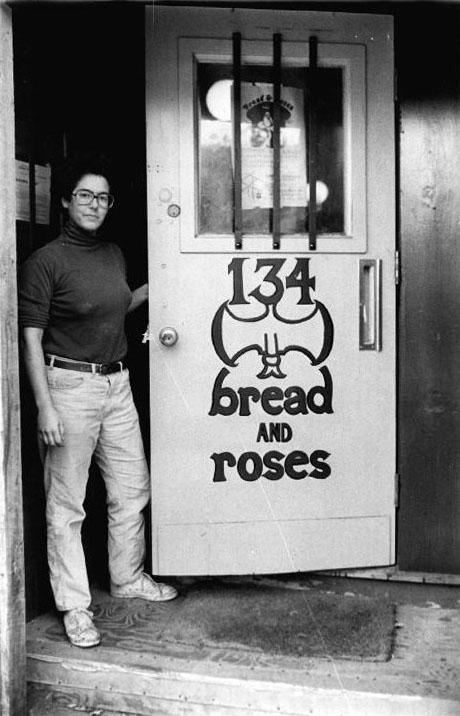
feministBreadandRosesBarbaraFried1976

Not all restaurants have been purely, or even mainly, commercial ventures. This was particularly true of women’s suffrage eating places and those of the 1970s feminist movement.

Although the women’s restaurants of these two periods were quite different in some ways, they shared a dedication to furthering women’s causes and giving women spaces of their own in which to eat meals, hold meetings, and in the 1970s, to enjoy music and poetry by women.

SuffrageLunchBoston1918

In the 1910s most major U.S. cities had at least one suffrage restaurant, tea room, or lunch room sponsored by an organization such as the National American Woman Suffrage Association (NAWSA).

As was true of later feminist restaurants, those of the suffrage era tended to be small and undercapitalized. An exception was the suffrage restaurant financed by the wealthy socialite Alva Belmont in NYC. In terms of patronage, it was almost certainly the most successful women’s restaurant of either era. It reportedly served 900 meals per day from a low-priced menu on which most items were 5 or 10 cents and consisted of soup, fish cakes, baked beans, and home-made pie.

Suffrage restaurants admitted men and welcomed the opportunity to ply them with leaflets and home-made soups, salads, and fritters that would incline them to support the cause. An aged Philadelphia activist recalled in 1988, “I worked at a suffrage tea room. We lured men in, for a good, cheap business lunch. Then you could hand them literature and talk.” In the NYC restaurant operated by NAWSA in 1911, it was impossible to ignore the suffrage issue since every dish, glass, and napkin bore script saying Votes for Women.

suffrageRestaurant1912

Though dedicated to women’s causes, women’s restaurants were not free of conflict. Many suffragists objected to how Alva Belmont ruled with an iron fist, brusquely ordering servers around until they walked out on strike, followed by the dishwashers. Belmont was ridiculed when she brought in her butler and footman to fill the gap. Her footman quit too. Some feminist restaurants experienced discord over cooperative management and, especially, whether or not to serve men.

The first feminist restaurant, NYC’s Mother Courage, was founded in April of 1972. (Its co-founder Dolores Alexander discussed it in 2004-2005 interviews.) Others established in the 1970s included Susan B. Restaurant, Chicago; Bread & Roses, Cambridge MA; The Brick Hut, Berkeley CA; Los Angeles Women’s Saloon and Parlor, Hollywood CA; and Bloodroot, Bridgeport CT). Undoubtedly there were more, especially in college towns. In the 1980s a number of women’s coffeehouses appeared, but they were performance spaces more than eating places.

FeministBloodroot1981

As part of the counterculture, 1970s feminist restaurants typically aimed at a broad set of goals. Women’s equal position in society was paramount but it was embedded in a project of establishing a more peaceful and egalitarian world. Feminist restaurants rotated jobs and paid everyone the same wages. They raised capital by small donations from friends. Staffs were entirely female and women also did most of the renovating. Their decor was spare, with exposed brick walls, mismatched furniture, and chalkboard menus. They served simple peasant-style food, usually prepared from scratch. Some served wine and beer. More often than not menus were vegetarian, or at least beef-less. The L. A. Women’s Saloon and Parlor supported farm workers and would not serve grapes or lettuce. The Brick Hut boycotted Florida orange juice during the anti-gay campaign of spokesperson Anita Bryant. The Women’s Saloon avoided diet plates and sodas, deeming them insulting to large-sized women.

Many proponents of feminist restaurants felt that women were often treated poorly in restaurants, many of which regarded men as their prime customers. Feminist restaurants made a point of presenting women dining with men with the check and wine to sample. But for many women patrons, perhaps especially lesbians, the enjoyment of a non-hostile space was more significant.

At some point each feminist restaurant confronted the touchy question of whether they would serve men. Considerable acrimony erupted around this question at the Susan B. Restaurant in Chicago and Bread & Roses in Cambridge, resulting in the former restaurant’s closure after only a few months. At Bread & Roses a co-founder exercised non-consensus managerial power and fired a server who made men and some heterosexual women feel unwelcome, setting off rounds of group meetings. The restaurant, opened in 1974, was put up for sale and in 1978 became the short-lived “women only” Amaranth restaurant and performance space.

Today Bloodroot may be the sole survivor of the feminist restaurant era.

© Jan Whitaker, 2013

Thursday, November 22, 2012

Scenes in a Boston Ladies Restaurant (1889)

Boston ladies (1890s)
Scenes in a Boston Ladies Restaurant (1899)

As regular Lost readers are aware, womyn's spaces have a complex and often contradictory history in terms of how gender/sexual boundaries are understood and enforced. And what I'm finding is that this ambivalence has been a consistent theme for at least the past hundred years or more. 

Today, you can find many lesbian bars, dyke marches, and other so-called "womyn's spaces" that are pretty much dominated by men. Women may feel vaguely uncomfortable about the situation, but many seem hapless or paralyzed by guilt when it comes to doing anything about it. 

You can also find many examples of women who are intent on preserving a particular womyn's space, along with women who are willing to aggressively regulate the presence of men to the extent that the law and/or custom will allow. These spaces can be as different as a 1950s lesbian bar in Detroit or Buffalo, a 1970s women's music festival, or a current women's passenger train car in India. 

Up until now, though, the evidence I have seen suggests that while some women may have been unhappy about the numbers of men that insisted on barging into the ladies' cafes and restaurants of 80 - 130 years ago (while the same men still insisted that the gentlemen's clubs, bars, and grills be strictly that), the women's objections were largely muffled, ineffective, and limited to the private sphere. (By way of exception, see this 1885 complaint of a New York City woman, which was published in the New York Times.) 

But just recently I found an article that shows that Boston women were not afraid of policing their ladies' restaurants. They didn't shy away from the old "fish eye" when it came to the dudes marching in--unlike many of their supposedly more liberated and assertive great, great-granddaughters.

Back on December 22, 1889, the Boston Daily Globe published a piece called "Scenes in a Ladies Restaurant." As you would expect, the descriptions of the women and their conversations are quite patronizing. And yet for all the condescending language and dismissive treatment of these women, we still see that these women were quite capable of taking care of business. In addition, we see the origins of a narrative that is still pretty common: the poor naif of a man who (accidentally!) wanders into a lesbian bar, only to be treated cruelly by the mean evil butches:

It is a rare thing to see a man in a ladies' restaurant. Few men possess the courage to venture in such a place. However a man gets in sometimes, but not intentionally always. When one does come in, no matter under what circumstances, he wishes before he has been there five minutes he had selected some other place in which to get his lunch. He looks about in a helpless and distressed way for a seat. His evil genius leads him to take the one beside the prim and proper spinster. She looks up to see who it is that dares to share a table with her, and then gives a little shudder, as if to say, "Oh, good gracious! It's a man!" And she turns slightly in her chair in order to present him with the cheerless north side of a very cold shoulder.

The unhappy recipient of these delicate attentions casts an appealing glance at the women opposite, and is rewarded with a look of cold contempt, whose mercurial registration would be about 20 below zero. The poor unfortunate young man is at once depressed by the frigidity of the surrounding atmosphere. He bends his downcast eyes, rings the bell and orders "chicken salad" in a supulchral tone, without raising his eyes. Many long and painful minutes elapse before his order is filled, during which time he devotes himself to the literary merits of the bill of fare, with an ardor of attention that is really pathetic. At last his order comes and he makes remarkably good time in getting through it. He apparently does not care for any dessert, except that he has an inward desire to desert this place of torture. He pays his bill and departs a wiser and a sadder man.

Just to show that nothing is new under the proverbial sun, read a contemporary retelling of this story here.

Thursday, November 15, 2012

Peninsular Hotel Ladies Cafe

South Boston, City Point (around 1910)
Peninsular Hotel Ladies Cafe

Location: City Point, Boston, Massachusetts, USA

Opened/Closed: 1890s

I have not had a lot of luck determining where the Peninsular Hotel was, or even finding a postcard showing its appearance. But I do have a newspaper ad that mentions the hotel's ladies cafe.

Boston Daily Globe,
July 19, 1897


We've mentioned more than once that men's space and women's space are (sometimes) separate, but very seldom equal. Notice that the ladies cafe was squished onto the second floor--which is nearly always considered more marginal space from a commercial standpoint. A second floor (or basement) location was pretty much standard procedure for the ladies cafes. 

Not only that, but in this case, the Gentlemen's Cafe even commands a larger font! So if you somehow didn't realize that the men had priority, the very layout of the ad spells it out for you. 

In the absence of any photos, I'd like to think that the Ladies Cafe had plenty of windows. At least we're promised that "all the rooms give a magnificent view of the bay with its hundreds of yachts." It's even possible that there might have better views of the bay from the second floor than the first floor. But then, the men were NOT excluded from the second floor view, as ladies cafes were set up for unescorted women and women in the company of men. While the boys had the stag party all to themselves downstairs. 

Those who don't understand history will sometimes claim (erroneously) that men have no spaces just for themselves, while women still do. Actually, the evidence has always been clear on this. Women's bars, guesthouses, cafes, restaurants, etc. are nearly always "open" to all with few exceptions. And if not, they're under constant social and economic pressure to be "open" to all. By contrast, men's bars, clubs, baths, guesthouses, etc. are seldom under the same pressures of reciprocity. 

Sunday, November 4, 2012

Lava Bar

Lava Bar

Location: Howard Johnson Hotel in Kenmore Square, 577 Commonwealth Avenue, Boston, Massachusetts, USA

Opened: January 1999

Closed: June 2001

Back in January 1999, there was the following announcement in the "Grrrl Talk" column of the Boston Phoenix:

The new spot this month is Melinda Ancillo's "Lava Bar," which is housed in the penthouse suite of HoJo's in Kenmore Square. Opening night was set for Sunday, January 17, after One in Ten went to press, so I can't say whether or not she did. In the meantime, die-hard club kids will remember Ancillo from Chaps, where she worked security for a few years. Although "Lava Bar" is Ancillo's gig, it's definitely a collaborative effort. For one, not only will U-Turn's Debi Saltzberg be mixing cocktails behind the bar, but Denise Russo from Upstairs at the Hideaway will help out, too. Plus, Ancillo booked DJ Kris Kono, who spent the summer spinning at Vixen's in P-town and still plays those Connecticut monthly parties, "Club Lucy."

Basically, Ancillo's betting that Kono can keep us happy and relaxed. For now, Kono is holding back on her house faves and instead plans to deliver, in Ancillo's words, "some soft, sexy tunes" to enhance the lounge ambiance of the bar. In other words, expect a very relaxed and quiet atmosphere. The room holds about 300 and comes complete with red-velvet sofas and a redwood bar in an L-shaped room. Check it out every Sunday from 9 p.m. to 2 a.m., at the Howard Johnson Hotel in Kenmore Square, 575 Comm Ave, Boston. Cover $5. Call (617) 267-7707.

Ah ha! I thought at first. A Boston lesbian bar I didn't know about! Then I found it was just another one of those tedious "lesbian nights." Lesbians, especially in Boston it seems, are seldom able to secure any permanent or even semi-permanent territory anymore. And this one was on a Sunday night, no less.

Here's more from "Grrrl Talk" a month later, in February 1999:

Lava Bar patrons
The Lava Bar took off last month during the long holiday weekend. Keeping up to par with most openings, this HoJo's spot was crowded its very first night. It wasn't as jammed the following week, but there were still plenty of people in attendance. In fact, after 9:30 p.m., when the music switches gears from soft to dance, it sparked a lot of grinding and all-around PDA on the dance floor. Let's just say there was a lot of lust in the air. No wonder Melinda Ancillo, who's promoting the night, deems it "a success."

But then it apparently migrated to Saturday night! (As opposed to, say, Tuesday from 6 PM to 7 PM.) This is big time! So count your blessings, girls! And smile! Lava Bar even won the best "lesbian night" award from the Boston Phoenix that year:

View from the Lava Bar
Boston hasn't had a full-time lesbian bar for a number of years now, so area girls make do with one-night-a-week hangouts like Lava Bar, situated at the top of the Howard Johnson's hotel in Kenmore Square. The accessibility of the location, the relative abundance of parking, and the diversity of the clientele have made Lava Bar the upscale Saturday-night hot spot for girls of all stripes -- from Newbury Street style mavens to the chinos-and-shirts crowd. An elevator from the street level opens into the bar; to the right is a big shiny dance floor that hops with DJ mixes. You'll have to navigate the dancers to find the small seating area, a great place to girl-watch. And if the girls aren't worth watching, the view -- from big windows around the dance floor -- always is.

It also got the same honors from the Boston Phoenix in 2000: 

The Lava Bar may be in the penthouse of Howard Johnson's, but that's easy to forget on a Saturday night. The club, which goes lesbian on Saturdays, has glass walls on three sides and is filled with sleek galvanized metal and lots of stylish velvet sofas. The atmosphere may be elegant, but the crowd and the music provide the necessary level of funk to keep the night fun. DJs Fran Englehardt and Thom Delahunt play an unusual blend of house, old-school soul, and Latin music. And if the music doesn't do anything for you, there are always theme nights. On one recent Saturday, women shucked their blouses and painted their breasts with liquid-latex paint (soap was not included).

Wow. That's pretty wild! At least they didn't use Magic Markers!

Here's a review from the Global Hangover Guide:

The former Lava Bar at the top of
Howard Johnson's
Lava Bar details:
Large bar, great booths

Since opening its doors this spring, Lava has remained afloat, and, surprisingly, has gained momentum, despite the city's habit of sinking lesbian-targeted clubs within their first year of existence.

Located in Kenmore Square on the top floor of the Howard Johnson's, every Saturday night you can get down with the girls to the house beat - or hang in the overstuffed booths off the floor - or chat with chicks while overlooking the city. A large bar greets all who enter, strategically located directly in front of the elevator, while a smaller bar is located beyond the dance floor toward the back of the club to satisfy the thirst of the more mellow crowd, seeking solitude in the dim lighting of the lounge area.

Lava survived the summer months, minus the co-eds to fill the floor, so this joint may be here to stay. Even though it is attached to HoJos, it has a separate entrance and elevator - so you don't feel like you are going to hotel to dance.

Unique to Lava, the elevator provides a great NYC clubby atmosphere.

As is the case with clubs, there is a $8 cover, but the elevator ride up (and maybe down, too) is worth it.

Still, even a 1999 article in the Boston Globe on the off-campus "gay scene" more or less admitted what every lesbian already knew: that the range of entertainment venues for women was still pretty pathetic.

There isn't much as far as clubs for women. Try the Lava Bar in Kenmore Square on Saturday nights, the Midway Cafe in Jamaica Plain on Thursday nights, and Ryles, a jazz club in Cambridge where the upstairs is devoted to women, but not jazz, on Sunday nights.

But even the Lava Bar option was gone by June 2001. From the Boston Globe:

Last June, it was all downhill for Lava Bar, then Boston's leading dance club for the lesbian community. After 2 1/2 years of providing a space for women to dance and mingle, the club's promoter, Melinda Ancillo, was told the Kenmore Square hotel that housed Lava Bar was being converted into student housing. Pretty much the only game in town for lesbians on Saturday nights, Lava Bar's sudden departure from the nightlife scene threatened to leave a huge void.

Saturday, September 29, 2012

Empty Barrel

99 Broadway - Boston (August 2009)
Empty Barrel

Location: 99 1/2 Broadway, Boston, Massachusetts, USA

Opened/Closed: 1930s?

The only reference I have found to the Empty Barrel being a former lesbian place is this short mention by Michael Bronski. This is part of an article outlining a LGBT walking tour of Boston:

Near Jacques (on Broadway) was the Empty Barrel (99 ½ Broadway)—for many years a speakeasy frequented by lesbians. Visitors can still see the stairs leading down to the entrance of the basement bar.

I'm sure more could be found out by hitting the paper archives. Yet another thing to add to that never ending "to do" list.....

Friday, September 21, 2012

Castle Square Hotel Ladies' Cafe


Castle Square Hotel
Ladies' Cafe ad
Boston Daily Globe
(May 20, 1899)

Castle Square Hotel Ladies' Cafe

Location: 421 Tremont Street, Boston, Massachusetts, USA

Opened: Hotel opened in 1894

Closed: Hotel closed and demolished from December 1932 - January 1933
Castle Square Hotel and Theatre (1894-1933)
The 500-room Castle Square Hotel was one of those grand "European Plan" hotels, the likes of which we shall never see again. It was designed by Winslow & Wetherell, and included a luxurious 1,800-seat theatre. It was centrally located--just three blocks from the New York, New Haven and Hartford and Boston and Albany rail station (the Back Bay Station).

Though the address for this hotel is usually listed as 421 Tremont Street, it had frontage on Tremont, Berkeley, and Chandler Streets, which may explain why the ad for the ladies cafe (see above) states that it is on Chandler Street. It's also likely, I suppose, that there was an entrance to the ladies' cafe off Chandler Street.

What is really fantastic about this ladies' cafe ad is that the "petit lunch" menu--"petit" is a misnomer if there ever was one--is listed in detail. For 25 cents you were STUFFED. Check this out:  cold boulllion in cups, mock turtle soup Baltimore, chicken croquettes with peas, lobster salad, along with Castle Square rolls and butter. For dessert, there was vanilla ice cream and strawberry shortcake. Now that's a classic ladies luncheon! If you and your lady luncheon guest had tickets for the theater later that evening, you were sure to snooze.

Speaking of the theater, we're told that the Castle Square Theatre included a vaudeville company and performance troupe. In 1917, a projection booth was added to the theater for films. By 1921, the theater became known as the Arlington Theatre. However, later in the 1920s, they returned to live theater performances and the name reverted back to the Castle Square Theatre.

So let's imagine that you and your lady companion have polished off your delectable "petit lunch." Perhaps you have strolled around the Back Bay for a bit, and now it is time to head for the Theatre. What might you have seen? Perhaps you might have seen the gorgeous Miss Izetta Jewel (1883-1978), a prominent and accomplished stage actress of the time who had a sixty-six week run with the Castle Square Stock Company beginning in May 1902. Here's a bit about her professional life:

Izetta Jewel received her education at the Henry C. de Mille School for Girls at Pompton Township, New Jersey, the East Greenwich Academy in East Greenwich, Rhode Island and a year's studies at the American Academy of Dramatic Arts in New York City. She made her professional stage debut at Wilmington, North Carolina on May 14, 1900 in a summer stock production ofThomas Hardy’s Tess of the d'Urbervilles.

Within two weeks of her debut the sixteen year old actress was offered the opportunity to replace the troup's recently departed lead actress as Fanny Le Grande in the their production of the Jules Massenet opera, Sapho. Later that year she joined the Rowe-King Repertoire Company's tour of New England and the following year supported actress Katherine Rober in summer stock productions at Providence, Rhode Island before touring with the Bennett and Moulton Opera Company for the 1901–02 season.

On May 5, 1902, Jewel began a consecutive sixty-six week run with the Castle Square Stock Company in Boston, playing such roles as Marianne in The Two Orphans, Polly Fletcher in The Lost Paradise, Helen McFarland in The Greatest Thing in the World, and Caroline Murat in More Than Queen.


In terms of her acting career, we'll stop there in 1902. But notice that Jewel was also a women's rights activist who went into politics later in later life:

On April 3, 1921 Jewel was among a delegation of fifty members of the National Woman's Party(NWP) that met with President Harding urging his support to call a special session of congress to address discrimination against women. Three months later the NWP named Jewel as one their twenty-seven founding members in gratitude for her work and financial support. By 1922 Jewel was a leading figure behind the Women’s Committee of the American Farm Bureau Federation that lobbied for reforms to help improve the lot of rural farmers and their families. Two years later she became the first woman south of the Mason Dixon line to win her party’s nomination for national office in a failed bid to represent West Virginia in the U.S. Senate. At the 1924 Democratic National Convention Jewel’s seconding speech (the first by a woman in both national parties) for presidential candidate John W. Davis captivated the usually distracted delegates for its eight minute duration and was duly rewarded by a warm applause. In 1930 she was unable to unseat her incumbent Republican rival to represent New York's 30th congressional district and the following year she failed to win a seat in the New York Assembly. Jewel served as Commissioner of Public Welfare for Schenectady in 1932 and 1933. At one point she was jailed for ignoring a court order to reinstate a fired public employee. Ironically a judge later voided the contempt of court charge because he felt as a woman she did not fully comprehend the consequences of ignoring the court. In 1935 Jewel was appointed Regional Director of Women’s Activities of the Works Progress Administration (WPA) overseeing women's relief projects in West Virginia, Pennsylvania, New Jersey, Kentucky and Ohio.

I just love it when all this random stuff just happens to pull together....

Tuesday, June 5, 2012

Garage for Women Only (Boston 1921)


Pauline Leiner (1921)
Garage for Women Only

Location: Boston, Massachusetts, USA

Opened/Closed: c. 1921

More than most, this is a pretty thorough description of a very early effort to open a women-only garage--very likely the first such venture in the United States. Instead of vague if intriguing generalities--as we had with the women-only garages in London (1929) and Paris (1926)--we actually have a real woman with a real name: Pauline Leiner. Not only that, but real, verifiable information on her life from other sources.

All the quotations below are pulled from an article in the Boston Daily Globe, August 21, 1921.

Let's permit the (unidentified) journalist  to introduce us to Miss Pauline Leiner as she was introduced to the newspaper readers of Boston. First off, note that we're collectively reassured that she really is "feminine"--in case you were overly burdened by such concerns--and that she's "not the type of person" you would confuse with a male mechanic:

GARAGE FOR WOMEN ONLY AND WITH ONLY WOMEN MACHINISTS

There the Woman Who Wants to Tinker Her Own Car Can Get as Dirty as She Likes, With No Male to Offer Advise

"Why shouldn't a woman make a success of managing a garage?" This was the challenge offered a few days ago to a representative of the Sunday Globe by Miss Pauline Leiner, who is presently to occupy this rather unusual business niche.

Miss Leiner is not the type of person you would associate with jumpers and cotton waste and grease cups or the ideosyncrasies of manifolds or carburetors. She's small and poised, with soft black hair, with more than a suggestion of something sensitively feminine about her. In the hazel eyes there is a hint of amusement and in the slow drawl the merest hint of pride at being the first woman in the country, so far as anyone knows, to assume the managership of such an, one might almost say, unromantic place as a garage.

But behind the drawl and the slight amusement in the eyes there is evidently a determination to lay firm young hands on this unexpected business and to make a go of it. As she says, "Why shouldn't a woman make a success of it?"

So how did Pauline Leiner get to the point where she had the knowledge, the background, and the confidence to venture into auto mechanics? Today we readily recall how the second World War opened up opportunities for American women in traditional male blue-collar occupations. We sometimes forget that the first World War had a similar impact. In particular, Leiner's service in the Motor Corps introduced her to the world of "skilled mechanics." Also take note of the all-women farm where Leiner apparently drove a tractor:

Miss Leiner is not a Boston girl, but in 1916 she came here from New York with friends and became drawn into all sorts of war-time activities. It was early in the days when the possibility that women might have to take the places of men in industrial work to be released for service was just beginning  to make itself felt.

Female drivers of the Motor Corps,
East Newton Street Armory, Boston
The motor corps was organized and in order to be eligible for service in such an organization it was imperative that recruits be skilled mechanics as well as trained chauffeurs. Miss Leiner thereupon took the
Y. M. C. A. automobile school and graduated.

But the influenza cut short her activities along this line and after convalescence, when the work of the motor corps was diminishing somewhat, she knew that she must do work which would keep her out doors.

The Westwood Land Unit was being built up and Miss Leiner seized her chance at its advantages, with the result that she learned what it was to work 12 hours a day on a farm where a crowd of young women did all the work normally done by men absent on different business.
Motor Corps of America (1919)

Miss Leiner has only recently finished a what you might call post-war engagement driving a tractor as well as having charge of a farm at Charles River Village.

Of course "the influenza" is a reference to the "Spanish Flu" pandemic of 1918, which killed between 20 and 40 million people worldwide.  

Apparently Leiner was to manage the new business with the backing of a (presumably male) Brookline garage proprietor. It seems he had become aware of the fact that over the war years, many women had assumed responsibility for automobile maintenance and repair. And while they were reluctant to turn all that back over to the men, they didn't especially want to "go into a regular ordinary garage run by men, put on overalls and go to work in full view by cynical eyes."

Plus, what we would identify as old-fashioned misogyny entered into it. The "sight of a woman tinkering with an automobile" brought out the "fair old devil" in their male co-workers, which was--in a colossal understatement-- a "little short of maddening for the woman." (I guess that's how we allude to sexual harrassment in 1921.) The solution? A garage for women only and with all-women mechanics, since "a stray male helper or two, obscure in position, would surely spoil the whole effect." It is reported that the all-women garage would be opened "within a month or two."

Pauline Leiner herself explains it best, and how, in terms of women, she was eager to "give 'em a place":

"The day is about gone, don't you think, for people to think any sort of work women may elect to do is queer? I drive an automobile and I'm only one of thousands of women.

"Time and time again I've had to stand around, waste time, become almost apoplectic from exasperation trying to get some simple adjustment made when, if I could lay my hand on a couple of tools and get the space to work in, I could have had the whole thing done in no time without bothering anyone, with no wear or tear on my own disposition.

"There are, I'm confident, any number of women who just wish they had some place where they could look out for their own cars. We're going to give 'em that place.

"For the woman who'd just as soon pitch in and get her hands greasy, if she has to, in order to get her car fixed speedily, or who like the 'feel' of tuning up the connections and all that--why, this--what you might call--Adamless Eden, where there won't be any gimlet-eyed males staring supercilliously and exclaiming, 'That ain't th' way you do it, ma'am."

Of course there is the mandatory lame joke--something about jacks decorated with pink ribbons--so it's no surprise that the reporter found Leiner "extremely reticent about any decorative factors." But we do find out the following regarding the garage facility as she envisioned it:

There is a large room with a fireplace, which will be utilized as a lounge and waiting room, which is to be decorated somehow, but I don't believe it will be with pink ribbons or anything sticky.

The building will have telephones everywhere. Miss Leiner is a woman. She knows that women always want to telephone someone, no matter where they are.

There will be lockers where patrons may keep working jumpers and such paraphernalia as they require for the hours when they retire from the world and become immersed in the interiors of greasy engines.

I asked her if she anticipated any difficulty in finding girls or women fitted, mechanically, to take the positions held in garages by men. "Not at all. There are too many women, just like me, who became skilled mechanicians during the war and who, I believe, would welcome a chance to enter a work about which there is a fascination, you know."

I haven't found a lot about Pauline Leiner apart from this article, but this is what I do know. She was born on April 27, 1895. The supposed "drawl" in her voice? That may have been from her father, who was born in Louisiana (her mother was born in New York). In 1920, at the age of 25, Leiner was living in a boardinghouse in Needham, Massachusetts and working as a gardener. She was single, never married, and would remain single her entire life. I'm not sure how long she stayed in the auto mechanics field, but at some point she returned to agriculture. When she retired, she was a manager of a dairy farm on Millbrook Road in Litchfield, Connecticut. She died on July 14, 1997 at the age of 102.

Friday, April 27, 2012

Ladies Writing Room, Hotel Vendome

Ladies Writing Room, Hotel Vendome

Location: 160 Commonwealth Avenue, Boston, Massachusetts, USA

Opened: Built 1871

Hotel Vendome (1910)
Closed: Ceased to exist as a hotel in 1971

The Historic Buildings of Massachusetts site provides this short description of the Hotel Vendome itself:

Built in 1871, the Mansard-roofed French Second Empire style corner building of the Hotel Vendome, on Commonwealth Avenue in Boston, was designed by William G. Preston, who had studied in Paris. The western section, designed by J.F. Ober and R. Rand, followed in 1881. Hotel Vendome was for many years the city’s premier hotel, but by the late 1960s attempts were made to demolish the outmoded building. Renovations were almost complete in 1972, when a fire destroyed the southeast section of the original structure. Nine firefighters died when part of the building collapsed after the fire was out. There is a memorial to the nine firefighters on the Commonwealth Avenue Mall at Dartmouth Street. A 1970s addition to the Vendome by Stahl/Bennett in the Brutalist style replaced the destroyed section.

The building was later converted to condominiums, and it is at the condominium's website that we find this wonderful drawing of the Hotel Vendome's Ladies Writing Room. If you care to see more photos and illustrations from the Hotel's glory days, make sure you check it out. But for now, I'm just going to let you imagine that you had the wealth and leisure that would have allowed you to dwell in such a grand Ladies Writing Room, with bountiful supplies of paper and ink at your disposal....

Ladies Writing Room, Hotel Vendome (1872)