Showing posts with label Greece. Show all posts

Saturday, September 24, 2016

Heraean Games


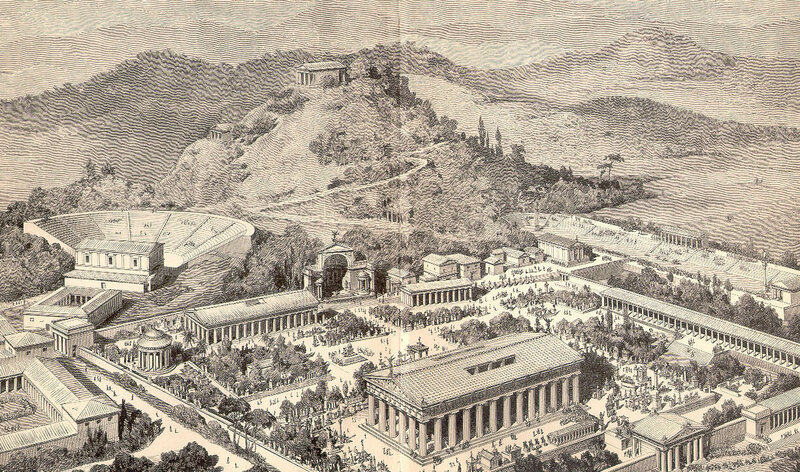
An artist's interpretation of ancient Olympia. [Photo: Public Domain]
Heraean Games

Location: Olympia, Greece

Opened/Closed: 776 BC-?

Selection from Atlas Obscura:


When Ancient Greece Banned Women From Olympics, They Started Their Own
Sadly, historians lack good documentation on the badass Heraean Games.


Much like their modern counterpart, the Olympic Games in ancient Greece wasn't exactly a level playing field for women. It's true that women of all ages were allowed to enjoy the festivities and exhilarating athletic events in cities throughout the Peloponnese states, including Delos and Athens. But the Games in Olympia in the land of Elis—the city where the Olympics originated—retained its traditional, sacred ban of women. Elis decreed that if a married woman (unmarried women could watch) was caught present at the Olympic Games she would be cast down from Mount Typaeum and into the river flowing below, according to Greek geographer and travel writer Pausanias.

During these ancient times, women lived much shorter lives, were excluded from political decision-making and religious rites, were forced into early marriages, and then gave birth to several children. Despite the societal inequalities and oppression, women in Greece wanted to play—so they started their own Olympics called the Heraean Games.

“Every fourth year,” Pausanias wrote in 175 A.D., “there is woven for Hera a robe by the Sixteen women, and the same also hold games called Heraea.”

The Heraean Games, a separate festival honoring the Greek goddess Hera, demonstrated the athleticism of young, unmarried women. The athletes, with their hair hanging freely and dressed in special tunics that cut just above the knee and bared their right shoulder and breast, competed in footraces. The track shortened to about one-sixth the length of the men’s was made up in the Olympic Stadium. While women were not allowed to watch the men’s Olympics, it’s uncertain if men were barred from these all-female races.


Sunday, February 1, 2015

No women allowed: tourist destinations where women are forbidden

Mount Athos
Instead of our usual post on a no-longer existing space for women, let's look at the opposite: places that still exist for men where women are banned.

This list is from a January 2013 Fox News piece:

Whether via girlfriend getaways, solo sojourns or adventure-heavy holidays, women are traveling more than ever these days. But even in today’s age of increasing gender equity, there are spots across the globe where the absence of a Y chromosome means a traveler must tread lightly – or not at all. 

Many of these bans on females are steeped in religious tradition and etiquette, but is a reminder of how far, or not,

women have come. 

Here are some tourist destinations where females strictly are forbidden.  

Mount Athos, Greece: The longstanding gender ban on this ancient mountain doesn’t apply to just women – it also includes many female domestic animals. Commonly known among Greeks as the “Holy Mountain,” the self-governed Mount Athos, which encompasses both the mountain and a peninsula in Macedonia, is accessible only via ferry -- and only to men with a special permit. A centuries-old belief maintains that the presence of females inhibits their path to the spiritual enlightenment of the monks living there among its 20 Eastern Orthodox monasteries.

Over the years, several women have been successful in sneaking onto Mount Athos’s forbidden-to-females shores, including a French writer who reportedly underwent a double mastectomy in order to disguise herself as a monk in the 1920s, and, more recently, four Moldovan women who illegally entered Greece and accidentally ended up at Mount Athos.
Saudi women

Saudi Arabia: If you’re a solo female traveler looking to visit Saudi Arabia as a tourist, you’ll have an easier time booking a trip to Mars. As of 2010, tourist visas to Saudi Arabia don’t exist, and visas for business and to visit family are notoriously difficult for Americans to obtain. On top of that, women who do travel to the country must be accompanied by a male relative in order to be granted entry. And even then, Saudi Arabia isn’t exactly a welcoming destination for females. Women need a man, or government permission, to do just about anything – Saudi Arabian women aren’t even allowed to drive.

“We hear nonstop all this bad press about Iran and how terrible Iran is, but Saudi Arabia is much more oppressive of women,” notes Michelle May, a San Francisco-based journalist who has traveled extensively to Middle Eastern countries. “Their human rights record and their treatment of women are far worse than Iran.”
Haji Ali Dargah Shrine


Haji Ali Dargah Shrine, Mumbai, India: One of Mumbai’s most iconic landmarks, which is dedicated to a 15th-century Sufi saint Pir Haji Ali Bukhari.  The site, which also holds the saint's tomb, draws between 15,000 and 20,000 daily visitors of all castes, creeds and religions, according to the organization that runs it.  But in July, a women’s group visited and found the Dargah’s most sacred area, called the sanctum sanctorum, had been barred to females. The shrine’s authorities claim that it is "un-Islamic under the Sharia Law" for women to visit graves and that they were rectifying a mistake that had allowed women to enter this area.

By November 2012, news of this development had spread, sparking outrage among many women’s rights groups that say the ban represents clear discrimination of women and that it damages the reputation of Islam in India. The state government has refused to intervene in the issue, which it claims is a religious matter, so at least for now, the shrine’s sanctum sanctorum remains off-limits to women.
Balinese Hindu temple
Hindu temples in India and Bali, Indonesia during certain times of the month: It’s a common sight – and a curious one, at least for many Westerners – at many Hindu temples in these parts of the world: signs that prohibit menstruating women from entering. It’s unclear exactly how this ban is monitored, but it’s based on the belief among some religions, including Hinduism and the Eastern Orthodox Church, that menstruating women are impure, and as result they are banned from entering sacred areas of worship or receiving communion.

The ban has been challenged in some places, but it’s still the status quo at many temples throughout India and Indonesia. Even more disturbing: It occasionally comes with the threat of violence if women visitors violate the rule.

Warning sign, Mout Omine
Mount Omine, Japan: In 2004, the United Nations declared this mountain in southern a UNESCO World Heritage site, but thanks to a centuries-old gender ban, it’s one that women are still not allowed to visit. For more than 1,300 years, only men have been allowed to navigate the rocky paths leading to the Buddhist temple near the 5,640-foot peak. That’s because, according to long-held religious beliefs, women pose a distraction for the religious pilgrims who should be engaged in strict self-denial while on the mountain. 

Today, the gender ban continues, despite an 1872 Japanese government decree that struck down longstanding conventions that kept women off many of the country’s mountains, including Mount Fuji. Since then, Mount Omine has defiantly ignored that order. Predictably, Japanese women’s groups lobbied the government and the United Nations against naming the mountain as a World Heritage site, to no avail.
Mount Omine

Galaxy water park, Bavaria, Germany: This past summer, one of Europe’s largest and most popular waterparks, which is part of the sprawling Therme Erding sauna complex near Munich, banned women from one of its high-speed slides because owners determined it to be causing “intimate injuries.” According to a park official, at least six women suffered injury to their genital area on the X-treme Faser slide, in which participants can reportedly hit speeds up to 45 miles per hour.

A park spokesman told an English-language newspaper that it was working on developing a bodysuit for women to prevent such mishaps in the future. According to a gynecological association that was referenced in the newspaper, however, there was no medical condition other than pregnancy that should prevent women from using such a slide. In other words, this particular gender ban appears to be washed up.

A few observations. I find it fascinating how men can command enormous pieces of male-only territory--entire mountains!--for hundreds of years, and completely legitimize their exclusive possession and control through religion and "tradition." These are male-only spaces from top to bottom. And they are backed up by institutions as powerful as the United Nations.

By contrast, women's space tends to be short-lived, very limited in size (a single dining room, a single club), and very compromised--e.g. often managed by males, owned by males, including males as employees, admitting males if they are accompanied by women or even if they are not. Trans women, we are told, should be admitted as women are--even in locker rooms or saunas--based solely on identification. In the end, it's really not that unusual to end up with so-called women's spaces that have more men present than women.

And even then they are relentlessly attacked as "exclusionary."

But I can assure you that none of the religious "brothers" in the spaces described in the Fox piece have ever lost any sleep over admitting women, or even trans men. Wouldn't even occur to them to consider it. No guilt, no apologies.

And you know that the "non-exclusionary" folks who are hounding the few remaining women's colleges out of existence or screaming about the Michigan's Womyn's Music Festival (a relatively large territory to be sure, but women-only for just ONE WEEK out of the year) are sure not picketing, protesting, or camping out beneath Mount Omine. Oh no, that would be culturally and religiously "disrespectful."

Friday, October 5, 2012

Troll Club

Street scene - Alikarnassoy Kolonas
Troll Club

Location: Alikarnassoy 7, Kolonas, Athens, Greece

Opened: ?

Closed: June 17, 2006

The only reference I have found to this former lesbian bar is at an old website by the name of Athens by Night Sapphites Guide (love that name!). But unless you're interested in history, don't bother to visit as it hasn't been updated since 2007. At any rate, this is what is said about Troll Club:

Troll, Lesbian bar-club * REPORTED CLOSED - 17 JUNE 2006 
www.troll.gr - Alikarnassoy 7, Kolonos (from Kostantinoypoleos & Lenorman bridge) tel. 210.5158920 
The second self-identified lesbian venue in Athens - Mostly young women and a few occasional gay friends 
very interesting music mixes (latest mainstream 2 all-time classics 2 Greek dance music) 
Opens late Tuesday-Sunday nights, (~ 11pm to 3am.. and more on weekends) !


We know that it was open in April 2005 as there is this reference:

Friday, April 8th, Athens, lesbian.gr-chat Party, at the Troll club, Alikarnassoy str, Kolonos, after midnight

But that's about it.

Thursday, April 19, 2012

Cluj women-only restaurant

Cluj women-only restaurant (1969)
Cluj women-only restaurant

Location: Cluj-Napoca, Romania

Opened/Closed: c. 1969

I quite literally know nothing about this restaurant--except for this snippet of film that shows up at British Pathe. I tried to download it directly onto the site here, but no such luck. So you'll have to go to the British Pathe link above to see it for yourself.

Since I started the Lost Womyn's Space project, I have found very few films of historic women's spaces--apart from a few YouTube videos of more recent lesbian bars. Which is unfortunate, because in many ways, film can give us a keen insight into what these places may have been like. As you watch this film clip, it is easy to find yourself seduced into the scene. The charming ambience of the restaurant itself. All the fashionable ladies with bouffant hair-do's. The diners exchanging tender glances. The Turkish-style coffee, lovingly prepared by a woman's capable hands.

SPOILER ALERT: And then we realize that the movie camera is not a neutral observer. That we are not mere visitors, innocently peeking into this intimate women's dining room from two generations past.

On the contrary, we find at the very end--much to our shock and disgust--that the filmmaker was a man who disguised himself as a woman in order to record this scene. That all this is basic male voyeurism, no different in kind from the dudes who plant video cameras in women's restrooms. Or the men who are seemingly compelled to invade, infiltrate, or spy on women's space in any way they can.

It is particularly sickening to realize that what is probably the only documentary film preserving anything of this women's restaurant was made by this particular voyeur, and that we have been lured into unwitting participation in this filmmaker's trespassing and deceit. And that, sadly, we have no choice in the matter if we are to "see" this place at all.

Regulars at the Gateways (1968)
Then it occurred to me that this is also true for one of the very few films showing a lesbian bar from this era. Back in June of 1968, the film director Robert Aldrich used the Gateways Club--a famous lesbian bar in London--as "local color" in The Killing of Sister George. All of the women in the background are actual club regulars, they are not professional actresses or hired extras. Even Smithy the bartender was the real-life club bartender.

See clip here.

In Kelly Hankin's The Girls in the Backroom: Looking at the Lesbian Bar we discover all the ways that Aldrich exploited and endangered the Gateways Club and its customers--all while exposing and redefining these women as "genuine" (if scary) objects of titilation and surveillance for a male heterosexual movie audience. Among other things, it turns out that many of the lesbians used in these scenes did NOT sign any forms authorizing the use of their images, and as a result, faced catastrophic personal consequences upon the film's release. As Hankin argues, "it was heterosexuals, rather than lesbians, who orchestrated the use and vision of authentic lesbian space and real lesbians in The Killing of Sister George. The lesbian extras were effectively voiceless and nameless in the production and credits of this film."

But then we know that the male obsession with moving into and "directing" women's space is at least as old as ancient Greece. In fact, Aristophanes himself addressed the subject in a play called Thesmophoriazusae. The plot? A man disguises himself as a woman, so he can crash the festival of the Thesmophoria (an annual woman-only fertility celebration dedicated to the goddess Demeter) and spy on the women's doings there.

So not much is new under the patriarchal sun....

Tuesday, November 29, 2011

Fairy Tale

Fairy Tale signage
Fairy Tale

Location: 25 Koleti Street, Athens, Greece

Opened: April 1994

Closed: Spring 2005

Fairy Tale is mentioned at two Greek travel sites.

In the Athens by Night Sapphites guide, Fairy Tale is listed among the "lesbian places that have been." It appears to have been Athen's first openly lesbian bar ("the first greek venue to have declared 'lesbian'"). In addition to being a "well-known lesbian bar," we're told that Fairy Tale was "the Sapphite's favorite." (Dang, I love that phrase!) We're also informed that it was small and warm, a "usual meeting place" that featured Greek music on Wednesdays. It is reported here that Fairy Tale closed in Spring 2005.

I'm not sure when Fairy Tale opened. However, a meeting was scheduled there in April 2003, so it was obviously open by that time:

Saturday, April 5th 2003, Athens, late evening - "the Antivirus magazine is expecting you to read it and to celebrate the first issue at the FairyTale bar, Koleti 25, in Echarcheia."

Hold that thought! We also see that Fairy Tale celebrated its 9th anniversary and farewell party on April 15, 2005, so we're able to establish a date of birth after all.

Fairy Tale is also mentioned at Harry's Greece Travel Guide. This appears to be an older website, as Fairy Tale is listed among the (then) existing "Lesbian Bars." (Note that the following warning is issued to would-be lesbian bar goers: "Some of these establishments are just gay-friendly or mixed so your discretion is appreciated.")
Exarchia Square, Athens

Fairy Tale 25 Koleti St., Exarhia, Tel: 210- 330-1763. Closed Mondays, Sundays opens after 2pm, serves lunch. Intimate with international and mainstream hits.

In case you were wondering, Exarhia (sometimes spelled Exarcheia, Exarheia, or Exarchia) is a downtown Athens neighborhood close to the National Technical University of Athens. The area features many bars and cafes, and has historically been associated with intellectuals, artists, and leftist/anarchist politics.

Thursday, April 7, 2011

Sappho's Thiasos

Sappho's school
Sappho's Thiasos

Location: Skala Errisou, Lesbos, Greece

Founded and Closed: 6th century BC

Sappho, of course, was the "tenth muse," one of the great lyric poets of antiquity, renowned for her love poems addressed to women. In addition, Sappho headed her own thiasos at Lesbos, which is variously defined as a school or community of women. Scholarly accounts about Sappho's life and work are still open to radical re-interpretation, since so much of her poetry was destroyed by the early leaders of the Christian Church. But here is one of the more comprehensive accounts I have found describing Sappho's thiasos:

The thiasoi were communities of women, the existence of which is documented not only in Lesbos where, as well as Sappho's thiasos there were also the thiasoi of her rivals Gorgo and Andromeda, but also in other areas of Greece, especially in Sparta. What sort of communities were these? They were not simply 'finishing-schools for young ladies', as some definitions have suggested, where purely spiritual loves flourished between the girls. The thiasoi were something different and more complex. They were groups with their own divinities and ceremonies, where girls, before marriage, went through a global experience of life which - leaving aside the differences attributable to differences of gender - was in some way analogous to the experience of life that men had in corresponding masculine groups. And the girls received an education within this community life. With reference to Lesbos, in particular, the Suda names three mathe-triai, meaning three 'pupils' of Sappho, who was called didaskalos, or 'schoolmistress'.

What did Sappho teach her pupils? First of all music, singing and dancing: the instruments which transformed them from uncultivated little girls, which is what they were when they came to her, into women whose memory might live:

But when you die you will lie there, and afterwards there will never be any recollection of you or any longing for you since you have no share in the roses of Pieria; unseen in the house of Hades also, flown from our midst, you will go to and fro among the shadowy corpses.

Sappho writes this to a rival, who has not learned from her those things which would have allowed her to escape from ignorance, and thus from oblivion. But Sappho was not only a mistress of the intellect: her girls also learned from her the weapons of beauty, seduction and fascination:  they learned the grace (charis) which made them into desirable women.  From this point of view, the definition of Sappho's circle as 'a finishing-school for young ladies' is not mistaken. But the description is certainly inadequate: in these 'ladies' clubs' the girls of Lesbos (and of other cities, given that Sappho's pupils included Atthis of Miletus, Gongyla of Colophon, Eunica of Salamina) went through an experience which, in our eyes, was quite unsuitable for 'respectable young ladies' - they loved other women.

A few paragraphs later, we see the following clarification about the love that blossomed between women at the thiasos. Indeed, there is a tantalizing reference to a "marriage" between two women:

Greek culture in the seventh and sixth centuries BC (the period with which we are concerned) not only accepted as normal the existence of love relationships between women in the life of the thiasoi, but formalised these, through the celebration of an initiation-type ceremony, which brought two girls together in an exclusive paired bonding of a marital type.

To clarify the meaning of initiation marriages within the thiasoi, and to provide proof of their existence, we have the celebrated parthenion (a song for a chorus of virgins) by Alcman, the 'Louvre parthenion'. Composed in Sparta on commission, this celebrated the recognition by the thiasos of a love affair which had now become exclusive between two girls, Agido and Hagesichora; an official union, one might say, which was solemnised by the recitation of a choral song.

Significantly, given that not all directors of thiasoi were capable, like Sappho, of composing songs personally, this one was written on commission by Alcman. But what exactly did the song proclaim?

Agido and Hagesichora (who seems to be the leader of the choir) appear in the song unambiguously in the role of a couple whose bond, now an exclusive one, takes away all hope from the girls in the choir, who are aware of the fact that nothing, no present and no temptation, will ever be able to detach Agido from Hagesichora, and persuade her to love another:

For abundance of purple is not sufficient for protection, nor intricate snake of solid gold, no, nor Lydian headband, pride of dark-eyed girls, nor the hair of Nanno, nor again godlike Areta nor Thylacis and Cleesithera

they sing. And then, turning directly to Agido,

nor will you go to Aenesimbrota's and say, If only Astaphis were mine, if only Philylla were to look my way and Damareta and lovely Ianthemis; no, Hagesichora guards me.

Agido, therefore, will no longer confide her love affairs to Aenesimbrota (evidently the director of the thiasos), and will no longer seek her intervention to obtain the love of one among her many companions: she now loves only Hagesichora, for ever.

Photo: Sappho's school, Skala Errisou, Lesbos, Greece
Monday, March 21, 2011

The Thesmophoria


The Thesmophoria

Location: Ancient Greece. In Athens, the festival took place near the Pnyx hill.


The Thesmophoria was the most popular of the festivals in honour of Demeter and her daughter Persephone. Only women took part. Its nucleus was the distinction of the sexes and the formation of a union of women. This served to emphasize women's role in the fertility both of the community and of arable land. At Athens the Thesmophoria lasted three days (from the eleventh of Pyanepsion to the thirteenth) and followed a special ritual.

The sacrifice of a pig was the festival's hallmark. It was explained by the myth of Persephone's abduction. In this myth, the swine of the pigman Eubulis had vanished into the bowels of the earth along with Persephone. Excavations at shrines of the Thesmophoria have brought to light similarly symbolic objects: offerings in the shape of a pig, and clay models showing either a female worshipper, or even Demeter herself, carrying a pig. A shrine of this kind was normally outside a city or on the slope of an acropolis. In Athens in particular, the site of the Thesmophorium has been identified near the Pnyx hill.

During the festival, women would gather at the shrine of Demeter, thus getting the chance to spend a few days well away from the house. They were allowed to bring their children with them, providing the latter were still of suckling age. Their spouses not only were obliged to give their consent that the women should attend the festival, but had to cover their estimated expenses. Virgins were not permitted to take part in the Thesmophoria. Whether hetairae and female slaves were, is a moot point.

The exclusion of men from the festival gave it the atmosphere of a mystery, and was duly noted by Aristophanes in his comedy Thesmophoriazusae.

What happened in the play, is that men crashed the festival. Some things never change...