Tuesday, May 10, 2016

Eleanor Residence for Working Women and Students

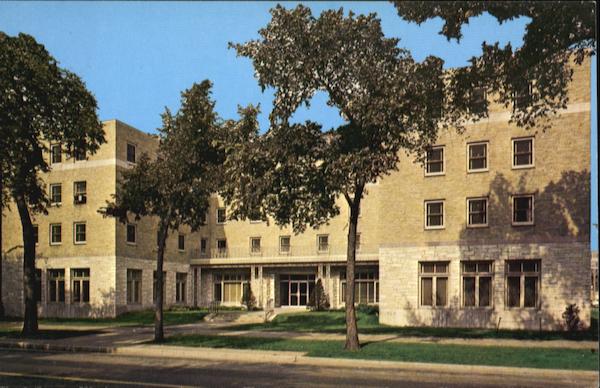
Parkway Eleanor Club, 1550 North Dearborn Parkway Chicago Illinois
Former Eleanor Residence for Working Women
and Students
Eleanor Residence for Working Women and Students

Location: 1550 N. Dearborn Parkway, Chicago, Illinois, USA

Opened: 1898

Closed: 2001


We're often told that the loss of womyn's space is some inevitable result of "progress." The Cool Girls, we are told, don't even want these things anymore!
But by reading carefully between the lines, we see that the real story is typically one of betrayal and selling out to more powerful interests (usually money, especially moneyed males). And notice that once again, the opinions of the women most affected by these decisions are decisively ignored. That these spaces are meaningful to womyn is just not even deemed worthy of notice. And notice all the mysterious "research" showing women didn't want this residence, but they couldn't find even one woman to interview who agreed!
This particular womyn's space, the Eleanor Residence, was lost over 15 years ago, but all those themes are here.
Funny how the loss of all these "old-fashioned" women's residences over the last decades of the 20th century has paved the way for women losing spaces that would have been unthinkable just a few years ago--bathrooms, locker rooms, sports teams. And we are still being told we're out of step with the times, fuddy-duddy, hysterical, or right-wing if we object.

From the Chicago Tribune:

Door closes on an era
For 103 years, Eleanor residences provided group homes and built-in friendship for single women.
With the sale of the last one--on prime Gold Coast land--the board hopes to help even more women and girls.

October 03, 2001|By Barbara Brotman, Tribune staff writer.

Kathleen Darley walked through the lobby of the Eleanor Residence with the elegant posture of the ballet dancer she is. Spotting Susan Rodriguez, she gave her two thumbs up.
"You got it?" Rodriguez asked eagerly.
"I think so," Darley said.
Rodriguez grinned. "Oh, we've got to celebrate tonight."


Darley had just had a promising audition for her dream job, a role in the Joffrey Ballet's "Nutcracker," which she later learned that she had indeed won. And inside this dormitory-like building on the Gold Coast, she had just received one of the benefits of the Eleanor Residence: the support of other women.
For 103 years, Eleanor residences have provided inexpensive, dormitory-style housing for single women in Chicago. In its heyday in the early 1900s, Eleanor was a vast social organization. There were Eleanor banking facilities; an Eleanor League for girls; an Eleanor monthly magazine; and an Eleanor Camp in Lake Geneva.
Though originally intended for young women starting careers, the residence came to serve newly divorced and widowed women, visiting students and women re-entering the work force.
But the residences' era came to an end Sunday, with the closing of the only remaining facility, the Eleanor Residence for Working Women and Students at 1550 N. Dearborn Pkwy. Darley and
Rodriguez were among the last residents.
In June, the board of the Eleanor Women's Foundation voted to end its role as a provider of housing, and become a grant-making philanthropy. It decided to close the last residence, sell the prime Gold Coast real estate [emphasis added], and use the proceeds to support programs for women and girls.
The sale is being conducted through the real estate firm of Newcastle Limited, which is evaluating the sealed bids that have come in.
Where single women once could not sign their own names on leases, now they routinely get their own apartments, said Susan Leinwohl, the foundation's executive director and an Eleanor resident in the 1960s.
"We've maintained a fairly decent occupancy, but demand has generally been decreasing," she said. "We feel that we can provide much more service to women and girls with the money that we will receive from the sale of the building. This is such a wonderful thing; I am really excited about this."
Closing brings sadness, anger
The women who lived at the Eleanor, on the other hand, were saddened.
"You have a built-in support system here. I have friends I'll know forever," said Darley, 21, a Texan who decided to begin her dance career in Chicago rather than New York partly because of the Eleanor.
And because the Eleanor provided two meals a day--room and board was $21 a day--it freed her to devote herself to dancing. "You move into a new city, and you just don't have a lot of time and energy for cleaning house and making an apartment," she said.

"I was devastated" to hear of the closing, said Linda Keller, 37, a courtroom Spanish interpreter who lives downtown. She stayed at the Eleanor from 1997 to 1999 when she moved back to Chicago from Spain, and while there established the "Happy Table," where residents dined by candlelight and spoke only of upbeat matters.
"It was such an opportunity for women," she said. "It was unique. It was a microcosm. You gathered women of all races, walks of life, social strata and educational status, and we learned from each other."
Some of the residents were furious about the closing.
"This place is really needed," said Rodriguez, 48, a nail technician known professionally as Fergie, who moved to the Eleanor when her 26-year marriage abruptly ended.
She thinks the board members don't understand how many women make low incomes and find themselves in desperate need of a temporary place to live.
"These women all drive BMWs and Audis," she said. "I don't think they realize what it's like to be out there."
Stephanie Ponn, 28, who works in sales and fundraising for the Chicago Sinfonietta, said she felt betrayed by the Eleanor board.
"They want to give the impression that these are all professional women here," she said. "But there are vulnerable women here--a woman who came here after a divorce and was starting life over again, women who were abused, women who are getting over mental problems. They knowingly took these women in and said, `You can stay here for two years,'" and then closed the residence.
"Maybe they want to help women, but I think they've been very hypocritical with the women here."
She found an apartment, as did Rodriguez and Darley, but worries that she may have to take on an additional or different job to afford it.
The board's point of view
Leinwohl said the board made every effort to help residents find other housing. The Eleanor Residence gave them free room and board for the month of September, and allowed them to take the room's furniture if they wanted. The board gave residents and employees three months' notice, she said, and brought in an apartment rental agency to help the women find new living quarters. Women who preferred communal living were referred to the Three Arts Club, a similar facility a few blocks away. (The Three Arts Club is specifically for women artists; at present, it has no openings until January.)


The Eleanor Women's Foundation deliberately tried to screen out women who were unable to live independently, she said.
"We are not set up to handle social service type of problems," she said. "Our advertising has always been clear: We are a residence for working women and students." It was also clear, she said, that this was not a permanent housing option; after two years, women had to move out.
"People are somewhat disgruntled; change is difficult," she said. "But the Eleanor really and truly has an obligation to serve as many women in Chicago as they can. I understand those feelings, but I'm pleased we can move forward."
The Eleanor board is not abandoning women, but changing in order to serve more of them, she said.
Only 1.4 percent of philanthropic funds in Chicago go to programs specifically for women and girls, according to a 1992 survey by Chicago Women in Philanthropy; the Eleanor Women's Foundation hopes that the proceeds from the property's sale can add significantly to those funds.
"We have to be the best possible stewards of our money," Leinwohl said. "If there were a real need for this [type of housing], the YWCAs would still be in this business." The YWCA of Metropolitan Chicago closed its last residence in 1972.
Before making the decision, the foundation spent a year and a half examining the needs of the women it was serving.
"Our research tended to show that women wanted other kinds of options for housing," Leinwohl said. "They wanted their own kitchens; their own bathroom facilities; and this is a little touchy, but they wanted [to be allowed to have] men in their room."
The rule prohibiting men above the first floor was a holdover from the Eleanor Clubs' early days.
Darley, who had actually heard the Eleanor was a convent, liked it because it allowed her to wander around in her pajamas freely; her parents loved it.
The tearoom days
The Eleanor Clubs were founded in 1898 by Ina Law Robertson, a Washington state school principal who moved to Chicago to attend graduate school at the University of Chicago. She thought young working women new to the city needed help making the transition from rural to urban life. She named her organization Eleanor after Eleanor Law, a friend whose wealthy brother had willed his estate to Law and Robertson for philanthropic purposes--Robertson took "Law" as her middle name out of respect for James Law. She also liked the name Eleanor because it means "light" in Greek.
Eleanor was a way of life. In 1916, according to the book "Women Building Chicago 1790-1990, A Biographical Dictionary," the Central Eleanor Club's tearoom downtown served 58,000 people; more than 2,000 young women took classes there in gymnastics, folk dancing, millinery and English. By 1920, the club occupied nearly an entire floor in the Stevens Building in the Loop.
At one point, there were six residential Eleanor Clubs in the city. The Gold Coast building, built specifically as an Eleanor residence, opened in 1956 as the Parkway Eleanor Club.
Leinwohl lived there from 1963 to 1965, when the young women there wore gloves and pillbox hats to interviews, and began reading Betty Friedan's "The Feminine Mystique."
"I absolutely loved it," she said. "I loved it better than my college experience. I met a wider range of interesting people. . . . Oh, it was so much fun."
But she believes that by becoming a philanthropic organization, the Eleanor Women's Foundation is honoring the spirit of its founder.
"She saw a need in her time. Well, we see needs that are not being met today," she said. "We're coming full circle, but in a different direction.

Tuesday, May 3, 2016

Women-only bus (Zhengzhou, China)

Not a "lost" space per se, but certainly endangered--just as all womyn's space is these days.

Once again, you have men complaining that women-only space is "sexist"--while simultaneously having no interest is stopping sexual harassment and rape. Very typical.

The coopted feminist lingo used to shut down female-oriented transportation may be new, but male attempts to shut these things down are actually at least 100 years old.

From the Shanghai-ist:

Women's only bus runs into accusations of sexism in Zhengzhou

ladies_bus1.jpg

Commuting women in the city of Zhengzhou can spend a little less time worrying about creeps now that the city has rolled out a "ladies-only" bus.

Predictably, controversy has sprung up in the Henan capital over this supposedly discriminatory form of transport. According to CCTV News, some male riders are complaining that the initiative is humiliating to men when there are so few individuals who would harass a woman in public.

Well, tell that to the women who became victims of this upskirt pervert at an Anhui bus station. In fact, a 2012 survey by China Youth Daily found that an incredible 81.9% of participants felt they had experienced sexual harassment on the subway.

ladies_bus3.jpg

The bus company installed this socially-conscious bus on route 906, one of the city's busiest bus routes. According to the Bus Transport Corporation of Zhengzhou, that route alone serves as many as 30,000 passengers in a single day.

The ladies' bus is offered during summertime rush hours to reduce the possibility of harassment to female patrons. The company also added a partner bus to follow along and avoid inconveniencing male passengers.

Female passengers appear to be satisfied by the service saying that they feel it's novel and respectful of women. Admittedly, nobody expected this kind of forward-thinking to come out of Zhengzhou. Last month, a city in Jiangxi became one of the few in China to provide women with special privacy booths for breastfeeding their children.

ladies_bus2.jpg

Aside from enjoying a pervert-free environment, the bus has got great ambiance too. It's decked out with plush teddy bears, a frilly driver's seat and a large red notice that reads "women's only bus." It seems like a pleasant respite from a world where nude men attack middle schoolers and bystanders hit record as women are murdered.

ladies_bus4.jpg

But you can't please everyone, one video that has gone viral on the Chinese internet shows an elderly man's reaction to the new bus service, shouting at the driver "You're discriminating against men!"
Watch the video below:


Unfortunately, women everywhere else in China are just going to have to start taking self-defense classes, to defend themselves from random pervs and pickpockets on public transportation:


By Matthew Patel

Saturday, April 30, 2016

Jecheon City Library

Jecheon, South Korea
Jecheon City Library

Location: North Changcheong Province, South Korea

Opened: ?

Closed: 2012

I sincerely doubt that the fellow who filed the complaint had any interest in using this women-only library at all. He was merely interested in finding a useful tactic for destroying it.

From The Korea Times:

Updated : 2012-02-07 18:56


Women-only library violates human rights

음성듣기

By Yi Whan-woo

The nation’s human rights agency said Tuesday that a provincial library open only to women violates basic human rights.

Its ruling came after a male resident filed a petition with the National Human Rights Commission of Korea in June concerning the lack of access for men to the  in North Chungcheong Province.

The commission took note of the fact that the library was built with the main purpose of serving women’s welfare. But the human rights agency ruled the restriction on men was still discriminatory.

“The provincial government had limited space at that time to build a library large enough to accommodate an influx of visitors, including men,” it said.

“But restrictions on men should be abolished as only 15 percent of the city’s population use the library,” it said.

“It can still serve its purpose to serve women by specializing services and using its resources and programs to promote female issues,” it added.

The library said it has kept the library open only to women in line with the wish of the person who donated the funds to construct the library. It also said that since the facilities were made to serve only women, it has been difficult to allow males.

Officials from the library, however, said they will consider whether they can take steps to allow male access.

Monday, April 25, 2016

Macy's Ladies Restaurant

Macy's Ladies Restaurant

Location: New York City, New York, USA

Opened/Closed: c. 1880

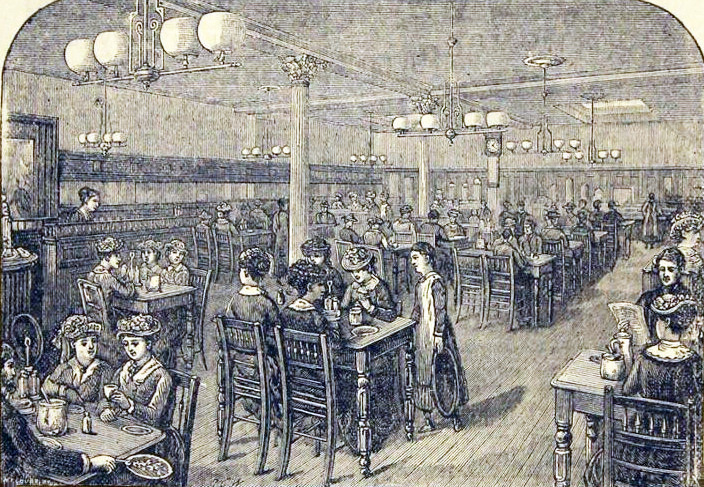
One of my very favorite blogs is Restaurant-ing through History. In a post on 1880s restaurants, the following is mentioned for 1880:

On the second floor of its newly expanded NYC department store, Macy’s restaurant for shoppers seats 200.

I'm not sure where this would have been in NYC, since the Herald Square location (still there today) didn't open till 1902.

But this was clearly a ladies restaurant. Check out the illustration below!

Though it was very common for men to crash "other" ladies restaurants of that era, perhaps one located in a department store failed to attract much interest. However, notice that it was not male-free. If you look carefully, you can still pick out a few fellows who just couldn't help themselves from barging in, though the New York of that era had tons of restaurants that were strictly male-only.

Macy's Restaurant (c. 1880)


London's Feminist Library


A volunteer browses through the books at The Feminist Library.
A volunteer browses through the books at The Feminist Library
Feminist Library
 
Location: London, England
 
Opened: 1975
 
Closed: Not closed yet, but endangered


From a longer piece at Womens Enews:

London’s Feminist Library Faces Eviction, Fights to Preserve History

LONDON (WOMENSENEWS)—When Sheila Hanlon was given the signal she began reading from Zadie Smith's "The Embassy of Cambodia." Magdalena Oldziejewska recited text from an academic book on women's leadership. Others in the crowd of about 80 also followed the conductor's prompts, sometimes reading in unison, other times not; loudly and then quietly.

They read together in protest outside the Southwark Council office, a local city council in central London, in late February to try to save The Feminist Library. The small, 41-year-old volunteer-run library boasts a large collection of women’s liberation movement literature, especially second-wave materials from the late 1960s to the 1990s.

"The Feminist Library is a dream space, a really special space," Hanlon recently told Women's eNews. "The idea of it is so powerful. It's something that everyone who identifies with feminism wishes they had in their city."

But now the library is feeling the same kind of economic pressure that is making London uninhabitable for many. Late last year the Southwark Council, which oversees the library’s borough, said the annual rent would rise to around $43,000 from $17,000.

In response, rally goers were asked to bring feminist books for a "read in" to protest the major rent hike. Those arriving empty handed could choose from a suitcase of books. Some also brought homemade banners, reading "Save the Feminist Library, Save Our Communities" and "Don't Erase Our Herstory."

Earlier that day Gloria Steinhem voiced support for the library, tweeting for it to "keep its home." Margaret Atwood tweeted support the week before.

The demonstration, part of a campaign that includes a petition and appeal for donations, worked. It won the library some time. But the fight for the library's future is far from over.

"What we achieved in a short time is amazing, but in six months what's going to happen?" said Caroline Smith, a volunteer and writer in residence at The Feminist Library, in an interview in the library's cramped office.

Housed on the first floor of a low-rise brown brick building that bears the sign "Multi-Purpose Resource Center," the library over 7,000 fiction and nonfiction books and 1,500 periodical titles from around the world. The library, which has been in this particular space for 30 years, is also an event and meeting space, runs a weekend bookshop and supports research, activist and community projects.

The Feminist Library is unique, Smith said, as it's used by both international researchers and local community groups. It's also fully accessible. "This is a safe space for women that exists in the public realm," she said. "These spaces are so few and far between."

Saturday, April 23, 2016

Women only communities: feminism's past or future?

This article doesn't refer to "lost" space per se. But it's an interesting read, though the author seems not entirely enthusiastic about the subject.

From Buzz:

Women only communities: feminism’s past or future?

Lottie Gross

The only sound to be heard is the clack of my shoes on the hard floor as I step inside the chapel - twenty Carmelite nuns stand before me undisturbed and immersed in prayer.

The only sound to be heard is the clack of my shoes on the hard floor as I step inside the chapel for Vespers. Twenty Carmelite nuns stand before me undisturbed and immersed in prayer. They live in silence and upon entering the order they vow to let go of their material possessions, to be obedient to God, and to submit themselves to a life of chastity.
Stainglass windows tell the story of Carmlite nuns in the Quidenham chapel
Stain glass windows tell the story of Carmlite nuns in the Quidenham chapel

No, I haven’t travelled back in time to meet these women but in fact to the tiny village of Quidenham in Norfolk. Sister Shelagh broke the rule of silence for me as I asked her what it’s like to live in such an intensely female environment.

“There is a deep bond of unity between us and it’s very supportive, living in a community. I know I couldn’t live this life on my own, so I’m very grateful for the support of the community.”

Sister Shelagh was married before she became a Carmelite nun. After ten years in her relationship she says she still hadn’t found contentment. She said turning to a life of monasticism, without our sexual counterparts, gave her a sense of contentment and comfort.

“It’s very rewarding and it gives full scope for human relationships, there’s no sense of having to cut bits of ones self off in order to live this life.”

Echoes of a patriarchal past


I’ve spent seven months investigating women-only communities, how they live and the issues they face. From Kenya to Brunei and now the UK, this convent is my last stop.

While I won’t disagree that all of the Sisters at the convent seem tranquil, I can’t help but think that chastity, obedience and silence echo past expectations of women in our once patriarchal society.

In today’s culture feminism and gender equality are two pressing and widely debated movements for the development of society and have been gaining momentum for over 100 years since the struggles of the Suffragettes in the late 18th Century. While all-female communities seem to be empowering women I wonder if they are holding women back.

This is not the case says Kat Pinder. As an organiser of RadFem 2013, a radical feminist conference in London, Kat considers herself a women’s liberationist and gender abolitionist. She says that all-female communities are essential for women’s liberation, “they are spaces where women can find themselves and remember themselves and understand who we are outside of male society”.

“A group of nuns, for example, who are based around a patriarchal religion, may not brand themselves as feminists initially but I have spoken a lot of women who have spent a lot of time in women only spaces and that’s how they’ve ended up coming to feminism, even though what they were doing was not necessarily organised around feminism.”

Jenny Eaton, from the Eos personal development programme for women, has seen this theory in motion and she says that women often become conscious feminists as a result of women only environments.

Active feminists


“Women who have never thought like it before begin look at the world in a different way because they have a different experience of being in groups of women because, with the odd exception, I have found that women learning and training together bond and they bond very quickly.

“Women who have a positive experience of personal growth in a group of women it actually makes them a feminist in a more active way.”

Of course, it’s not just religion that brings women together and not all these women are feminists. So what makes them want to be part of a world without men?

Clinical psychologist Bhavna Negandhi says that, as women, it’s in our nature to thrive in all-female environments:

“If you look at it from a biological and historical perspective, an evolutionary perspective, that’s what women did. Men used to go out hunting and the all female community was left behind to help each other out with children, companionship, emotions, and have general chit chat.

“Even now, while men turn to women for emotional support, women don’t seem to get the same from men. Women prefer to get their emotional support from other females and maybe wanting to be a part of all female group is probably for that emotional and even practical support.”

 A Kenyan cooperative


Judy Umoja
Judy came to the village four years ago
and has since learned attended school and
learned English
It was in the Kenyan Chalbi desert where I met a group of women who do just this. Having escaped from forced marriage to a HIV positive man three times her age, twenty-year-old Judy, pictured, found the Umoja Women’s Group: a community of women working and living together, where there are no men allowed.

She told me how when she arrived in the small town of Archer’s Post the women here took her in as their child and looked after her.

“When I came here, I heard that the village called Umoja was for women with problems, so when I arrived the women here took me in like their child and now I am ok, I am happy.”

Since its modest beginning in the 90s, when the village was just one mud hut and handful of destitute women, the community has grown enormously. Now the 48 women who live here, belonging to many different tribes, make and sell traditional tribal jewellery to tourists in order to keep the village running and have recently built a preschool for their children.

Bhavna says that when it’s not religion bringing women together, it’s the need for support of some kind like that of the women of Umoja, but there will always be competition and rivalry, there will always been bitchiness.
WRAC LADIES
They WRAC Association meet each year to
catch-up with old friends and celebrate their
contributions to the British Army.


Surreptitious sabotage and sisterhood


As an American teen, writer Jillian Lauren lived in an opulent palace in the colourful city of Brunei occupied by over 20 women who were all competing for the attention of one man: the Prince of Brunei, Jefri Bolkiah.

In this modern version of the traditional harem there was fierce competition, surreptitious sabotage and shifting alliances among the girls. But even while they were contending with one another, it wasn’t always a mean girls act.

“It was a really competitive environment in terms of the relationships between us girls, but there were some real friendships that arose out of it and I do think that women will take care of each other and that we did on some level.”

It is this consistent theme that runs throughout the groups that I have met in this investigation: this sense of sisterhood. Gender segregation has been a habitual part of society in the past, from single-sex education to the units in the armed forces, and men and women have fought for equality and integration in such environments. The Women’s Royal Army Corps (WRAC) was disbanded in the 90s after women demanded they be treated equally to men. Now both sexes live and work together throughout the military but some are still not happy. Ex-members of the WRAC say they often preferred the single sex structure, leading to questions about whether it is actually gender integration rather than segregation that is holding women back.


Wednesday, April 20, 2016

British Rail "ladies only" train compartments

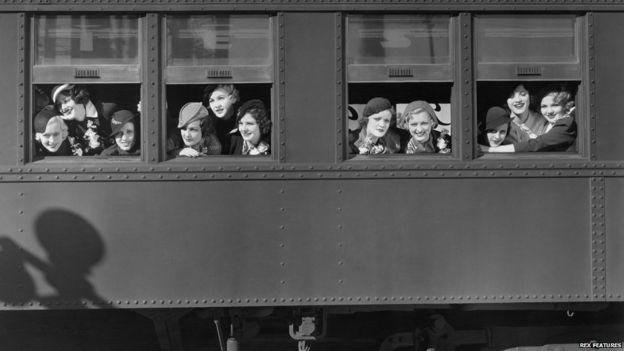
Women at a train window, 1940s
"Ladies Only" Train Compartment

British Rails "ladies only" train compartments

Location: United Kingdom

Opened: 1840s

Closed 1977

From the BBC News Magazine:

The era of 'ladies only' train compartments

By Jon Kelly
BBC News Magazine
26 August 2015

Labour leadership contender Jeremy Corbyn says he would consult on introducing rail carriages exclusively for women. But "ladies-only" compartments were once a familiar sight in the UK.

Today India, Indonesia, Japan and Mexico all offer female travellers their own sections of trains. And there's now much discussion over whether the UK should consider it. But for more than a century, British women did have similar facilities.

In March 1977, The Times reported that British Rail was phasing out its remaining "ladies only" compartments. At the time around 100 still existed on services between London and Essex.
Ladies Only sign on Southern Railway 4-sub S8143S
A "Ladies Only" Sign on Display at the
National Railway Museum

They operated from as far back as the 1840s, and by the 1850s South Eastern had a rule that a "carriage is always reserved for ladies if required".

In October 1874 they were introduced on London's Metropolitan Railway following a series of highly-publicised attacks on women travellers - according to York University railway historian David Turner, who has researched the subject.

Calls for the carriages grew after 49-year-old Col Valentine Baker was convicted of indecent assault on a 21-year-old woman on a service from Portsmouth to Waterloo in June 1875.

The victim was forced to flee through the compartment's only door, which opened externally, leaving her balancing on the running board outside the moving train and clutching the door handle until the train came to a halt.

"Women were travelling alone and they were worried about being attacked as they went through tunnels," says cultural historian Fern Riddell. Women at a train window, 1940s

Turner says the compartments were "rooted in the Victorian archetype of women being meek and submissive, who should know their place".

But much of the impetus for them came from women themselves, says Riddell. It was a period when women were commonly subjected to verbal and physical harassment in public places, she says, and, just as today, many demanded protection from it.

There were grumbles about the new sections from the outset, however. "Why will not ladies, especially when alone, travel in the carriage set apart as 'The Ladies' Carriage?'," wrote one correspondent to The Times on 25 June 1875, who complained that it was frequently empty while the rest of the train was full.

"A British Mother" replied in a letter to the editor that these compartments were "very frequently occupied by nurses and children" and that there was continuous "baby talk". She continued: "All ladies are not prepared to encounter the desagrements incident to the crying, feeding of children not their own."

Indeed, take-up was never as high as anticipated. "They were never that popular," says Bob Gwynne of the National Railway Museum.

During trials conducted in 1887, Great Western found that just 248 of 1,000 female-only seats were taken up, while more than 5,000 women used the smoking cars, says the NRM's Oliver Betts.

Newer trains were built with doors that opened on to internal corridors rather than out into the open air. Changing social attitudes, too, meant lone female travellers were less of a novelty.

But the "ladies only" compartments remained, generally denoted with green signs to distinguish them from smokers' sections, which were red.

During World War One, the Liverpool Echo reported (perhaps fancifully) that a student travelling to London in a women-only compartment had sat alongside two nuns. On the way, the young woman noticed that one of the sisters "disclosed a masculine wrist". The student informed the guard and when they reached their destination, the nuns "found themselves under arrest as dangerous German spies".

A 1936 Great Western Railway rulebook required guards to inform any unaccompanied women that the "ladies-only" compartments were available.

But women did not always take them up on the offer. In November of the same year, Transport Minister Leslie Hore-Belisha was asked in the Commons about them. "I am informed that there are carriages marked 'ladies only', but that the ladies prefer not to use them," he told the House.

By the 1960s they were a rarity, persisting mainly on suburban lines, and the replacement of compartments with open carriages rendered them impractical, says Gwynne.

But since then there have been calls for their reintroduction. In 1999 it was reported that ministers were planning to introduce women-only carriages on London Underground trains. Last year Transport Minister Claire Perry told the Conservative party conference she was open to the idea of bringing them back to the wider rail network to reduce sex attacks.

However, a report last year for the Department of Transport, by Middlesex University, said this would be a "retrograde step" that "could be thought of as insulting, patronising and shaming to both men and women".