Monday, July 13, 2015

L's

Patricia Highsmith at 21
L's

Location: Macdougal Street, New York, New York, USA

Opened/Closed: 1930s-1940s

I have found exactly one reference to L's. That was in a December 2009 New York Times article on the lesbian novelist Patricia Highsmith. The article discusses a lot of the places where Highsmith used to go in the 1930s and 40s, when she lived in New York's Greenwich Village. A brief selection:

A few blocks east is Macdougal Street, the home of some of Highsmith’s other favorite, now extinct, hang-outs like the Jumble Shop, a Prohibition-era tearoom she and [Judy] Holliday (then Judy Tuvim) went to in high school and L’s, a lesbian bar where she would later troll for lovers. Macdougal is also where the cop Clarence Duhamel in “A Dog’s Ransom” stays with his girlfriend.

Where Macdougal meets Waverly Place stands the refurbished Washington Square Hotel, formerly the Hotel Earle, a seedy spot that both Highsmith and her mother often checked into when visiting New York later in life. It was the scene of many of Highsmith’s seductions and the inspiration for her short story “Notes From a Respectable Cockroach.”


I'm wondering, though, if "L's" wasn't a shorthand for Louis' Luncheon at 116 MacDougal Street. From an NYC Landmarks Commission report on the "20th Century Lesbian Presence" in South Village Historic District, Manhattan:

By the 1920s, the South Village emerged as one of the first neighborhoods in New York that allowed, and gradually accepted, an open gay and lesbian presence. Eve Addams’ Tearoom at 129 MacDougal Street was a popular after-theater club run in 1925-26 by Polish-Jewish lesbian emigre Eva Kotchever (Czlotcheber), with a sign that read "Men are admitted but not welcome." Convicted of "obscenity" (for Lesbian Love, a collection of her short stories) and disorderly conduct, she was deported. Later popular lesbian bars were: Louis’ Luncheon (1930s-40s), 116 MacDougal Street; Tony Pastor’s Downtown (1939-67), 130 West 3rd Street, which was raided on morals charges in 1944 for permitting lesbians to "loiter" on the premises, but survived with mob backing until the State Liquor Authority revoked its license in 1967; jazz club Swing Rendevous (c. 1940-65), 117 MacDougal Street; Ernie’s Restaurant/ Three Ring Circus (c. 1940-62), 76 West 3rd Street; Mona’s (c. late 1940s-early 1950s), 135 West 3rd Street, later The Purple Onion (c. 1965-72); Pony Stable Inn (c. late 1940s-1968), 150 West 4th Street, remembered by African-American lesbian poet Audre Lorde in Zami; and Bonnie & Clyde’s (c. 1972-81), 82 West 3rd Street.
 
I believe all these other places have been posted on before--except for Louis' Luncheon.

Thursday, July 9, 2015

Rose's Lesbian Boarding House

Rose's Lesbian Boarding House
Rose Hovick
Rose Hovick

Location: West End Avenue, New York, New York, USA

Opened/Closed: 1930s

Rose's Lesbian Boarding House is one of those absolutely random finds--you're looking for one thing, but you get distracted by something else, and on it goes.

Those of you who are into American musical theater probably remember Gypsy, which was based on the 1957 memoir of "striptease artist" Gypsy Rose Lee. The book (and subsequent musical and movie) introduced us to Rose Hovick, who has become immortalized as the ultimate stage mother.

Yet Rose did something rather interesting in later life, which was running a lesbian boarding house (and possibly a lesbian farm as well, depending on the source).

This boarding house is mentioned in a number of sources related to Gypsy Rose Lee, but unfortunately, all of them are brief, rather cryptic, and somewhat contradictory.

From Jewish Currents:

Gypsy’s mother, Rose Hovick, ran a lesbian boarding house in New York and shot and killed one of her lovers when she made a pass at Gypsy.

From Historylink:

Madam Rose died in 1954. Her last words threatened her daughter Louise, promising to drag her daughter into death with her. In later years, Rose had run a lesbian boarding house and farm. One of her guests was shot at a party, and the verdict was suicide, but Lee’s son, Erik Preminger, is quoted in a Vanity Fair article saying that the victim was Rose’s lover, and that Rose killed her in front of many witnesses after she made a pass at Gypsy.

From Hub Pages:

According to her sister Belle, she blackmailed, or begged her daughters for money and gifts, often showing up to visit dressed in ragged clothing and claiming to be poor. In the meantime she was running a Lesbian boarding house, and Gypsy had rented her a farm.

In one of his biographies of the family he grew up in grandson Erik Lee Preminger alleges that Rose actually shot and killed a guest for making a pass at Gypsy, also alleging the person shot was Rose's lover. Obviously, with the internet and research, again, more than one story. In some accounts it is a boarding house guest, in others the guest is decidedly a male and a guest at a party.
 

Sometimes, it is claimed that daughter Louise (Gypsy) rented the boarding house. From Wikipedia:

Later on in her life, her daughter Gypsy Rose Lee rented both a farm in Highland Mills, New York and a lesbian boardinghouse in a ten-room apartment on the seedy West End Avenue in Manhattan. At some point, one of the guests made a pass at the visiting Gypsy (according to Erik Preminger, her son by director Otto Preminger), who was said to be Mother Rose's own lover, and in a jealous rage Mother Rose shot the lover/guest dead. This incident was publicly explained as a suicide.

One of the fullest description seems to be from Matt & Andrej Koymasky:

Rose (or Mama Rose, as she is best known), who was Jewish and lesbian, had married John Hovick, a newspaperman, at the age of fifteen, and was the classic example of a smothering stage mother who insistently pushed her two daughters into stardom: stripper Gypsy Rose Lee and actress June Havoc; Gypsy's story about lives of the three women became the a 1959 hit musical, Gypsy: A Musical Fable.
Rose was no longer bothering with men. She had, as Havoc would write, 'turned toward her own sex,' at first running a lesbian boardinghouse in a 10-room apartment Gypsy rented for her on West End Avenue, and then running a sort of lesbian farm in her country house in Highland Hills. At a party in that house, Rose pulled another gun, this time on one of the girls. She killed her. Because Gypsy was a star, it was covered up. "There were a lot of people there when it happened". says Erik Preminger [Gypsy's son], who had heard the same story from three people. "The girl was Rose's lover and she made a pass at my mother."
Gypsy Rose Lee, her daughter, born around 1910 and died from cancer in 1970. The only living Hovick was June Havoc (nee Hovick), her other daughter, who was born in around 1915.


Boz Hadleigh in Broadway Babylon throws a brothel into the mix:

In the Broadway version [of the musical], after Louise blossoms into a relatively demure stripper and strikes out on her own, it's suggested that Mama (never referred to as "Mama Rose") could open an acting school for kids, to keep occupied. In reality, Rose Hovick wound up running a lesbian boarding house and brothel. This was revealed in June Havoc's second autobiography, More Havoc, published in 1980, by which time The Topic could finally be broached (her first book, Early Havoc, in 1959, was a sisterly attempt to grab back some of the limelight from Gypsy, whose memoirs had angered June less than the resultant hit musical).

June's mother had informed her, "Sex is dirty because men are dirty." As for her lesbian tenants, Rose warned, "Don't you dare feel superior to those girls. At least they have the good sense to know they can't get pregnant with spit!"

But just to add to the confusion,  Carolyn Quinn in Mama Rose's Turn, The True Story of America's Most Notorious Stage Mother, isn't convinced there ever was a lesbian boarding house:

Then there was the story that Rose, who had rented out rooms, probably for less than a year, in her Manhattan apartment to ladies who quite possibly had been lesbians, had run a "lesbian boarding house." No one who knew of Rose's love for the almighty buck could have ever bought into the idea that Rose would have turned away paying customers based on their sexual orientation. Paying customers of every orientation made Rose's heart sing.

Quinn also doubts that Rose ever shot and killed any woman lover in said boarding house.

Monday, July 6, 2015

Hermitage Ladies Restaurant

Ad for the Hermitage, New York Times,
January 24, 1910
Hermitage Ladies Restaurant

Location: 42nd Street and 7th Avenue (Time Square), New York, New York, USA

Opened/Closed: c. 1910


We haven't posted on a ladies restaurant in a while, and it seemed like time.

Hotel Hermitage (1915)
Separate eating and drinking establishments for ladies and gentlemen were fairly common in the years before Prohibition.

Though ladies escorted by gentlemen were no doubt admitted into the ladies restaurant, but ladies were not admitted into the Gentlemen's Café and Grill whether they were escorted or not.

Still a familiar double standard when it comes to womyn's space.

Friday, July 3, 2015

Hollywood

Behind the BarsThe Hollywood

Location: 304 West 4th Street, Austin, Texas, USA (later 113 San Jacinto)

Opened/Closed: 1980s through 90s

Hollywood is mentioned in an Austin Chronicle article on lost gay and lesbian bars.

The first gay bar I went to was in Dallas. I didn't drink or smoke. I was real naive. I was like, "What is this scene ...?" But they played ABBA, and I was like: "Cool! I like Abba! OK!" It was real confusing. I was more into seeing shows. I went to clubs like Club Foot. There was kind of a crossover. Androgyny was being played with a lot at that time. "Oh he's the straightest guy there is, but he likes to look like Eno!" There were all these weird crossed signals, and then if you went to a gay bar, everybody looked totally like John Travolta. We liked going to the Hollywood because they played soul. We thought, "This is pretty cool." We'd go there on the way to the Ritz to have a couple of drinks before a show. My friend was so confused. He'd get frustrated. He would be like, "Oh, that guy is sooo cute, and I was like, "That's a girl." – Dan Plunkett, owner of End of an Ear Records

I hated the Hollywood. The thing about the Hollywood, that was a place where there was gonna be fights. It was in 1984. I did Deborah Hay's big group dance thing, and there was this one movement, and I'm on the dance floor, doing my dance. Whatever. We were doing some crazy dances; I hung out with dancers. And this girl kicked me in the head! 'Cause, granted, I had this move where my head was down, but I was like, "Did you just kick me in the head?" And she said, "Yup." And I said, "Well, why?" And she said, "'Cause you're dancing funny," in a really defiant way, and I remember going out into the parking lot and crying. Crying my eyes out. You know what? Many people will tell you about a gay bar where the end of the story is "I was in the parking lot crying!" I never went back to the Hollywood. – Gretchen Phillips

Crying is not the worst thing that ever happened in the Hollywood parking lot. A lesbian was shot to death here in March 1980. Unfortunately, the most comprehensive reference I can find to the incident consists of two sentences at Gay History Wiki:

Carol Oetting was killed by a single shot to the head as she was parking her car at “The Hollywood”, a lesbian bar in Austin, Texas. Police reported that they had discovered no suspect or motive.

Not surprisingly, the murder does NOT show up on any LGBT lists of hate crimes that I can find, even though it took place in the parking lot of a lesbian bar. Unfortunately, this kind of erasure is not uncommon when it comes to the murder of lesbians.


Tuesday, June 30, 2015

Green Street Rooming House

66 Green Street, 2013
66 Green Street (2013)
Green Street Rooming House

Location: 66 Green Street, Northampton, Massachusetts, USA

Opened: 1975

Closed: 1992

From the Five College Archive & Manuscript Collections:

The Green Street Rooming House was a lesbian cooperative started in the Elmhurst apartment house at 66 Green St in Northampton, Massachusetts. It operated from circa 1975 to 1992. From the 1960's on, Northampton had become a haven for lesbian and feminist activity. Some residents of the boarding house were students at the five colleges, and others were lesbians coming out of the closet seeking freedom to express their sexuality. The rooming house was established as a lesbian-only residence with a designated live-in manager who functioned as a liaison between the residents and the landlord. The house operated in a cooperative spirit by rotating cleaning chores and sharing in the preparation of meals. A notebook was always kept in the central hallway for residents to write messages to each other.
 
The owner and landlord, Michael Cohen and his assistant manager John Knowles, provided basic house supplies, such as toilet paper, soap, light bulbs and cleaning products and also authorized maintenance for heat, electric and plumbing. Initially, the landlord was not told that the current lesbian tenants were starting a lesbian-only household. Eventually, he found out and thought it amusing that a group of women wanted to maintain a cooperative community in a rooming house. In 1992 the building was sold to Housing and Economic Resources for Women and it eventually became a co-ed rooming house. In 2007 it was bought by Smith College and was torn down in 2013.

Sunday, June 28, 2015

Isis


Isis

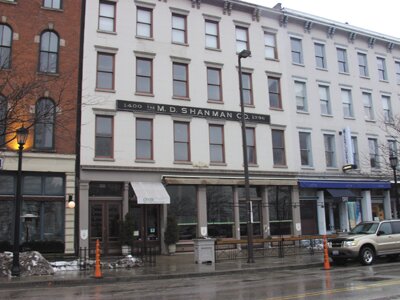
Location: 1400 West 6th Street, Cleveland, Ohio, USA

Opened: Unclear

Closed: 1989

Isis is yet another lesbian bar that, unfortunately, is probably best remembered for a violent crime against lesbians. Back in June 1982, two lesbians were abducted at gunpoint from a nearby parking lot. One woman, Mary Ann Finegan, was shot to death. The other, who prefers to remain unnamed, was raped, shot, and left for dead after witnessing Mary Ann's murder.

It would not be until 2010--28 long years later--that the killer was brought to justice.

Yet another reminder as to why we should suspect the motives of men who hang around womyn's spaces.

From Gay People's Chronicle:

Isis was a popular bar at 1400 West 6th Street near the corner of Frankfort Avenue, “for the contemporary woman,” according to a July, 1982 ad in the gay monthly High Gear. It was known to women in Cleveland and Akron, where Finegan lived with her four dogs in nearby Barberton. Isis closed in 1989, and the space has since been home to a variety of businesses, though none gay or lesbian. It is now Crop Bistro and Bar.

“Mary Ann and I had broken up the week before and had no plans to meet up with each other that night,” continued the survivor, now 66, who asked that her name not be printed.

“We got to the bar around 9:30 or 10 pm,” said the friend who joined her for dinner that evening, who also asked that her name be kept private. She has helped care for the survivor and been a companion to her for almost three decades, and remains protective of her. “It was a nice evening. We parked the car and sat in the parking lot talking for awhile.”

Later, the friends noticed Mary Ann’s pickup truck and saw her walk toward the bar. “I knew she was probably looking for me,” the survivor recalled. She left her purse in her friend’s car and went to talk to ‘Finy’ while her dinner companion went inside the bar.

“We all called Mary Ann ‘Finy,’ ” she noted.

The two walked to Finegan’s truck and got in. “Mary Ann was a great listener but she had a hard time expressing herself.” That night, she seemed kind of upset, like she needed to talk.

They talked for a while and Finegan started the truck to move to a parking spot closer to the bar, according to early police reports of the incident. Before she could park, a man suddenly opened the passenger door, put a gun against the survivor’s chest while climbing in and told Finegan to drive “or I’ll kill her.”

Wednesday, June 24, 2015

Park View Grill

Park View Grill

Location: Carolina Beach Road, Wilmington, North Carolina, USA

Opened/Closed: c. 1990

The only Internet references I can find for the Park View Grill are all related to the murder of a lesbian by a man she met while playing pool there. Sometimes women need to be reminded as to why we need safe women-only spaces.

And we need to seriously question the motives of why men want to go to these (very few remaining) spaces. We need to keep our eyes wide open, as too many women are way too naïve and trusting. They fail to even speculate why these women-hating, lesbian-obsessed little sh**s want to "hang out" with us. And women are dying as a result.

In this particular case, I would suggest NOT looking up the details of the crime. It was a typical sociopathic/sadistic over-kill in the worst way.

From Q Notes:


Community remembers 1990 hate crime victim
Memorial breaks the silence on Talana Kreeger slaying

by Bambi Weavil, Special to Q-Notes


Talana Kreeger, 32, was raped and murdered by Ronald Sheldon Thomas (pictured right) in Wilmington, N.C., on Feb. 22, 1990.
WILMINGTON, N.C. — Eighteen years ago, Talana Kreeger was brutally sexually assaulted and murdered in a vicious hate crime here. The painful memory of that tragic event has been held in silence in this Coastal community — until now.

Community members gathered into a packed sanctuary at St. Jude’s Metropolitan Community Church on Feb. 22 to remember and celebrate Kreeger’s life. They came to express the need to answer the questions of why Talana Kreeger was murdered and why the community had been silent about such a brutal and passionate crime of hate.

Kreeger, 32, was murdered by truck driver Ronald Sheldon Thomas on Feb. 22, 1990, after leaving Park View Grill, a lesbian establishment, where they drank and played pool. Kreeger was remembered as fun-loving, loved and free-spirited.

The memorial service allowed community members to express the need to start the process of healing within the gay community and come together to fight for stronger hate crime legislation in North Carolina and nationwide.

The gathering was organized by Tab Ballis, director of “Park View,” a documentary-in-progress about Kreeger’s murder. He hoped the memorial would provide healing for individuals who knew her personally. Film clips of “Park View” were shown between speakers including Kristen Dempsey, Lynette Miller, Frank Harr, Ken Cox, Scott Whisnant and state Rep. Pricey Harrison (D-Guilford).

Miller, Kreeger’s friend, told the audience how Talana freed spiders when she encountered them and wanted to let them live instead of killing them. Miller emphasized that Kreeger was a lover of all animals and a generous and giving friend to anyone who knew her.

The Rev. Amanda McCullough led the lamentation and prayer for affirmation in hope that the community would continue to honor Kreeger’s life as well as the dedication of a memorial plaque to be placed at St. Jude’s.

The church is also is establishing a memorial fund in honor of Kreeger and other victims of hate crimes. Money specifically donated to the Talana Kreeger Memorial Fund will be used to establish a special prayer garden.


Ronald Sheldon Thomas
Various speakers from the community also related their stories and thoughts, including local lesbian author Cheryl Cushine, gay leader and activist Bo Dean, Director of the Rape Crisis Center Amy Feath and New Hanover County District Attorney Ben David.

Dean expressed passionately the need for the gay community to address its internal divisions, and urged everyone to come together and unite in the fight against hatred. Laura McClain, a local lesbian singer/songwriter who is also an associate producer and music director for “Park View,” performed selected songs including “We are a Gentle Angry People” and “Left for Dead” — written in Kreeger’s memory.

This article gives a few more details, though it's pretty circumspect about the lesbian angle to this crime. Not even the owner seemed to suspect why this guy, basically a drifter, was hanging around all night:

It was about 1:30 a.m., on Thursday, Feb. 22, 1990, almost closing time at the Park View Grill, a bar on Carolina Beach Road.
      
The owner, Wanda Whitley, and her roommate, Heidi Crossley, were shooting pool in the back room. With them were Talana Quay Kreeger, a carpenter who had been doing some remodeling on the Park View, and Ronald Sheldon Thomas, a long-haul trucker who had pulled in a few hours and about 10 beers earlier.
 
The foursome discussed heading to a nearby Hardee's for something to eat. Kreeger, 32, hitched a ride in Thomas' tractor-trailer rig.
 
They never made it to Hardee's.