Showing posts with label lesbian boarding house. Show all posts

Thursday, July 9, 2015

Rose's Lesbian Boarding House

Rose's Lesbian Boarding House
Rose Hovick
Rose Hovick

Location: West End Avenue, New York, New York, USA

Opened/Closed: 1930s

Rose's Lesbian Boarding House is one of those absolutely random finds--you're looking for one thing, but you get distracted by something else, and on it goes.

Those of you who are into American musical theater probably remember Gypsy, which was based on the 1957 memoir of "striptease artist" Gypsy Rose Lee. The book (and subsequent musical and movie) introduced us to Rose Hovick, who has become immortalized as the ultimate stage mother.

Yet Rose did something rather interesting in later life, which was running a lesbian boarding house (and possibly a lesbian farm as well, depending on the source).

This boarding house is mentioned in a number of sources related to Gypsy Rose Lee, but unfortunately, all of them are brief, rather cryptic, and somewhat contradictory.

From Jewish Currents:

Gypsy’s mother, Rose Hovick, ran a lesbian boarding house in New York and shot and killed one of her lovers when she made a pass at Gypsy.

From Historylink:

Madam Rose died in 1954. Her last words threatened her daughter Louise, promising to drag her daughter into death with her. In later years, Rose had run a lesbian boarding house and farm. One of her guests was shot at a party, and the verdict was suicide, but Lee’s son, Erik Preminger, is quoted in a Vanity Fair article saying that the victim was Rose’s lover, and that Rose killed her in front of many witnesses after she made a pass at Gypsy.

From Hub Pages:

According to her sister Belle, she blackmailed, or begged her daughters for money and gifts, often showing up to visit dressed in ragged clothing and claiming to be poor. In the meantime she was running a Lesbian boarding house, and Gypsy had rented her a farm.

In one of his biographies of the family he grew up in grandson Erik Lee Preminger alleges that Rose actually shot and killed a guest for making a pass at Gypsy, also alleging the person shot was Rose's lover. Obviously, with the internet and research, again, more than one story. In some accounts it is a boarding house guest, in others the guest is decidedly a male and a guest at a party.
 

Sometimes, it is claimed that daughter Louise (Gypsy) rented the boarding house. From Wikipedia:

Later on in her life, her daughter Gypsy Rose Lee rented both a farm in Highland Mills, New York and a lesbian boardinghouse in a ten-room apartment on the seedy West End Avenue in Manhattan. At some point, one of the guests made a pass at the visiting Gypsy (according to Erik Preminger, her son by director Otto Preminger), who was said to be Mother Rose's own lover, and in a jealous rage Mother Rose shot the lover/guest dead. This incident was publicly explained as a suicide.

One of the fullest description seems to be from Matt & Andrej Koymasky:

Rose (or Mama Rose, as she is best known), who was Jewish and lesbian, had married John Hovick, a newspaperman, at the age of fifteen, and was the classic example of a smothering stage mother who insistently pushed her two daughters into stardom: stripper Gypsy Rose Lee and actress June Havoc; Gypsy's story about lives of the three women became the a 1959 hit musical, Gypsy: A Musical Fable.
Rose was no longer bothering with men. She had, as Havoc would write, 'turned toward her own sex,' at first running a lesbian boardinghouse in a 10-room apartment Gypsy rented for her on West End Avenue, and then running a sort of lesbian farm in her country house in Highland Hills. At a party in that house, Rose pulled another gun, this time on one of the girls. She killed her. Because Gypsy was a star, it was covered up. "There were a lot of people there when it happened". says Erik Preminger [Gypsy's son], who had heard the same story from three people. "The girl was Rose's lover and she made a pass at my mother."
Gypsy Rose Lee, her daughter, born around 1910 and died from cancer in 1970. The only living Hovick was June Havoc (nee Hovick), her other daughter, who was born in around 1915.


Boz Hadleigh in Broadway Babylon throws a brothel into the mix:

In the Broadway version [of the musical], after Louise blossoms into a relatively demure stripper and strikes out on her own, it's suggested that Mama (never referred to as "Mama Rose") could open an acting school for kids, to keep occupied. In reality, Rose Hovick wound up running a lesbian boarding house and brothel. This was revealed in June Havoc's second autobiography, More Havoc, published in 1980, by which time The Topic could finally be broached (her first book, Early Havoc, in 1959, was a sisterly attempt to grab back some of the limelight from Gypsy, whose memoirs had angered June less than the resultant hit musical).

June's mother had informed her, "Sex is dirty because men are dirty." As for her lesbian tenants, Rose warned, "Don't you dare feel superior to those girls. At least they have the good sense to know they can't get pregnant with spit!"

But just to add to the confusion,  Carolyn Quinn in Mama Rose's Turn, The True Story of America's Most Notorious Stage Mother, isn't convinced there ever was a lesbian boarding house:

Then there was the story that Rose, who had rented out rooms, probably for less than a year, in her Manhattan apartment to ladies who quite possibly had been lesbians, had run a "lesbian boarding house." No one who knew of Rose's love for the almighty buck could have ever bought into the idea that Rose would have turned away paying customers based on their sexual orientation. Paying customers of every orientation made Rose's heart sing.

Quinn also doubts that Rose ever shot and killed any woman lover in said boarding house.

Tuesday, June 30, 2015

Green Street Rooming House

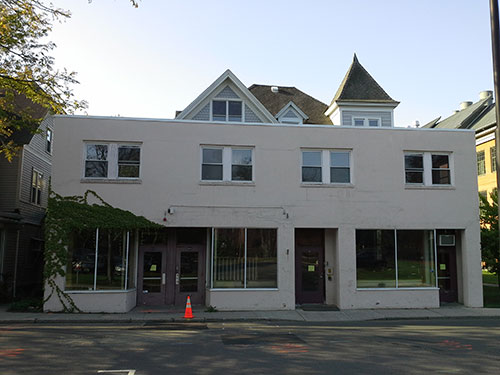
66 Green Street, 2013
66 Green Street (2013)
Green Street Rooming House

Location: 66 Green Street, Northampton, Massachusetts, USA

Opened: 1975

Closed: 1992

From the Five College Archive & Manuscript Collections:

The Green Street Rooming House was a lesbian cooperative started in the Elmhurst apartment house at 66 Green St in Northampton, Massachusetts. It operated from circa 1975 to 1992. From the 1960's on, Northampton had become a haven for lesbian and feminist activity. Some residents of the boarding house were students at the five colleges, and others were lesbians coming out of the closet seeking freedom to express their sexuality. The rooming house was established as a lesbian-only residence with a designated live-in manager who functioned as a liaison between the residents and the landlord. The house operated in a cooperative spirit by rotating cleaning chores and sharing in the preparation of meals. A notebook was always kept in the central hallway for residents to write messages to each other.
 
The owner and landlord, Michael Cohen and his assistant manager John Knowles, provided basic house supplies, such as toilet paper, soap, light bulbs and cleaning products and also authorized maintenance for heat, electric and plumbing. Initially, the landlord was not told that the current lesbian tenants were starting a lesbian-only household. Eventually, he found out and thought it amusing that a group of women wanted to maintain a cooperative community in a rooming house. In 1992 the building was sold to Housing and Economic Resources for Women and it eventually became a co-ed rooming house. In 2007 it was bought by Smith College and was torn down in 2013.

Sunday, January 25, 2015

Geneva House

Geneva House
96 Geneva Street today - an empty lot

Location: 96 Geneva Street, Highland Park, Michigan, USA

Opened: Early 1970s

Closed: Mid to late 70s?

This description of Geneva House is taken from a longer June 2014 PrideSource article called LGBT Time Capsule: Dr. Tim Retzloff Chronicles Detroit's LGBT History:

While commune style living may be more synonymous with San Francisco, the Detroit area had its own lesbian commune in the early 1970s when a small group of women took an ordinary wood-frame house at 96 Geneva St. at the corner of Second Blvd. in Highland Park and turned it into a lesbian-feminist sanctuary.

Geneva House had its origins with a feminist guerilla street theater troupe that performed on the Wayne State University campus and around downtown Detroit, but soon shifted to an all-lesbian commune that founder Jaye Spiro said housed the "Dyke House Gang."

Generally, five women lived at Geneva House at any given time, along with several pets, in an area that was racially mixed. There were four bedrooms, with one resident putting up a hammock to sleep in. One of those residents, Merilee Melvin, said "We all had very bad haircuts and there was a lot of no bra stuff and cotton T-shirts, baggy jeans; there was no dressing up. No girly stuff, it was a very anti-femme scene. And the Geneva House was sort of that thing."

"It kind of became, to some extent, a kind of lesbian community center," Melvin explained. "The Wayne State Gay Liberation Front would refer calls from women to our phone number. So we became this sort of informal lesbian helpline. And I remember talking to people on the phone. Man! Because in the early '70s, it was really hard to get information about what it means to be a lesbian."

Today, 96 Geneva Street is a vacant residential lot. In fact, it appears this former womyn's space is for sale and has an estimated market value of $58,500.

Saturday, July 26, 2014

Canterbury Castle and other collective houses in Sydney, Australia

Canterbury Castle
New Canterbury Road, Petersham, Sydney

Location: Canterbury Road, Sydney, Australia

Opened/Closed: Mid 1970s

According to Rebecca Jennings, Canterbury Castle was a women's "collective house" that grew out of the Sydney's vibrant lesbian-feminist scene back in the mid 1970s. Crystal Street (sometimes spelled Chrystal Street) was another.

She further discusses Canterbury Castle in a wonderful article called Lesbian Spaces: Sydney, 1945-1978:

Just as private houses had played an important role in lesbian socialising in the immediate post-war decades, as a location for private parties, with the advent of a lesbian political movement in the 1970s, lesbian collective houses became a central part of the lesbian scene. Sandra, who became part of the lesbian feminist scene in Sydney in the 1970s, recalled:
  
We lived in big group shared households, you know lesbian houses. And two of the earliest ones in Sydney were… one was in Petersham and it was called Canterbury Castle because it was on Canterbury Road and it was a big house and… a whole lot of lesbians lived there. And there was also one on Crystal Street in Petersham, which I think was called Crystal Street.


In 1974, members of the radicalesbian households at Canterbury Castle and Crystal Street were interviewed by feminist journal Refractory Girl for an article on collective households. They told the interviewer that what held the household together was a shared commitment to the women’s movement and the fact that there was ‘more energy to be directed towards others women’.


Many of the women in shared households would have been on the dole or working in casual jobs, but there was frequently an ideological commitment to sharing domestic responsibilities. Chris had fond memories of the shared lesbian household she lived in in Lewisham and the sense of togetherness which came from sharing household tasks. She recalled: ‘We had our bikes and you know, we’d go off to the Paddy’s Market, somebody’d go to the Paddy’s Market, somebody’d go to the butchers, somebody’d go there, so we did all that. So it was a very nice household. Mind you, I did get thrown out for not doing any housework.’

For the women who lived there, collective houses represented a small lesbian community in themselves. Sandra recalled that ‘some of them were quite big houses, like one of the ones that I lived in, in Redfern, in Chalmers St, it was six bedrooms… so you might have 10 people living there and then you’d have people coming and going as well.’For lesbian feminist visitors from other states, lesbian collective houses were often the first port of call when they visited Sydney and provided a base from which to engage in political activities in the city. One of the residents of Crystal Street told Refractory Girl: ‘Here at Crystal Street we get so many visitors – there’s a continuous exchange of people. We’ve got people from Melbourne staying here now: Melbourne, Adelaide, Newcastle, Canberra, New Zealand.’

Diane Minnis further discuses these places here.


Thursday, April 28, 2011

Edith Mary Chapman's Boarding House

East 900 South Street today
Edith Mary Chapman's Boarding House

Location: 615 Nine South Street (now East 900 South Street) across the street from Liberty Park, Salt Lake City, Utah, USA

Opened: 1923

Closed: 1931

Until the Second World War, boarding houses were a very common form of urban housing, especially for young, unmarried women. In fact, keeping a boarding house was one of the few "respectable" ways for middle class women to earn a living in the 19th and early 20th centuries Though many boarding houses were limited to women only, very few have been identified as having an explicitly lesbian presence as such, even though it was certainly not unheard of for lodgers to bed together on an "intimate basis." Edith Mary Chapman's boarding house was one of the exceptions.

We know about Edith Mary Chapman's boarding house because it's mentioned in an article on Mildred J. "Barry" Berryman (1901-1972), a Salt Lake City lesbian who came out publicly while still a student at Westminster College in Salt Lake, sometime before 1919. According to gay historian Connell O'Donovan, Mildred's announcement created "an uproar" and "scandal" at the time. Though Mildred managed to graduate, the trauma led her into a short-lived marriage before she had her first lesbian relationship with Mae Anderson, a violinist and music teacher. That relationship lasted about a year and a half.  Mildred's attempts at finding another "ideal companion" proved unsuccessful, and yet another marriage was attempted. However, Mildred left her husband right after the wedding. 

It was just after Mildred decided to devote her life to "writing and science" that Mildred met Edith Mary Chapman, sometime around 1924. Edith was a recent graduate of the University of Utah and a Critic Teacher and Instructor of Elementary Education at the University. Edith had also had a previous lesbian relationship with a "masculine" school teacher, which had broken off after "several years duration." That relationship, which was apparently quite tumultuous, had a traumatizing effect on Edith as well. Like Mildred, she swore off love, and tried to dedicate herself to "study and teaching" for several years after the break up.

Though Berryman and Chapman had a sixteen year age diffference between them (Chapman was the older one), they "fell desperately in love."

And that brings us to Edith's boarding house. Edith inherited the house upon her father Arvis's death in 1919 and her mother's death in 1923. At some point after her mother's death, Edith turned the place into a "boarding house for other homosexual women." Grace Nickerson, a lesbian teacher at the LDS School of Music, lived there "briefly." Others who lived there "for several years" included Mildred, Dorothy Graham, and Caroline "Carline" Monson. Dorothy Graham was the manager of the Coon Chicken Inn in Salt Lake, a well-known restaurant owned by her family, which featured male drag performers, such as Julian Eltinge, during the 1920s and 30s. And according to D. Michael Quinn, Carline Monson had lived in the house for many years before the death of Edith's mother. In fact, it is surmised that Carline and the widowed Sarah Ann Briggs Chapman had, in fact, been "domestic partners."

Jan McKenzie, a young girl who moved next door to Edith's house in 1925, remembered Edith as " 'very high class', dark-haired, beautiful, with pretty teeth, and 'high ideals,'" a woman "who loved working with children as a school teacher." She described Mildred as a " small, petite woman - very friendly"  who "loved wearing riding boots and 'masculine clothes.'"

It seems the couple ran into problems over Edith's "jealous rages and amourous demands" (according to Mildred), and they broke up after four years, with Mildred moving out around 1929. Mildred was apparently "the first of the long-term residents of the Lesbian boarding house to move out." In addition, we're told that by 1931, all " the other members of the boarding house had moved out, except Carline Monson, who had done all of the cooking at the boarding house." Carline remained in the house until her death in 1941.

After going on some "excursions" to San Francisco, Edith decided to leave Salt Lake and relocate "to Berkeley, California, where she could pursue her teaching career in an environment more conducive to her sexuality." (At that time, there were gay bars for men in Salt Lake, but lesbian socializing was largely limited to "parties at home"--or "excursions" to lesbian bars like Mona's in San Francisco). Dorothy Graham moved to Seattle about that same time as well.

Mildred moved "back home with her family" and began groundbreaking research on Salt Lake's gay and lesbian community, which included cases studies on "24 homosexual women" (Mildred included herself as case #23). By 1936, she had opened her own home-based photography studio and shortly thereafter, entered a relationship with a woman only known as Z (case #24). (Edith was apparently written up as case #9.) The manuscript was never published during Mildred's life time.

It appears that Mildred and Z broke up some time in the early 1940s. Also sometime in the early 1940s, Mildred started working in the defense industry and that was when she met Ruth Uckerman Dempsey. They were to stay together for 33 years.

One of the reasons we know all this history is that Ruth's daughter from her first marriage, Bonnie Louisa Larsen, later married Vern Bullough. As O'Donovan notes:

Because of her mother's lesbianism, Vern and Bonnie "explored the lesbian culture in San Francisco in the late 40's". Vern Bullough at that time was a reporter for the Salt Lake Tribune, and thus began covering police harassment of homosexuals at bars and cruising spots. Vern Bullough later wrote a seminal history book titled Homosexuality, A History, published in 1978, and he is now a prominent sexologist at SUNY Buffalo.

After Mildred's death at the age of 71, Ruth sent Mildred's unpublished manuscript to Vern and Bonnie, asking that they publish it. The Bulloughs published some of Mildred's findings in the 1978 issue of Signs: Journal of Women in Culture and Society. Ruth died in 1979.

5/5/2011: From personal correspondence with Connell O'Donovan, I was able to confirm the exact address of the Chapman boarding house. Connell was also kind enough to send along a photo of the house along with the name of yet another boarder at the home, Ethel C. Stewart, who was born in Utah in 1888.  She worked as the bookkeeper at a local brickyard.  When Mildred "Barry" Berryman moved out in 1929, Ethel moved in. Thanks, Connell!