Showing posts with label Philadelphia. Show all posts

Tuesday, January 17, 2017

Barone's Variety Room

Barones matchesBarone's Variety Room

Location: 1116 Walnut Street, Philadelphia, Pennsylvania, USA

Opened/Closed: 1963

Since it appears that the old days are coming back, it's important to remind folks, especially our younger readers, just how the powerful responded to lesbian space.

This excerpt is from the Philadelphia Inquirer, May 12, 1974. The quoted material is from Byrna Aronson, who was then an administrative assistant with the American Civil Liberties Union.

"We were in Barone's Variety Room (a lesbian bar) in March, 1968, and plainclothes police came in. I didn't see them. I leaned down to kiss my girlfriend on the cheek, and Captain Clarence Ferguson, in a pork-pie hat, tapped me on the shoulder and said 'You're under arrest.' And I said, 'What for?' He said, 'Sodomy.' I just started to laugh.

Twelve women were carted off in a paddywagon that night, Ms. Aronson among them. They were booked on a variety of charges. It was alleged (in graphic language) that several women had been making love on the floor, that others were drunk and disorderly, and that some had resisted arrest.

The next morning at their arraignment, a magistrate dismissed the charges. "But we were left with an arrest record. In Philadelphia, if you're booked, your records go to the FBI. And so anytime you apply for a job that requires any kind of security clearance, you're out of luck. One of the women arrested had such a job, and she lost it.

Barone's was closely associated with another lesbian bar named Rusty's. See our previous post on Rusty's here.

Saturday, February 20, 2016

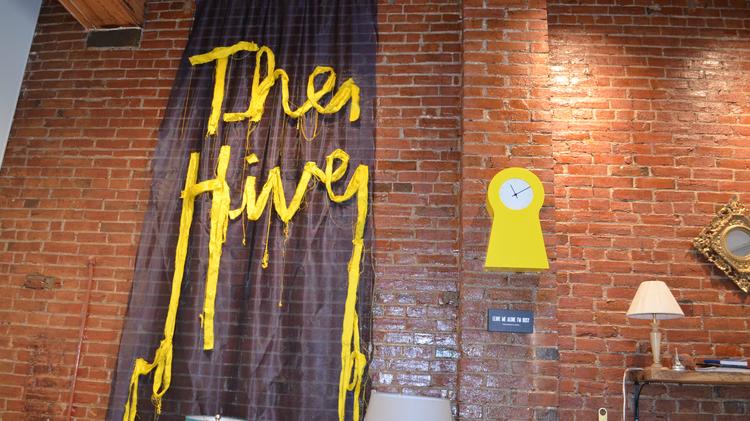
The Hive

The Hive.
The Hive
The Hive

Location: Race Street, Philadelphia, Pennsylvania, USA

Opened 2014

Closed: 2016

What a cool idea. Sorry to see this go.

From Philadelphia Business Journal:

Local coworking space for women shuts down

Jan 13, 2016, 2:09pm EST
Dan Norton Reporter
Philadelphia Business Journal

The Hive, an Old City coworking space fixed toward women entrepreneurs, will shut down at the end of January, Technical.ly Philly reports.

Melissa Alam, The Hive's founder, wants to shift her attention to other projects, but she will continue to produce programming under The Hive's brand.

Alam opened The Hive's doors more than a year ago, but now she wants to spend more time working on her quarterly food publication called Spoonful Magazine. She sat down for a Q&A with the Business Journal right before she signed the lease in September 2014 on the 200 block of Race Street.

Alam graduated from Temple with a marketing degree in 2010. After a couple of years at a digital agency job, she quit in favor of a life in entrepreneurship and freelancing.

The co-working space's closure is nothing new in Philadelphia.

Several coworking spaces and incubators haven't been able to sustain certain business models in the region, including Venturef0rth, Impact Hub and Seed Philly.

Saturday, May 30, 2015

Club Libations

Club Libations
Club Libations
Location: 231 North Broad Street (some sites say South Broad Street), Philadelphia, Pennsylvania, USA.

Opened: 1998 or before?

Closed: 2009?

From what has become my gold mine for lost lesbian bars, Clubfly:

Type: Lesbian Club
In a nutshell: A rare find and dance club for lesbians of color. Open Friday and Saturday nights...


This truly is a "rare find" as I seldom find lesbian space that is predominantly for Black women or women of color. Of course, Clubfly reports that it is now "closed," but with no date.

Here is more from Philly2Night:

A rare find and dance club for those who range from gay to straight with everything in between. This upstairs hideaway is the ultimate girls for girls' night scene. Not your typical underground finding above a Northern Italian restaurant. Known as Libations, it is a local change from popular LGBT night spots.

So we also find out that not only was this lesbian space limited in time (Friday and Saturdays only), it was limited in space, i.e. confined to the second floor--a familiar location for dedicated readers here at Lost Womyn's Space. This is a very familiar pattern existing from at least the nineteenth century and the era of ladies restaurants and ladies dining rooms, which were nearly always placed on the second floor above the "main" (men's) facilities. Also reminiscent of racial segregation in general, and the way in which Black patrons were often limited to the balconies in movie theaters.

The more things change, the more they stay the same. We may have the right to vote, the right to go to college (if you are willing to go deeply in debt), but the overall spatial pattern of pushing (limited) women's space to more marginal real estate (i.e. the second floor, which may be accessible by stairs only) remains.

GayCities adds a few more details:

Upstairs women's bar and nightclub
Dark and dive-y, this bar, upstairs from a Northern Italian restaurant is popular with ladies on the weekends. The dress is upscale.

Tags: Mostly Women, 20-somethings, 30-somethings, African American, Dancing
 
Fortunately, GayCities also has some customer reviews which are always nice to have. Sadly, they also document the entrenched racism/sexism that still exists in the GLBT community:
 
From October 2009:
 
coming to philly
IM COMING TO PHILLY THIS WEEKEND AND I BEEN TOLD THIS IS THE SPOT FOR LESBIAN WOMEN OF COLOR...LET ME KNO WHATS UP
 
From January 2008 (PhillyStud9):
 
Not what it used to be
Libations has now become the kiddie club to hang out at on Friday and Saturday night. Back in the day(1998-1999) it was great, all races, all ages. Not is just the menatlly young black crowd that is not worth the $5 cover charge....
 
Also from January 2008 (SoulSista):
 
Can we do better ?
First, Libations isn't a nightclub...its a bar that's gay on the weekend. This bar is definitely not for the mature crowd and the people there are not social at all. Most just stand against the wall with a scowl on their face. While I waited for my sweety to get her drink, I looked around the bar at all the depressed faces. My fiance and I went because we wanted to get out of the house...bored as we usually are in this city. Sadly Libations and Sister's shows the racial divide in the community. if you are looking for fun, smiling faces, diversity and great atmosphere..skip this club.
 
Sister's was another lesbian bar in Philadelphia--now lost as well (2013). 
 
And finally, here is a great narrative from April 2007 by Nigia at uwishunu:
 
The dramatically narrow, dark staircase at the top of Philadelphia restaurant Upstairs At Varalli, reveals that the underground scene has emerged. Located at Broad and Locust, it is a light at the end of the tunnel for Black and Latino lesbians looking for an underground scene. This upstairs hideaway is the ultimate girls for girls’ night scene. Not your typical underground finding above a Northern Italian restaurant. Known as Libations, it is a local change from popular LGBT night spots. The night club is also an alternative scene for hip-hop and R&B lovers. This club mixes up the local Philadelphia LGBT scene and puts a definite twist on Philadelphia night life.

Libations is an experience of real underground Philadelphia nightlife. The life that many thought only existed in cities like New York, D.C and Atlanta. The club blends the intimacy of a small 21 plus venue with the atmosphere of a dance heavy mega-club. The walls sweat in hip-hop and R&B rhythms that keep the crowd moving and when it dies down to a simple two-step, female bar tenders serve up the best, only to rejuvenate the crowd who always finds its way back to its dance floor.

So yeah, it is definitely not an ambiance for the mild with a cultural scene that exudes of modishly chic women and flair. This Friday and Saturday night hang-out has a sound and a style that calls for you to roll out of the house in only the best and latest attire. A style that creates a fashion playground that can range from diva avant garde to edgy androgynous. Let’s just say that with its pulsating realm and indulgence for eye catching ladies, Libations night club keeps its girls fully aroused.


Friday, June 13, 2014

The Vanishing: Why are lesbian places disappearing?

Important article. Lost womyn's space is getting more and more attention...for good reasons.

The Vanishing

Why are lesbian spaces disappearing, and what can be done to preserve our collective history?

The Vanishing
                
In the past two years alone, many cities have seen their last or only lesbian bar close up shop forever. If you can believe it, London, England, only had one, Candy Bar, and it closed late last year. At the end of last summer, Philadelphia lost its well-known, multi-floor bar, Sisters, after losing the less well-known Roy’s Comfort Zone the year previous. And early this year it was announced that The Palms, the nearly 50-year-old bar in West Hollywood, was closing. More last call stories stretch from Portland, Oregon, to Houston, Texas, to Chicago, Illinois. And yet, Oklahoma City keeps two lesbian bars up and running.

Read the rest here.

Thursday, March 13, 2014

Roy's Comfort Zone

Roy's Comfort Zone (2007)
Roy's Comfort Zone

Location: 1412 West Huntington Park Avenue, Philadelphia, Pennsylvania, USA

Opened: At least as early as 2005

Closed: Till at least 2012

If you go by Clubfly, Roy's Comfort Zone was a clearly a lesbian place, no doubt about it--though now out of business:

Roy’s Comfort Zone Roy’s Comfort Zone Philadelphia (CLOSED)
1412 W Hunting Park Ave
Philadelphia, Pennsylvania 19140 
tel(215)324-7562
Type: Lesbian Bar
In a nutshell: Friday night watering hole for the ladies. The music is fair for the average gal just needing a drink to end a hectic week. Warning - parking is on the street, and it is on the north side...


Just one problem. There are not a lot of formal reviews that implicitly call this a lesbian place. Or even a gay place necessarily.

For instance, here's what Clubplanet has to say:

Roy's Comfort Zone is the type of place you start off your night. The drinks are cheap and strong but the crowd isn’t the type to get the party started. Grab a quick drink here and then head out to the real party. 

This place has/had such a low profile, that there are no reviews at yelp. Just mention of its existence.

Ah. Here's a clue. It was apparently still in existence during Pride Week 2012. And it appeared to cater to Black "sexy females":

Philly Black Pride Party

Friday Apr 27, 2012 8:00PM-01:00AM in Philadelphia   

Its that time of year PHILLY PRIDE, Sweeties is setting if off with old & new skool music, putting it down again. If you missed last years party, then you dont want to miss this years, if you want to see some of the hottest, sexiest females from Delaware, D.C., New York, and Atlanta then Phillys Black Pride is the place to be Roys Comfort Zone.
 
Oh. And then there's this news story. Not good.
 
Police are on the lookout for a man who opened fire in Hunting Park.  Investigators say the 38-year-old victim was hit in the leg at about 1 a.m. while he played video games inside Roy's Comfort Zone on the 1400 block of West Hunting Park Avenue.
The man who fired the gun then ran out of the bar and police are looking for him.

There's no word on any motive in the shooting.

Pay dirt. We finally locate some customer reviews at yahoo local from what appear to be Black lesbians. Here's what they say:
 
JewelzOhSoSexii 08/09/05:
 
I LIKE ROY'S JUST GET SICK OF SEEING THE SAME PPL!
 
buttercup 01/25/06:
                  
It was ok in there. I went there for the first time last fri and it was alright. It was very hot in there and not enough space but there were definitely alot of sexy ladies in the spot. Not to mention the music was aight!!!!
 
Mssweet31 04/30/06: 
                  
Yes I finally made and I had a ball!!!!!!!!!!! The music was good and the people were nice!!!! It was a good atmosphere and I definately will be goin again!
 
TreasureT 01/13/12:
                 
Wow I hear that something new is coming, the reopening of ROY'S COMFORT ZONE. P&C Productions wll be presentng a place for you to party again on every first[1st] and third[3rd] Friday of every month catering to the LGBT community. Starting Feb. 3, 2012 9pm to 2am. I hear from 9 to 10 its free but $10 to get in SO I SAY GET YOUR PARTY ON, you know get the party started some place for the family to party again:]
 
A lesser trafficked review site called gayscom also notes that Roy's is "Mostly Women."

We also hear that the food was good solid down-home cooking (no vegan quinoa sliders!). From foursquare:

 Sakinah T.· December 29, 2011

Turkey wings mac and yams 10$ best platter

Yum!

As far as I can tell, no business has replaced Roy's at this location. So is it still in operation? Given the lack of any reviews since 2012 and the clubfly notation, I'm going to assume not. If I'm wrong, y'all let me know.

Given the rarity of Black lesbian space, it was a real treat to stumble upon this one.

Friday, November 8, 2013

Rusty's

Philadelphia lesbian feminist
newspaper Wicce, featuring
Rusty Parisi (1974)
Rusty's

Location: Corner of Quince and Walnut Streets, Philadelphia, Pennsylvania, USA

Opened: 1963

Closed: Early 1970s

We get our introduction to Rusty's from the Timeline of Lesbian/Queer History in Philly:

1963:     Rusty’s, the first lesbian bar in Philadelphia located behind where Moriarty’s Irish Pub now resides, begins to gain in popularity. The bar was named after Rusty Parisi, who was one of the first lesbian bar owners in the city.

We're also informed from the same source of the following:

On March 8, 1968, Rusty’s gets raided, and many women were verbally abused by officers.

But more about that raid later.
 
Here's a quite detailed history of Rusty's from the Philadelphia Gayborhood Guru:

About 1963, the bar [known as the Star Lite Café] became known as Barone’s Variety Room. The main entrance to the restaurant and bar was on Walnut Street, but if you went around to the Quince St. side of the building, through the side door and up the stairs, you were in Rusty’s.

In November of 1967, Philadelphia Magazine published an article by Nancy Love called “The Invisible Sorority,” a semi-lurid exposé on Philadelphia’s lesbian community. The article opened with a visit to Rusty’s:

Matchbook covers from Barone's (Rusty's)
A small sign over the door on Quince Street, a little alley next the Forrest Theatre, says “Variety Room.” It’s very quiet as you go up the old wooden steps to the second floor and down the long corridor. You don’t hear the juke box until you’re actually in the room. You pay the $2 minimum to a woman in a white button-down shirt and slacks who looks a little like a gym teacher you once had, and she gives you a strip of tickets for drinks. It’s a smallish panelled room with a bar at one side and lots of tables clustered around a dance floor. At first, the relaxed atmosphere and informal dress and young girls make you think of a girls college hangout in a small town.
The woman at the door in the button-down shirt might have been Rusty Parisi, owner of the bar. She is the woman in glasses on the cover of the Philadelphia lesbian feminist newspaper Wicce, above.  This issue, published in 1974, featured an interview with Rusty and a nostalgic look back at lesbian life in the ’60s. Rusty was one of the first bar owners in Philadelphia who was gay herself. She discussed butch and femme roles, police harrassment and her own experiences. When asked how she felt about men in general, she replied bluntly, “I’ve never been with one and I’d never want to be. So that’s what I think of men in general. Not much.”

The matches, above left, are from the cigarette machine in Rusty’s. With their 1960s pin-up girls and phallic rockets, (the one on the right  is limp!), they are two of my favorite objects in the William Way Community Center’s archival collections.

And from the same source we learn more about that raid:


Hanckel & Bello
Ada Bello and Frances Hanckel
On the night of March 8, 1968, a year after “The Invisible Sorority” appeared, women out for a drink at Rusty’s suddenly found the jukebox unplugged and the house lights brought up. It was a police raid. Under Police Comissioner [Frank] Rizzo, raids on gay and lesbian bars were an all too common occurence in 1960s Philly.  Many of the women were verbally abused; police accused them of being drunk and disorderly. Some were booked and held overnight. They were brought before a magistrate the next day, but all charges were dropped. It was a clear-cut case of  police harassment.

Rusty Pilice RiadThe local chapter of D.O.B. editorialized against the raid. D.O.B., the “Daughters of Bilitis,” was a national lesbian social and support organization with a policy of political non-involvement. The Philadelphia chapter was one of the exceptions. A few nights later, after another raid on Rusty’s, local activists Ada Bello, above, on the left, seated next to Frances Hanckel, right.  Lourdes Barbara Gittings were present. When Police asked Gittings for her I.D., Barbara flashed her ACLU card. The police moved on.

Rustys Door 2010
Entrance to the former Rusty's,
now Moriarty's Irish Pub

In May, the D.O.B. arranged a meeting with the Philadelphia Police Inspector and they brought along an ACLU observer. The D.O.B. let the Inspector know that they represented the community and that they were were not afraid to protest violations. The police issued a statement that “homosexuals have been, are now, and will be treated equally with heterosexuals.” Because of their active support in the incident, membership in the Philadelphia D.O.B. increased dramatically. A year before the Stonewall riots, the raid on Rusty’s and the reaction of local lesbians was a success story for gay rights.
Moriarty's Irish Pub


The Box Turtle Bulletin also had an excellent description of this raid. Do check it out.

There is also a passing reference to Rusty's at the University of Michigan Lesbian History site:

“Barone’s,” also known as “Rusty’s” developed into a definitely lesbian, sub-cultural space.  Crossing the threshold into Rusty’s, you entered the “inside” world.  Inside Rusty’s, lesbians were able to define themselves through community and public space.  Lesbians called each other “Brothers,” and protected each other from police and straight male harassment.  There was a tendency not to welcome men into lesbian bars, but a few gay men would attend.

According to this account, it wasn't just a case that men weren't "welcome" in Philadelphia's lesbian bars. In fact, it is claimed that there were out-and-out turf wars, with "diesel dykes" beating up men (even gay men) who were perceived as territorial invaders. Such a contrast to today, when lesbians have (apparently) become such marshmallows:
Rusty's back in the day


 In the 1950's and 60's, Camac Street and its environs, especially around the area of Spruce Street, were sometimes the scene of conflicts between gay men and lesbians. The gay men would be walking up Spruce Street at night (for decades considered the area where most of Philadelphia's Center City gays and lesbians could be found), and sometimes were mistaken for straight or gay men invading "lesbian turf." While I was conducting research for Gay and Lesbian Philadelphia, local personality Henri David told me that some "strong looking diesel dykes" would occasionally beat up gay men who wandered into certain areas thought to be lesbian territory. This didn't happen often, David assured me, but it did occur. Many of the gay men were from the city but many more were from the suburbs--and may have taken the same train that [Christopher] Isherwood took to spend a night at the Camac Baths.

Lesbians came in from different parts of the city as well, although women traveling late at night often had to go to unusual lengths to protect themselves against predatory men. Marge McCann, a Germantown resident who ran unsuccessfully against Clark Polak for the presidency of the Janus Society, an early homosexual rights group, recalled taking the Broad Street subway at night disguised as a boy. McCann would slouch down in the subway seat and adopt a tough pose: this was her ticket back and forth to the city's only lesbian bar at the time, Rusty's.

Rusty's was near Philadelphia's infamous TROC burlesque theater, near 10th and Race Streets, and had the paranoid atmosphere of a 1920's speakeasy.

 
Patrons who went to Rusty's had to peer into a peephole in order to be admitted. Joan C. Meyers, an art student and photographer living in Center City at the time, recalls that she was turned away from Rusty's because she was not dressed in a "lesbian uniform," that being short hair with no make-up.

Meyers said that her flowing Joan Baez locks caused Bee, a staff person at Rusty's, to say: "We are tired of straight women like you coming around bothering our girls."


According to the book Gay and Lesbian Philadelphia (2002), Rusty's went out of business in the early 1970s, "when patrons tired of sneaking through back alleys to request permission through a peephole."

Another thought: Notice how Rusty's was located on the second floor. This is a surprisingly common spatial pattern among women's spaces. In fact, it was a pattern that was typical among the old "ladies restaurants" and "ladies dining rooms" of the 19th century. That's one reason I think there is a lot of overlap between these seemingly distinct and different places.

Friday, September 13, 2013

Sisters Nightclub

Sisters

Sisters Nightclub

Location: 1320 Chancellor Street, Philadelphia, Pennsylvania, USA

Opened: June 21, 1996

Closed: August 2013

From South Florida Gay News:

Philadelphia’s Only Lesbian Bar Shuts Down

Citing financial difficulties, the owners of Sisters Nightclub shut down Monday after 17 years in operation. Sisters has been the only full-time lesbian bar in the city since its inception June 21, 1996.
Denise Cohen, who managed the club since its opening, said in a Facebook posting that business owner Jim Ross notified her of the closing Monday morning.
Cohen did not respond to repeated requests for comment.
The building, 1320 Chancellor St., is owned by Mel Heifetz, while Ross owns the business.
After a series of calls and emails, Heifetz told PGN he would not comment for this story.
There is a sign on Sisters’ door that the building is undergoing renovations and will reopen in the fall, but it is unclear if the business or building has been, or is in the process of being, sold. Heifetz refused to comment on the matter.
Sisters interior - vacant
Heiftez purchased the three-story building on July 12, 1994, for $86,000. The city assessed the property at $70,400 each year from 2010-13, but that figure jumped to $746,400 for 2014, seemingly because of the city’s new property-tax evaluation. The adjoining building, home to the now-defunct Key West Bar, is also empty.
Cohen said in her posting that there will be no closing party, and noted that sudden closings are not uncommon in the bar and restaurant industry.
Response to Cohen’s Facebook posting was strong, with more than 200 “shares” by the next day.
Cohen said on her personal Facebook page that Ross was equally upset when he shared the news with her.
Sister interior, with women jammed around the bar
“This is not something he wanted to do and I know he is just as devastated for his staff, for his business and for his community,” she wrote. “There just wasn’t enough sales to continue operations and without that support we could not grow, we could not change, we struggled in this economy and it took its toll.”
Knock owner and Woody’s founder Bill Wood echoed the surprise many expressed via social media.
“I’m still a little confused by it all,” Wood said. “Usually you hear rumors and people commenting if no one’s going there or employees saying that they’re having a tough time. But I don’t think anyone heard anything like that.”
Sisters dance floor
PGN columnist Suzi Nash ran the club’s Thursday-night karaoke event since Sisters opened.
“I’m sad to see an institution like Sisters close down,” she told PGN. “As the host of karaoke since day one, I’ve seen so many people gather and grow and seek solace, joy and companionship at the bar. Over the course of 17 years, I’ve had couples who met on the karaoke stage get married and people who made their first tentative foray into the gay community at Sisters grow into activists and proud members of the community. It’s been an anchor for the lesbian community for both the patrons and the many nonprofit organizations they’ve supported. She will be sorely missed.”
The City of Brotherly Love Softball League is one such organization that Sisters supported.
Women’s division commissioner Jen Brown said Sisters was a fixture in the league.
“Since opening, Sisters was one of the CBLSL’s top sponsors and supporters, Brown said, noting they often sponsored several teams per season. “They helped us host fundraisers for the league and for their teams. When I shared the news of their closing with some softball players from other cities who visited for our World Series in 2011, each of them had a story about Sisters from their week in Philly. That really shows how special they were to our league and our community.”
The club was also a popular gathering space during events like OutFest and Pride.
Franny Price, executive director of Philly Pride Presents, which runs both events, said Sisters filled a needed gap.
“Every city has a girls’ bar. Every gay community has one. Sisters was ours,” Price said.
As news of the closing spread Monday, personal accounts of nights and days at Sisters abounded.
“I couldn’t wait to turn 21 so that I could go to Sisters for the first time,” Brown told PGN. “After eight years and countless visits, I can’t remember one that didn’t create a memory: singing karaoke with strangers, dance-offs with my closest friends and a lot of laughs. I never felt more comfortable in a club than I did when I was at Sisters. It felt great to be around other people who were like me — where I wasn’t defined solely by my sexual orientation.”
William Way LGBT Community Center archivist Bob Skiba said this is the first time since the 1940s that Philadelphia is without a lesbian bar.
“It leaves a huge gap, there not being women’s bar right now,” he said. “This is the first time since World War II that there has been no women’s bar in Philadelphia. So that’s a pretty big thing.”
Wood referenced a recent Inquirer article about the demise of a number of LGBT bars in the suburbs, potentially owing to the mainstreaming of the community.
“I think a lot of bars now are trying to not segregate by sex so maybe that’s the problem,” he said. “Maybe it’s good that the lesbian community isn’t just going to lesbian bars, but it’s still a great loss. You hate to see anybody close, especially after 17 years. They provided a really big service for a really long time.”
Even with more bars integrating men and women, and LGBTs and allies, Price noted that it was important for women to have a space to call their own.
“It was kind of like a sense of security and safety knowing that, as a gay woman, there was somewhere like Sisters. Whenever there was something coming up, people would look to Sisters to see what was going on there because that’s where the bulk of the lesbian community went,” she said, noting that Sisters stood apart from the venues that offer LGBT events but that don’t identify as LGBT establishments. “I have a problem with the ‘gay night’ or ‘ladies night’ thing. I like to think we’d be welcomed every day. And we had that at Sisters. Whenever anyone would come to the city and ask where the girls’ bar is, you’d say, ‘Sisters.’ Now what are we going to say? ‘Well, Wednesday night you can go here’ or ‘Tuesday night you can go here.’ It’s sad.”
While Sisters held the distinction as the city’s only lesbian bar, it also was the longest continually operating lesbian bar in Philly history.
Skiba noted there were a number of women’s venues open simultaneously in the 1970s and ’80s, but none as long as Sisters.
Sneakers, on North Third Street, was open for 11 years, PBL for a decade, Hepburn’s on 12th Street for six and Mamzelle’s above The Bike Stop for four.
The land where Sisters is located was, in the mid-19th century, home to stables for rental horses. From the 1930s-’80s, it was Frankie Bradley’s restaurant and later Hesch’s restaurant, which closed in 1987.
Depsite Sisters’ closing, Price said supporters should revel in its longevity, which she attributed to the work of Cohen and her staff.
“[Cohen] did something nobody else did in Philadelphia, and that’s keep a women’s bar open for 17 years,” Price said. “Look at how incredible that is when you think back to all those bars that couldn’t stay open. She managed to keep it open for 17 years. That’s incredible. I’m hoping someone says, ‘Do you want to open a new women’s bar?’ to her because she knows what she’s doing.”
The Big Gay Boat Party, a monthly LGBT party on the Moshulu staged in part by Cohen and Sisters, will continue, with the next event being held Aug. 25.

Tuesday, June 18, 2013

Women's Restaurants

This is a fantastic post on women's restaurants that I found at Restaurant-ing Through History, one of my favorite blogs. Reproduced with the author's permission.

Women's Restaurants

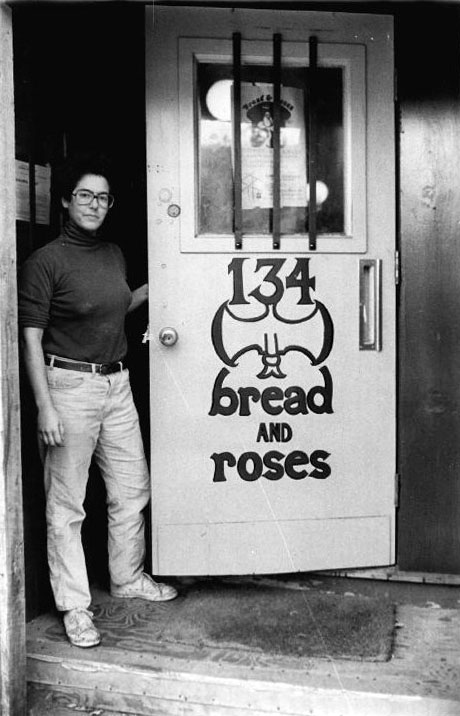
feministBreadandRosesBarbaraFried1976

Not all restaurants have been purely, or even mainly, commercial ventures. This was particularly true of women’s suffrage eating places and those of the 1970s feminist movement.

Although the women’s restaurants of these two periods were quite different in some ways, they shared a dedication to furthering women’s causes and giving women spaces of their own in which to eat meals, hold meetings, and in the 1970s, to enjoy music and poetry by women.

SuffrageLunchBoston1918

In the 1910s most major U.S. cities had at least one suffrage restaurant, tea room, or lunch room sponsored by an organization such as the National American Woman Suffrage Association (NAWSA).

As was true of later feminist restaurants, those of the suffrage era tended to be small and undercapitalized. An exception was the suffrage restaurant financed by the wealthy socialite Alva Belmont in NYC. In terms of patronage, it was almost certainly the most successful women’s restaurant of either era. It reportedly served 900 meals per day from a low-priced menu on which most items were 5 or 10 cents and consisted of soup, fish cakes, baked beans, and home-made pie.

Suffrage restaurants admitted men and welcomed the opportunity to ply them with leaflets and home-made soups, salads, and fritters that would incline them to support the cause. An aged Philadelphia activist recalled in 1988, “I worked at a suffrage tea room. We lured men in, for a good, cheap business lunch. Then you could hand them literature and talk.” In the NYC restaurant operated by NAWSA in 1911, it was impossible to ignore the suffrage issue since every dish, glass, and napkin bore script saying Votes for Women.

suffrageRestaurant1912

Though dedicated to women’s causes, women’s restaurants were not free of conflict. Many suffragists objected to how Alva Belmont ruled with an iron fist, brusquely ordering servers around until they walked out on strike, followed by the dishwashers. Belmont was ridiculed when she brought in her butler and footman to fill the gap. Her footman quit too. Some feminist restaurants experienced discord over cooperative management and, especially, whether or not to serve men.

The first feminist restaurant, NYC’s Mother Courage, was founded in April of 1972. (Its co-founder Dolores Alexander discussed it in 2004-2005 interviews.) Others established in the 1970s included Susan B. Restaurant, Chicago; Bread & Roses, Cambridge MA; The Brick Hut, Berkeley CA; Los Angeles Women’s Saloon and Parlor, Hollywood CA; and Bloodroot, Bridgeport CT). Undoubtedly there were more, especially in college towns. In the 1980s a number of women’s coffeehouses appeared, but they were performance spaces more than eating places.

FeministBloodroot1981

As part of the counterculture, 1970s feminist restaurants typically aimed at a broad set of goals. Women’s equal position in society was paramount but it was embedded in a project of establishing a more peaceful and egalitarian world. Feminist restaurants rotated jobs and paid everyone the same wages. They raised capital by small donations from friends. Staffs were entirely female and women also did most of the renovating. Their decor was spare, with exposed brick walls, mismatched furniture, and chalkboard menus. They served simple peasant-style food, usually prepared from scratch. Some served wine and beer. More often than not menus were vegetarian, or at least beef-less. The L. A. Women’s Saloon and Parlor supported farm workers and would not serve grapes or lettuce. The Brick Hut boycotted Florida orange juice during the anti-gay campaign of spokesperson Anita Bryant. The Women’s Saloon avoided diet plates and sodas, deeming them insulting to large-sized women.

Many proponents of feminist restaurants felt that women were often treated poorly in restaurants, many of which regarded men as their prime customers. Feminist restaurants made a point of presenting women dining with men with the check and wine to sample. But for many women patrons, perhaps especially lesbians, the enjoyment of a non-hostile space was more significant.

At some point each feminist restaurant confronted the touchy question of whether they would serve men. Considerable acrimony erupted around this question at the Susan B. Restaurant in Chicago and Bread & Roses in Cambridge, resulting in the former restaurant’s closure after only a few months. At Bread & Roses a co-founder exercised non-consensus managerial power and fired a server who made men and some heterosexual women feel unwelcome, setting off rounds of group meetings. The restaurant, opened in 1974, was put up for sale and in 1978 became the short-lived “women only” Amaranth restaurant and performance space.

Today Bloodroot may be the sole survivor of the feminist restaurant era.

© Jan Whitaker, 2013

Friday, June 7, 2013

Miss S.J. Hale's Boarding and Day School for Young Ladies

School for Young Ladies
Miss S.J. Hale's Boarding and Day School for Young Ladies

Location: 922 Spruce Street, Philadelphia, Pennsylvania, USA

Opened/Closed: Around 1859

The only source I have on Miss Hale's comes from a February 1859 article in the Godey's Ladies Book entitled "American Schools and Colleges for Young Ladies." It's reproduced at a site called Accessible Archives:


PHILADELPHIA SCHOOL FOR YOUNG LADIES — We would again call the attention of our readers to Miss S.J. Hale's Boarding and Day School for Young Ladies, 922 Spruce Street. This school combines, in an unusual degree, the comforts of a home with the discipline and regularity of a school. The health and deportment, as well as the intellectual advancement of the scholars, have careful attention.

922 Spruce Street today
The Course of English study is thorough and liberal. A superior French teacher resides in the family, to aid in conversation in that language. The musical department is under the care of those qualified in the highest degree to improve the pupils intrusted to them; and all the other accomplishments are well and carefully taught.

922 Spruce is now a private residence. 

Tuesday, December 18, 2012

Pudenda

3300 Hamilton Street today

Pudenda

Location: 3300 Hamilton Street, Philadelphia, Pennsylvania, USA

Opened/Closed: 1970s

From Gay and Lesbian Philadelphia by Thom Nickels.

Pudenda was a West Philadelphia women's collective that included "a mixture of gay and straight, working women, and women in school."

"It was open, anyone who needed a place to stay could live there. Eventually we had something like 15 women living in the house. People used to come to the house to come out. They knew it was a dyke house, they knew it would be accepting. We had wonderful times around the dining room table. We shared chores and cooked for one another. It was the healthiest way to come out," Arleen Olshan remembers.

Arleen Olshan was one of the original members of the Pudenda collective. A photograph of Arleen and three other original members can be seen on page 61.


Monday, April 23, 2012

Ladies Dining Room, Ladies Writing and Reception Room at the Hotel Vendig

Hotel Vendig
Ladies Dining Room, Ladies Writing and Reception Room at the Hotel Vendig

Location: 13th and Filbert, Philadelphia, Pennsylvania, USA

Opened: 1891

Closed: Doesn't appear to be still operating under this name, but have yet to verify when it was closed.

I have found almost no information on the Hotel Vendig, apart from a few old postcards. But this was obviously a very nice (if not super luxurious) hotel for this era. The postcards tell us that it was run on the "European Plan," that it was "Absolutely Fire Proof, " and that "Special Sample Rooms" were available. Best of all,  "Every Room has Bath or Shower and running Ice Water." So relieved to hear that! But as a better hotel, this also meant that it had distinctly separate areas for ladies and gentlemen.

So rather than spend too much time on analysis, let's just take a peek at what those ladies' spaces looked like.

Ladies Dining Room, Hotel Vendig

Ladies Writing and Reception Room, Hotel Vendig


Even to the casual observer, it is clear that the design of the designated ladies' areas favored a light and airy aesthetic, with lots of white.

As we have discussed before, ladies were generally not welcomed in the "main" dining areas of these hotels, though men very often "escorted" ladies into the ladies cafe. So these were not women-only spaces strictly speaking.

The Ladies Writing and Reception Room met with at least one woman's approval as scribbled on the back of the postcard is the following message: "This room is very pretty as well as useful. " I have to admit that this is a first for me--I had never seen a writing space for women before, at least before some of the writer centers, workshops, and retreats created by the second wave of the feminist movement. I'd like to think that some fine stories and poetry came out of this space, in addition to all the chatty postcards and letters sent off to the loved ones back home.


Lobby, Hotel Vendig
But check this out. We see a similar light and airy design scheme in the lobby, which is somewhat neutral or "mixed" territory. So apparently this design was not limited to the ladies' spaces.

As for the gentlemen's areas--which are seldom explicitly identified as gentlemen's areas--we have one general postcard depicting what they looked like:


Hotel Vendig - general views

Of the areas illustrated, three are more or less neutral--the bedroom (upper left), the Filbert Street entrance (lower left), and the 13th Street entrance (lower right).

The two middle photos are basically gentlemen's eating areas: the Buffet (on the left) and the Grill (on the right). Even comparatively recently, the "grill" has been associated with men-only areas in country clubs and the like. Both of these spaces seem to be a little darker and "clubbier" in appearance than the ladies' areas.

The intention behind the Exchange (upper right hand corner) is not entirely evident. But I suspect it was something like the Men's Lounge at New York's Hotel McAlpin, which was "a long gallery fitted up in the manner of a sumptuous clubroom with easy chairs, library, smokers' necessities, bar, stock ticker and public stenographer." You know, all that business stuff that the silly little females needn't worry about.

But apart from all that, I'm still finding myself in serious desire of a ladies writing room. And I'm sure that a lot of other women writers would love to have one too....

Monday, July 25, 2011

Hepburn's

Katherine Hepburn in "Sylvia Scarlett" (1935)
Hepburn's

Location: 1320 Chancellor Street, Philadelphia, Pennsylvania, USA

Opened: ?

Closed: Late 1995

In her book Lesbian Rule: Cultural Criticism and the Value of Desire (2003), author Amy Villarejo relates the following tale:

In college and the years just after, I frequented a lesbian bar called Hepburn's. Named obviously after Katherine, the bar was decorated with production-still enlargements of Hepburn's face. Teeny pads of lavender paper, with a discrete Hepburn's across the top, sat in old-fashioned glasses alongside miniature pencils, ready for the exchange of phone numbers and note-taking. (On reflection it appears that I did more of the latter than the former.) On one of those pads, about ten years ago, I wrote "Sylvia Scarlett. Why lesbian?"

Most of the photographs in that bar featured Hepburn in her famous cross-dressing role in the 1935 film Sylvia Scarlett, directed by the gay and extraordinary George Cukor. With hair slicked back and shirt collar framing her young patrician face, Hepburn's image as a dashing boy clearly excited a lesbian reading, set lesbian somehow reverberating. Hepburn's--the bar--borrowed the image and also those excitations, that indeterminate allure, for its own.

Unfortunately, Kim Brittingham's recollections of her first experience at Hepburn's are far less nostalgic:

In my early 20s, I went to a lesbian nightclub called Hepburn's in Philadelphia with some gay friends. Despite growing up in a house full of self-righteous bigots, I retained a socially liberal core. Like pancakes in a Teflon pan, my parents' lessons had a tendency to smack the surface and slide right off again. So it wasn't that strange to find me in a gay club. I rather enjoyed looking. And to my utter fascination, there were quite a few women there who didn't look like lumberjacks. How could my mother have missed this?

A female ambled over to us. She was what you'd call "butch." She thrust her face close into mine, scowling. "Are you gay?" she demanded.

I immediately felt foolish. The fact is, I didn't know what I was. I dated guys because it was easier, but I felt like I could potentially be ... well, anything. I was flesh and nerves and thoughts and emotions and electrical impulses. And in that moment, all of it was caught off-guard.

"I ... I don't know," I stammered.
Sisters exterior
She shook her head and cackled.

She looked at my lesbian companion and said: "Certain people just have no business being here, ya know what I mean?"

To my dismay, my lesbian friend nodded.

After Hepburn's closed in late 1995, Sisters (another lesbian bar) opened at Hepburn's former location in June 1996. Apparently Sisters is still in business--and Philadelphia's only lesbian bar.  

However, even as late as 2007, Hepburn's still conjured up fond memories by former patrons. As Nicole R. mused, "Back in the day, Sisters used to be Hepburn's.  I really liked that name a lot better.  It lent it this air of class, of old movies and glamor."

Other former lesbian bars in Philadelphia (from the 1970s to the 90s) include Sneakers, Rusty's, Upstairs, PBL, and Rainbow's.

Photo: Katherine Hepburn in "Sylvia Scarlett" (1935). Exterior of Sisters.