Showing posts sorted by date for query sweden. Sort by relevance Show all posts

Thursday, November 14, 2013

The Furies Collective


Furies basement, 221 11th Street SE (1972)
The Furies Collective

Location: 221 11th Street Southeast, Washington, DC, USA--and two other locations (see below)

Opened: Spring 1971

Closed: Late spring 1972/Summer 1972

From the Rainbow History Project:

The Furies collective, one of whose main sites was at 221 11th St SE, was, along with the Gay Liberation House and the Skyline Collective, among Washington, DC's best known communal living groups in the early Seventies.  The twelve women meeting on 11th Street SE constituted an important experiment in lesbians of diverse social and economic backgrounds living together and working to make their political and social beliefs a day-to-day reality.  Most of the members of the collective wrote for the newspaper.

From January 1972 until mid-1973, the collective published its groundbreaking newspaper, The Furies, and distributed it nationally.  The Rainbow History Project has an incomplete collection of original copies of the newspaper.  Many of the articles from the newspaper were reprinted in Women Remembered, Class and Feminism, and Lesbianism and the Women's Movement.  (The last two books are in the collection of the Rainbow History Project).  When the collective disbanded in late spring 1972, "the core of the newspaper staff decided to continue the paper as a project separate from the collective."

There is a lot more fascinating material at the Rainbow History Project link above, so make sure you visit.

According to Julie R. Enszer, the "work and words" of the Furies had a "profound effect on lesbian-feminism," even though the "publication and as a political formation lasted only two years."

Here is a selection from her essay:

In the spring of 1971, amid the excitement of the growing Women’s Liberation Movement in the United States and the energies of gay liberation, a group of women in Washington, DC formed a collective called The Furies. Twelve women initiated the collective and over two-dozen women were involved in the collective while it was active between the spring of 1971 and the summer of 1973. Furies members included Charlotte Bunch, Sharon Deevey, Rita Mae Brown, Nancy Myron, Jennifer Woodul, Joan Biren, Helaine Harris, Susan Hathaway, and Ginny Berson. Three locations in Washington, DC were the site of many of the meetings of The Furies: 1861 California NW, 217 12th St SE and 221 11th St SE.

The Furies also published a newspaper, titled The Furies: Lesbian/Feminist Monthly. The first issue of the newspaper, dated January 1972, outlined their commitment to “the growing movement to destroy sexism” and to “building an ideology which is the basis of action.” It described the collective as “lesbians in revolt” and recounted the genesis of their name from the ancient Greeks. Also included in this first issue were articles highlighting feminist organizing in other locations around the country and an article about Queen Christina of Sweden as an example of the feminist and lesbian power the group wanted to mobilize. These types of articles—ideological pieces, feminist histories, and political and social analyses—appear throughout the newspapers.


There is a fair amount of research and political critique on the Furies, both pro and con. I'm not going to begin to try to summarize all that here, but I encourage you to do your own searching if interested.

Thursday, May 31, 2012

Besjukovschtschina

Central Russia (1812)
Besjukovschtschina

Location: Allegedly somewhere in central Russia (as defined in the late 19th century). Difficult to pinpoint exactly where this could have been, as the name is not on contemporary maps and there have been many border and name changes since then.

Founded: As an all-women "state" or "colony" in 1861

Closed: There are several articles published between 1897 and 1901 about this place, but no references after that time.

This is one of those odd little stories I stumble upon from time to time. Was this a real place? Or was this a folklore fantasy, like Sweden's all-lesbian Chako Paul City? (Chako Paul City was "created" by the Chinese media back in 2009.) Only more research will tell. Here's the news account from 1897, which is the earliest I have found and the most extensive description.

From the Free Lance, March 20, 1897:

WHERE WOMEN RULE.

The Name of their Colony a Jawbreaker.

There is at least one spot on earth where women have their rights. If they do not it is their own fault, for they are the supreme arbiters of social and industrial conditions, and run everything to suit their own caprices. The place in question is the township of Besjukovschtschina, located in central Russia. Whether or not the women had the privilege of naming the place is not known. If they are guilty they proved themselves a failure at the start, for there are several letters in the alphabet they did not employ in designating it. It was in 1861 that an epidemic had reduced the population to the verge of starvation, and the women, led by Saschka, ordered the men to leave and go to the city to find work. The women remained alone and began to till the farms. The men were allowed to return only for the holidays.

The woman state comprises a territory of ten square miles and is divided into seven villages. Saschka and several other women, the wives of the exiled elders, administer to all public affairs, such as the levying of taxes, the allotment of acres to the various families, the keeping up of the churches, the paying of shepherds, etc. They also assume the recruiting officer's duties by sending those men who attain the proper age to town in order to submit to medical examination.

In the summer the fields of the district afford a peculiar aspect. One may ride over the Besjukovschtschina domain from morn till night without encountering a single male being. All the work, the hardest as well as the lighter manipulations, is executed by women and girls of different ages. With naked feet and arms they trot behind the plow, throw out seeds and gather fruit. Here we observe a dozen or more members of the weaker sex engaged in lifting a mighty rock; or subduing a bucking horse or a wild bull. Toward evening all hands assemble in the church squares of the seven villages to hear reports of common interest, the women acting mayors being speechmakers, who discuss public questions in a decisive and businesslike manner. This done, the women go home to attend their own affairs.

Besides cultivating the fields they keep the roads in order and ocassionally set up a new cottage or stable. When on the occasion of his coronation, the czar [Alexander III in 1881? Nicholas II in 1894?] released some 20,000 communities of the obligation to discharge their back taxes, Besjukovschtschina, not being in arrears like the rest, was not benefited, and that is nearly the only regretful incident Saschka's administration has developed in the eyes of her partners. A governmental statistician who visited the colony recently gathered material showing that since the enforced grass widowhood the Besjukovschtschina die at an earlier period than was their fate during the old days of serfdom.  

The Evening Post from May 28, 1898 adds a few more details, but not many:

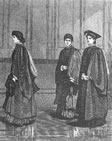
Traditional costumes of Central Russia
WHERE WOMEN RULE.

The Women's Signet says: 'The state of Besjukovschtschina, in Russia, is probably the only place in the world that is ruled by women. This State is made up of seven villages, each presided over by a Mayoress, the whole under the superintendence of a lady named Saschka, who acts as President. There are women magistrates, women preachers, women police--in fact, every capacity is filled by women. The roads are made by women, and women sell milk and deliver letters. If you want to bring action against your neighbour in this State, you go to a woman lawyer, and if there is anything in your house to be stolen, then a burglar of the weaker sex steals it. No place of any importance is filled by a man. This state of affairs has been brought about by an epidemic in 1861, and during which time the men of the State behaved so badly as to reduce the population to starvation. Since then the women have taken the State in hand and made it prosperous.

Other references to Besjukovschtschina can be found in 1899, 1900, and 1901. But these are all regurgitations of the articles already cited.

As somebody with a little background in demography, one contradiction did stand out for me. I highly doubt that this place had both a declining life expectancy and increasing prosperity. That just doesn't happen.

If Besjukovschtschina really once existed, the ways she could have been destroyed are nearly too numerous to recount. You don't have to be an expert in twentieth century history to figure this out. Start with a pogrom-like attack. Then throw in the Russian Revolution of 1905, the first World War, the Russian Revolution of 1917, The Russian Civil War....And if she had survived all that, how would she have survived Hitler and Stalin?

Tuesday, June 14, 2011

Chako Paul City (Shakebao)

Two citizens, Chako Paul City
Chako Paul City (Shakebao)

Location: Somewhere in the frozen hinterlands of northern Sweden (or wherever a fertile imagination takes hold)

Founded: The legend holds that Chako Paul City was founded in in 1820 by a wealthy, man-hating widow. In reality, it seems to have been founded in the overheated imagination of an anonymous, sex-starved, heterosexual Chinese man, sometime around 2009.

Closed: Myth was debunked the same year it was given birth. But perhaps, somewhere, somehow, Chako Paul City lives on?

In 2009, inexplicable reports surfaced in the Chinese media about a mythical women-only city in northern Sweden. Needless to say, Swedes only found out about this City when Swedish tourism agencies were besieged by literally millions of Chinese men looking for more information.

Here's how the story was reported in Swedish media that same year:

Chinese media tempted by fantasy of women-only Swedish town
Published: 5 Oct 09 14:57 CET

A mythical Swedish town where men are barred from entering and women turn to homosexuality has piqued the interest of several Chinese media outlets.

The town, supposedly founded in 1820 in the northern Swedish woods by a wealthy widow, boasts 25,000 residents and a medieval castle, according to the Chinese news agency Xinhua.

A pair of blonde female sentries stand guard at the unnamed town, referred to in reports as "Shakebao" or “Chako Paul City”, and men wishing to enter risk being “beaten half to death” by police.

In addition, many of the town’s female residents turn to homosexuality “because they could not suppress their sexual needs”, the Chinese news service Harbin News reports. The story also formed the basis of a Shanghai Media Group television report.

But Claes Bertilson, a spokesperson for Sweden’s Association of Local Authorities and Regions (SALAR), is doubtful about the claims made by the Chinese media about Sweden’s supposed “women-only” town.

“I’ve never heard anything about it,” he told The Local.

“At 25,000 residents, the town would be one of the largest in northern Sweden, and I find it hard to believe that you could keep something like that a secret for more than 150 years.”

Bertilson was also at a loss as to where the fictitious account could have originated.

“I have no idea where something like this could have come from,” he said.

Accuracy aside, the Chinese press reports provide a plethora of titillating details about life in the mythical Swedish town.

Most of the town’s all-female population is employed in the forestry industry, with many sporting a “thick waist belt full of woodworking equipment”, according to Xinhua.

And women who decide to leave the town to fulfill their carnal desires are only allowed to re-enter Chako Paul City if they agree to bathe and undertake several other measures designed to ensure that their out-of-town trysts don’t negatively affect the mental state of other women in the town.

Perhaps not surprisingly, Xinhua adds that “Chako Paul's tourism industry is increasingly prosperous”.

“Hotels and restaurants are everywhere, to receive women from around the world,” the agency reports.

Although Per Wilhelmsson of the tourist office in Umeå in northern Sweden said he had never heard of Chako Paul City, he did confirm that tourism in the area is bustling.

“Our tourism industry is doing quite well, among the best in northern Sweden,” he said.

He was fairly certain no “women-only” city existed in northern Sweden, adding that the story reminded him of a stunt carried out in the 1980s by Pajala, a northern Swedish town suffering from a different problem.

“They arranged for bus loads of women to come up to this town because there weren't enough of them,” he explained.

When asked what else might be drawing tourists to northern Sweden besides the chance to visit an isolated town filled with sexually frustrated females, Wilhelmsson had a theory of his own.

“It’s hard to say for sure, but I think part of it might be increased interest following our designation as Europe’s Cultural Capital for 2014,” he said.

But then, Chako Paul City became...real! At least to a couple of film makers (Lasse Långström, Leo Palmestål), who decided to make a "documentary" about their search for Chako Paul City.

In the winter of 2009 freelance reporter Beata, accompanied by photographer Magda, went out into the northern wilderness to find the mythical lesbian city of Chako Paul.

A meeting at Zappho bar with a person who claimed to be from the city had resulted in a road direction. It proved to lead to one of the city’s guard cabins and an exciting meeting occurred.

Why has the city been hidden? How do they reproduce? Why choose to live without men? What is their social structure like? What did Astrid Lindgren and Valerie Solanas do there?

Join us on Beata and Magdas journey into a hidden world and learn everything you wanted to know about a lesbian utopian society.

Worldpremiere was at the Lesbian festival on the 5 of June 2010 at Kvinnofolkhögskolan, Gothenburg, Sweden. Was also shown at the Punk Illegal festival the 12 of June, on the Queertopia festival the 22 – 25 July, at the Gothenburg Feminist Film Festival on the 3 – 5 of September and at Pogo Cafe in London on the 25 of Oktober.

Info om filmen / Info about the film:
Längd/lenght: 30 min
Genre: Resereportage / Travel reportage
Språk/Language: Svenska / Swedish
Text/Subtitles: Engelska / English

Here's the trailer.

Photo: Mythical inhabitants of the lesbian town of Chako Paul City

Tuesday, April 5, 2011

King's College for Women


King's College for Women
Location: 13 Kensington Square, London, England

Founded: 1885 as the King's College London Ladies' Department

Closed: Men admitted in 1953, name changed to Queen Elizabeth's College

From the King's College London website:

Queen Elizabeth College (QEC) had its origins in the Ladies' (later Women's) Department of King's, opened in 1885. The first King's 'extension' lectures for ladies were held at Richmond in 1871, and from 1878 in Kensington, with chaperones in attendance.

In 1881 the Council resolved 'to establish a department of King's College London, for the higher education of women, to be conducted on the same principles as the existing departments of education at this college'. By 1886 the King's College London Ladies' Department at 13 Kensington Square had 500 students. In 1902 it became the King's College London Women's Department and in 1908 King's College for Women. In 1907 lectures were given in subjects then thought to be specially relevant to women, such as 'the economics of health' and 'women and the land', and in 1908 systematic instruction in household and social sciences began.

In 1915 the Household and Social Science Department of King's College for Women opened at Campden Hill, Kensington, while other departments were transferred to the Strand site. In 1928 the Department became completely independent at King's College of Household and Social Science, and in 1953 it received a royal charter, its name was changed to Queen Elizabeth College and men were admitted for the first time. The College became distinguished in particular for its teaching and research in nutrition, physiology, hygiene and bacteriology. It was recognised as a School of the University of London in 1956. It merged with King's in 1985.

Alumni of the Women's college, its predecessors and QEC include Queen Victoria's grand-daughter Margaret, who became Queen of Sweden, Radclyffe Hall, the Lesbian writer, and Sir Richard Sykes, Rector of Imperial College London.